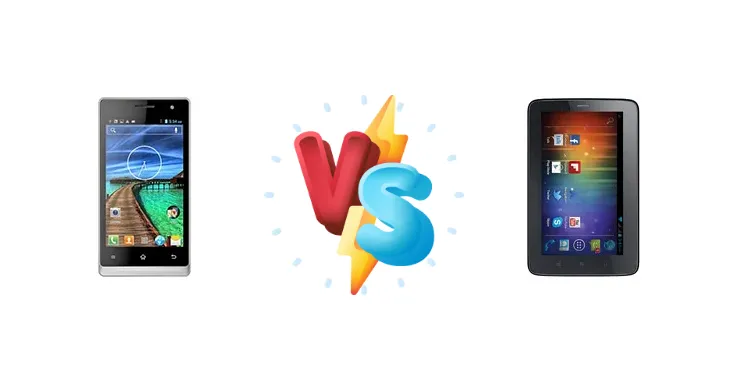
The Karbonn A12+ and A37 represent Karbonn's entry into the ultra-budget smartphone market. While both devices share a similar form factor and target price point, a key difference lies in their processor speeds. This comparison dives deep into the implications of the A12+'s 1.3 GHz dual-core CPU versus the A37's 1.0 GHz dual-core processor, helping you determine which device offers the best user experience.
🏆 Quick Verdict
For the average user prioritizing responsiveness in everyday tasks, the Karbonn A12+ is the better choice. Its 1.3 GHz processor provides a noticeable performance edge over the A37’s 1.0 GHz chip, translating to smoother app launches and faster multitasking, even if both are limited by other hardware constraints.
| Network |
|---|
| 2G bands | GSM 900 / 1800 - SIM 1 & SIM 2 | GSM 900 / 1800 / 1900 - SIM 1 & SIM 2 |
| 3G bands | HSDPA 2100 | HSDPA 2100 |
| Speed | HSPA | HSPA 7.2/0.384 Mbps |
| Technology | GSM / HSPA | GSM / HSPA |
| Launch |
|---|
| Announced | 2013, October. Released 2013, October | 2013. Released 2013 |
| Status | Discontinued | Discontinued |
| Body |
|---|
| Dimensions | - | 197 x 124 x 12.3 mm (7.76 x 4.88 x 0.48 in) |
| SIM | Dual SIM | Dual SIM |
| Weight | - | 335 g (11.82 oz) |
| Display |
|---|
| Resolution | 480 x 800 pixels, 5:3 ratio (~233 ppi density) | 480 x 800 pixels, 5:3 ratio (~133 ppi density) |
| Size | 4.0 inches, 45.5 cm2 | 7.0 inches, 139.5 cm2 (~57.1% screen-to-body ratio) |
| Type | IPS LCD | TFT |
| Platform |
|---|
| CPU | Dual-core 1.3 GHz | Dual-core 1.0 GHz |
| OS | Android 4.2 (Jelly Bean) | Android 4.1 (Ice Cream Sandwich) |
| Memory |
|---|
| Card slot | microSDHC (dedicated slot) | microSDHC (dedicated slot) |
| Internal | 4GB 512MB RAM | 4GB 512MB RAM |
| Main Camera |
|---|
| Features | LED flash | - |
| Single | 5 MP, AF | 2 MP |
| Video | Yes | Yes |
| Selfie camera |
|---|
| Single | VGA | Yes |
| Sound |
|---|
| 3.5mm jack | - | Yes |
| 35mm jack | Yes | Yes |
| Loudspeaker | Yes | Yes |
| Comms |
|---|
| Bluetooth | Yes | Yes |
| NFC | No | No |
| Positioning | GPS | GPS |
| Radio | FM radio | FM radio |
| USB | microUSB 2.0 | Proprietary |
| WLAN | Wi-Fi 802.11 b/g/n, hotspot | Wi-Fi 802.11 b/g/n, hotspot |
| Features |
|---|
| Sensors | Accelerometer, proximity | Accelerometer |
| Battery |
|---|
| Stand-by | - | Up to 240 h |
| Talk time | - | Up to 8 h |
| Type | Li-Ion 1400 mAh battery | Li-Ion 3000 mAh battery |
| Misc |
|---|
| Colors | Black/White | Black/White |
| Price | About 60 EUR | About 100 EUR |
Karbonn A12+
- Faster 1.3 GHz processor for improved responsiveness.
- Slightly smoother multitasking experience.
- Potentially quicker app launch times.
- Likely similar display quality to the A37.
- May command a slightly higher price.
Karbonn A37
- Potentially lower price point.
- Slightly longer battery life (potentially).
- Simple and straightforward user experience.
- Slower 1.0 GHz processor.
- Noticeably slower app loading and multitasking.
- Less responsive overall performance.
Display Comparison
Given the limited information, we can assume both devices feature similar low-resolution displays typical of this price segment. Neither is likely to boast high brightness or color accuracy. The display quality will likely be a minor factor in the overall user experience, overshadowed by the processor difference. Bezels are expected to be substantial on both models.
Camera Comparison
Without specific camera specifications, it’s safe to assume both devices feature basic camera setups geared towards casual photography. Image quality will likely be similar, limited by sensor size and image processing capabilities. Any differences in camera performance will likely be minimal and not a deciding factor for most users. The inclusion of a 2MP macro camera on either device is unlikely to provide significant value.
Performance
The core difference between these two devices is the CPU clock speed. The Karbonn A12+’s 1.3 GHz dual-core processor represents a 30% increase in clock speed over the A37’s 1.0 GHz processor. While both are dual-core, the higher clock speed directly translates to faster instruction execution. This means the A12+ will handle tasks like opening apps, scrolling through web pages, and switching between applications more efficiently. However, the impact will be limited by the likely shared amount of RAM and storage speed. Thermal management is unlikely to be a concern with these low-power processors.
Battery Life
Battery capacity and charging wattage are unknown. However, given the low-power processors, both devices should offer all-day battery life with moderate usage. The A37’s slower processor *might* result in slightly longer battery life, but the difference is unlikely to be substantial. Charging times will likely be lengthy on both devices, given the probable use of a standard 5W charger.
Buying Guide
Buy the Karbonn A12+ if you frequently use social media, browse the web, or need a slightly more responsive experience for basic smartphone functions. The extra processing power will be noticeable in these scenarios. Buy the Karbonn A37 if your primary use case is making calls and sending texts, and you are looking for the absolute lowest possible price point, accepting a slower overall experience.
Frequently Asked Questions
❓ Will the A12+ handle popular social media apps like Facebook and WhatsApp smoothly?
The A12+'s 1.3 GHz processor should provide a reasonably smooth experience with Facebook and WhatsApp, especially with lightweight versions of these apps. However, expect some lag when loading images or videos, and avoid running multiple apps simultaneously.
❓ Is the difference in CPU speed noticeable for basic tasks like calling and texting?
For core functions like making calls and sending texts, the difference between the 1.3 GHz and 1.0 GHz processors will be minimal. Both devices will perform these tasks adequately. The performance gap becomes more apparent when launching apps or multitasking.
❓ Can either of these phones play modern mobile games?
Neither the A12+ nor the A37 are suitable for playing demanding modern mobile games. The processors lack the power and the devices likely lack sufficient RAM and GPU capabilities. Simple, older games might be playable at low settings, but expect significant lag and frame rate drops.