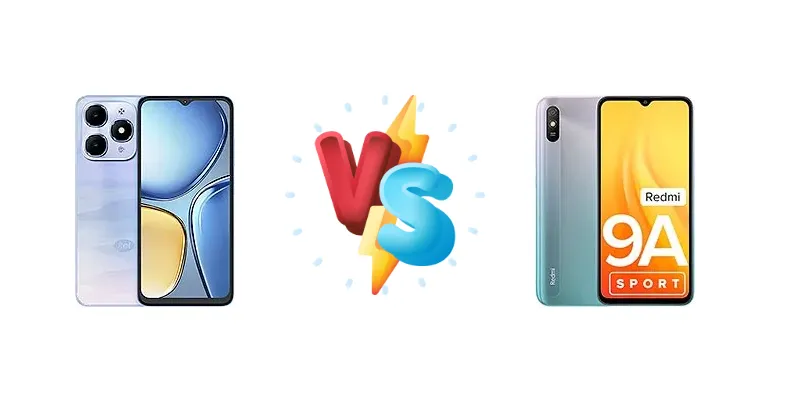
The sub-$150 smartphone market is fiercely competitive. Both the itel Zeno 20 and Xiaomi Redmi 9A Sport aim to deliver essential smartphone functionality at an incredibly affordable price. However, they take different approaches to achieving this, primarily through their chipset choices and charging capabilities. This comparison dives deep into the specifics to determine which device offers the best value.
🏆 Quick Verdict
For the average user prioritizing consistent performance and slightly faster charging, the itel Zeno 20 emerges as the better choice. Its Unisoc T7100 chipset, while not a powerhouse, offers a more modern architecture than the Redmi 9A Sport’s Helio G25, resulting in a smoother overall experience.
| Network |
|---|
| 2G bands | GSM 850 / 900 / 1800 / 1900 | GSM 850 / 900 / 1800 / 1900 |
| 3G bands | HSDPA 900 / 2100 | HSDPA 850 / 900 / 2100 |
| 4G bands | 1, 3, 5, 8, 38, 40, 41 | 1, 3, 5, 8, 40, 41 |
| Speed | HSPA, LTE | HSPA, LTE |
| Technology | GSM / HSPA / LTE | GSM / HSPA / LTE |
| Launch |
|---|
| Announced | 2025, August 23 | 2021, September 28 |
| Status | Available. Released 2025, August 25 | Available. Released 2021, September 28 |
| Body |
|---|
| Dimensions | 8.6 mm thickness | 164.9 x 77.1 x 9 mm (6.49 x 3.04 x 0.35 in) |
| SIM | Dual SIM | Nano-SIM + Nano-SIM |
| Weight | 187 g (6.60 oz) | 194 g (6.84 oz) |
| | - | Water-repellent coating |
| Display |
|---|
| Resolution | 720 x 1612 pixels, 20:9 ratio (~267 ppi density) | 720 x 1600 pixels, 20:9 ratio (~269 ppi density) |
| Size | 6.6 inches, 104.6 cm2 | 6.53 inches, 102.9 cm2 (~81.0% screen-to-body ratio) |
| Type | IPS LCD, 90Hz, 480 nits (typ), 1500 nits (peak) | IPS LCD, 400 nits (typ) |
| Platform |
|---|
| CPU | Octa-core 1.8 GHz | Octa-core (4x2.0 GHz Cortex-A53 & 4x1.5 GHz Cortex-A53) |
| Chipset | Unisoc T7100 | Mediatek MT6762G Helio G25 (12 nm) |
| GPU | PowerVR GE8322 | PowerVR GE8320 |
| OS | Android 14 (Go edition), itel OS 14 | Android 10, MIUI 12 |
| Memory |
|---|
| Card slot | microSDXC (dedicated slot) | microSDXC (dedicated slot) |
| Internal | 64GB 3GB RAM, 128GB 4GB RAM | 32GB 2GB RAM, 32GB 3GB RAM |
| | - | eMMC 5.1 |
| Main Camera |
|---|
| Features | LED flash, HDR, panorama | LED flash, HDR |
| Single | 13 MP | 13 MP, f/2.2, 28mm (wide), 1.0µm, PDAF |
| Video | 1080p@30fps | 1080p@30/60fps |
| Selfie camera |
|---|
| Features | - | HDR |
| Single | 5 MP | 5 MP, f/2.2, (wide), 1.12µm |
| Video | Yes | 1080p@30fps |
| Sound |
|---|
| 3.5mm jack | - | Yes |
| 35mm jack | Yes | Yes |
| Loudspeaker | Yes | Yes |
| Comms |
|---|
| Bluetooth | Yes | 5.0, A2DP, LE |
| NFC | No | No |
| Positioning | GPS | GPS, GLONASS, BDS |
| Radio | Unspecified | FM radio |
| USB | USB Type-C 2.0, OTG | microUSB 2.0, OTG |
| WLAN | Yes | Wi-Fi 802.11 a/b/g/n, Wi-Fi Direct |
| Features |
|---|
| Sensors | Fingerprint (side-mounted), accelerometer | Accelerometer, proximity |
| Battery |
|---|
| Charging | 15W wired | 10W wired |
| Type | 5000 mAh | Li-Po 5000 mAh |
| Misc |
|---|
| Colors | Starlit Black, Space Titanium, Aurora Blue | Carbon Black, Coral Green, Metallic Blue |
| Models | A6610L | - |
| Price | ₹ 6,899 | About 100 EUR |
| SAR | 0.82 W/kg (head) 0.46 W/kg (body) | - |
itel Zeno 20
- Faster 15W charging for quicker top-ups.
- More modern Unisoc T7100 chipset architecture.
- Potentially smoother multitasking experience.
- Less established brand reputation.
- Camera specifications are less readily available.
Xiaomi Redmi 9A Sport
- Well-known Xiaomi brand and support network.
- Larger screen size (typically 6.53 inches).
- Commonly features a 13MP main camera.
- Older MediaTek Helio G25 chipset.
- Slower 10W charging.
- Less efficient Cortex-A53 cores.
Display Comparison
Neither itel nor Xiaomi provide display specifications beyond the basic panel type. Given the price point, both likely utilize IPS LCD panels. The absence of detailed specs like peak brightness or color gamut makes a direct comparison impossible. However, the Redmi 9A Sport’s larger screen size (typically 6.53 inches vs. the Zeno 20’s 6.1 inches) may be preferable for media consumption, though this comes at the cost of potentially lower pixel density.
Camera Comparison
Both phones are expected to feature basic camera setups. Detailed camera specs are unavailable, but both likely include a primary sensor and potentially a depth or macro lens. Given the price bracket, image quality will be heavily reliant on software processing. Without specific sensor size or aperture information, it’s difficult to declare a clear winner. However, the Redmi 9A Sport often includes a 13MP main sensor, which is a common configuration for this price point, while the itel Zeno 20's camera specs are less readily available, suggesting it may be a lower resolution sensor.
Performance
The core difference lies in the chipsets. The itel Zeno 20 features the Unisoc T7100, an octa-core processor clocked at 1.8 GHz. This is a relatively recent chip designed for entry-level smartphones. The Xiaomi Redmi 9A Sport, on the other hand, utilizes the MediaTek Helio G25, a 12nm chip with an octa-core configuration split into 2.0 GHz and 1.5 GHz Cortex-A53 cores. While the G25’s higher clock speed on some cores *appears* advantageous, the Unisoc T7100 benefits from a more modern architecture, potentially leading to better sustained performance and efficiency. The G25’s older Cortex-A53 cores are less efficient than the cores found in the T7100. This translates to a smoother experience for multitasking and app loading on the itel Zeno 20.
Battery Life
The Redmi 9A Sport supports 10W wired charging, while the itel Zeno 20 steps it up to 15W. While neither is particularly fast by modern standards, the 15W charging on the Zeno 20 will result in noticeably quicker top-ups. The actual battery capacity of both devices is not specified, but typical capacities for phones in this segment range from 5000mAh to 6000mAh. The faster charging speed of the itel Zeno 20 provides a tangible benefit, especially for users who frequently need to recharge throughout the day.
Buying Guide
Buy the itel Zeno 20 if you need a phone for everyday tasks like social media, messaging, and light web browsing, and value a slightly more responsive user experience. Buy the Xiaomi Redmi 9A Sport if you prioritize a well-established brand reputation and are primarily focused on basic communication features with minimal performance demands.
Frequently Asked Questions
❓ Will the Unisoc T7100 in the itel Zeno 20 handle popular apps like WhatsApp and Facebook smoothly?
Yes, the Unisoc T7100 is designed for everyday tasks like social media, messaging, and web browsing. Its octa-core configuration and more modern architecture compared to the Helio G25 should provide a smoother experience, even with multiple apps open.
❓ Is the 10W charging on the Redmi 9A Sport significantly slower than the 15W charging on the itel Zeno 20 in real-world use?
Yes, while both are relatively slow charging standards, the 15W charging on the itel Zeno 20 will noticeably reduce charging times. Expect a difference of approximately 30-60 minutes to fully charge from 0% to 100%, depending on usage during charging.
❓ Can the Redmi 9A Sport handle basic mobile gaming like PUBG Mobile or Free Fire?
The Redmi 9A Sport can *run* these games, but expect to play at the lowest graphics settings and potentially experience frame rate drops, especially during intense moments. The Helio G25 is not a gaming-focused chipset.
❓ Does the itel Zeno 20 support dual SIM functionality?
While not explicitly stated in the provided specifications, itel phones in this price range typically support dual SIM functionality. It's advisable to confirm this with the retailer or on the official itel website before purchasing.