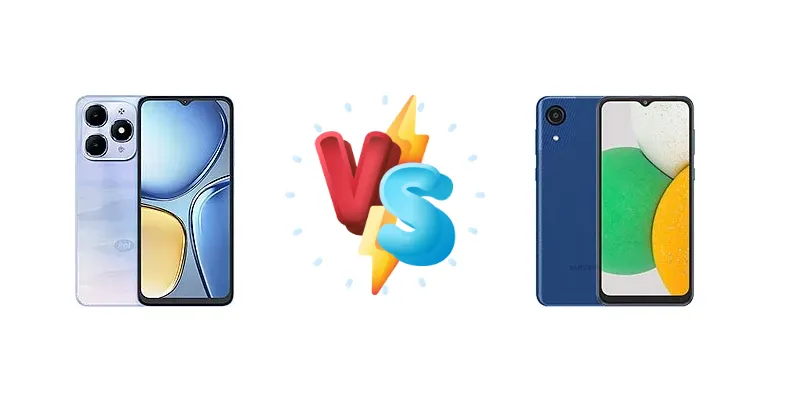
The itel Zeno 20 and Samsung Galaxy A03 Core represent the extreme end of the smartphone price spectrum. Both aim to deliver basic smartphone functionality at an incredibly affordable price point, but they achieve this with different hardware approaches. This comparison dissects their key specifications to determine which device offers the best experience for the budget-conscious user.
🏆 Quick Verdict
For most users, the itel Zeno 20 emerges as the slightly better choice. Its Unisoc T7100 chipset, while not a powerhouse, offers a more modern architecture and higher clock speeds than the Samsung Galaxy A03 Core’s SC9863A, translating to a snappier user experience. The 15W charging is also a minor advantage.
| Network |
|---|
| 2G bands | GSM 850 / 900 / 1800 / 1900 | GSM 850 / 900 / 1800 / 1900 |
| 3G bands | HSDPA 900 / 2100 | HSDPA 850 / 900 / 2100 |
| 4G bands | 1, 3, 5, 8, 38, 40, 41 | 1, 3, 5, 7, 8, 20, 28, 38, 40, 41 |
| Speed | HSPA, LTE | HSPA 21.1/5.76 Mbps, LTE |
| Technology | GSM / HSPA / LTE | GSM / HSPA / LTE |
| Launch |
|---|
| Announced | 2025, August 23 | 2021, November 15 |
| Status | Available. Released 2025, August 25 | Available. Released 2021, December 06 |
| Body |
|---|
| Build | - | Plastic back, plastic frame |
| Dimensions | 8.6 mm thickness | 164.2 x 75.9 x 9.1 mm (6.46 x 2.99 x 0.36 in) |
| SIM | Dual SIM | · Nano-SIM· Nano-SIM + Nano-SIM |
| Weight | 187 g (6.60 oz) | 211 g (7.44 oz) |
| Display |
|---|
| Resolution | 720 x 1612 pixels, 20:9 ratio (~267 ppi density) | 720 x 1600 pixels, 20:9 ratio (~270 ppi density) |
| Size | 6.6 inches, 104.6 cm2 | 6.5 inches, 102.0 cm2 (~81.8% screen-to-body ratio) |
| Type | IPS LCD, 90Hz, 480 nits (typ), 1500 nits (peak) | PLS LCD |
| Platform |
|---|
| CPU | Octa-core 1.8 GHz | Octa-core (4x1.6 GHz Cortex-A55 & 4x1.2 GHz Cortex-A55) |
| Chipset | Unisoc T7100 | Unisoc SC9863A (28 nm) |
| GPU | PowerVR GE8322 | IMG8322 |
| OS | Android 14 (Go edition), itel OS 14 | Android 11 (Go edition) |
| Memory |
|---|
| Card slot | microSDXC (dedicated slot) | microSDXC (dedicated slot) |
| Internal | 64GB 3GB RAM, 128GB 4GB RAM | 32GB 2GB RAM |
| | - | eMMC 5.1 |
| Main Camera |
|---|
| Features | LED flash, HDR, panorama | LED flash |
| Single | 13 MP | 8 MP, f/2.0, AF |
| Video | 1080p@30fps | 1080p@30fps |
| Selfie camera |
|---|
| Single | 5 MP | 5 MP, f/2.2 |
| Video | Yes | - |
| Sound |
|---|
| 3.5mm jack | - | Yes |
| 35mm jack | Yes | Yes |
| Loudspeaker | Yes | Yes |
| Comms |
|---|
| Bluetooth | Yes | 4.2, A2DP |
| NFC | No | No |
| Positioning | GPS | GPS, GLONASS |
| Radio | Unspecified | Unspecified |
| USB | USB Type-C 2.0, OTG | microUSB 2.0, OTG |
| WLAN | Yes | Wi-Fi 802.11 b/g/n, Wi-Fi Direct |
| Features |
|---|
| Sensors | Fingerprint (side-mounted), accelerometer | Accelerometer, proximity |
| Battery |
|---|
| Charging | 15W wired | - |
| Type | 5000 mAh | Li-Ion 5000 mAh |
| Misc |
|---|
| Colors | Starlit Black, Space Titanium, Aurora Blue | Black, Blue |
| Models | A6610L | SM-A032F, SM-A032F/DS, SM-A032M |
| Price | ₹ 6,899 | £ 74.99 |
| SAR | 0.82 W/kg (head) 0.46 W/kg (body) | 0.30 W/kg (head) |
| SAR EU | - | 0.24 W/kg (head) 1.39 W/kg (body) |
itel Zeno 20
- More powerful Unisoc T7100 chipset
- Faster 15W wired charging
- Potentially better multitasking performance
- Brand recognition is lower than Samsung
- Display specifications are unknown
Samsung Galaxy A03 Core
- Established Samsung brand reputation
- Potentially wider service network
- Familiar Android experience
- Slower Unisoc SC9863A chipset
- Likely slower charging speeds
- Older 28nm process may impact efficiency
Display Comparison
Neither device boasts a standout display. Given the lack of detailed display specifications, we can assume both utilize LCD panels typical of this price range. The focus here isn't on visual fidelity, but basic readability. Samsung's brand history suggests slightly better color calibration, but the itel Zeno 20's display size is unknown, making a direct comparison difficult. Expect both to struggle in direct sunlight.
Camera Comparison
Camera performance on both devices will be limited. Without sensor size details, it’s difficult to make a definitive statement. However, the focus should be on usability rather than image quality. Both likely feature basic camera setups geared towards social media sharing in good lighting conditions. Expect significant noise and a lack of detail in low-light scenarios. The presence of a 2MP macro camera on the A03 Core is largely a marketing gimmick, offering minimal practical benefit.
Performance
The core difference lies in the chipsets. The itel Zeno 20’s Unisoc T7100 is an octa-core processor clocked at 1.8 GHz. This contrasts with the Samsung Galaxy A03 Core’s Unisoc SC9863A, a 28nm process chipset with a split octa-core configuration (4x1.6 GHz Cortex-A55 & 4x1.2 GHz Cortex-A55). The T7100’s higher clock speed and potentially more efficient architecture (process node unspecified, but likely newer than 28nm) should result in faster app loading times and smoother multitasking. The A03 Core’s slower Cortex-A55 cores will likely exhibit more lag during demanding tasks. The A03 Core's older 28nm process also suggests potentially higher power consumption.
Battery Life
Battery capacity is not specified for either device. However, the itel Zeno 20’s 15W wired charging offers a slight advantage over the likely 10W or slower charging on the Samsung Galaxy A03 Core. Faster charging means less time tethered to a wall outlet, a crucial benefit for users who rely heavily on their phones throughout the day. Without knowing the battery capacity, it's difficult to predict real-world battery life, but the more efficient Unisoc T7100 in the Zeno 20 could contribute to longer usage times.
Buying Guide
Buy the itel Zeno 20 if you prioritize a slightly more responsive user interface and faster charging. It’s ideal for users who need a functional smartphone for basic tasks like calling, texting, and light social media. Buy the Samsung Galaxy A03 Core if brand recognition and a potentially wider service network are paramount. It’s a reasonable choice for first-time smartphone owners within the Samsung ecosystem, but expect compromises in performance.
Frequently Asked Questions
❓ Will the Unisoc SC9863A in the Samsung Galaxy A03 Core struggle with popular apps like WhatsApp and Facebook?
While the A03 Core can run these apps, the SC9863A's slower processing speed and less efficient architecture may result in noticeable lag when switching between apps or loading media. Expect a less fluid experience compared to devices with more powerful chipsets.
❓ Is the itel Zeno 20 likely to receive software updates and security patches?
itel's track record for software updates is inconsistent. While the Zeno 20 likely ships with Android Go Edition (optimized for low-end hardware), long-term software support is not guaranteed. Users should not expect frequent updates or extended security patch coverage.
❓ How long will it take to fully charge the itel Zeno 20 with the 15W charger?
Without knowing the battery capacity, a precise estimate is impossible. However, 15W charging should deliver a full charge in approximately 2.5 to 3.5 hours, assuming a battery capacity between 3000mAh and 4000mAh. This is faster than the likely charging time for the A03 Core.
❓ Does the Samsung Galaxy A03 Core support 4G LTE for fast data speeds?
Yes, the Samsung Galaxy A03 Core does support 4G LTE connectivity, allowing for reasonably fast data speeds where available. However, performance will still be limited by the phone's processor and RAM.