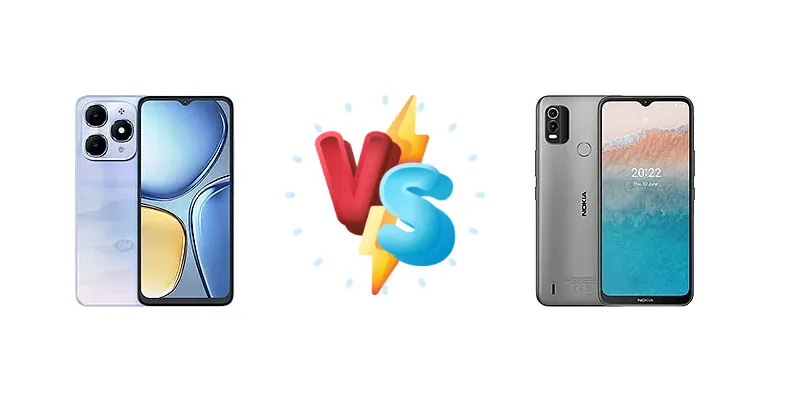
The itel Zeno 20 and Nokia C21 Plus represent the extreme end of the smartphone price spectrum. Both target first-time smartphone buyers or those needing a reliable secondary device. However, despite similar price points, they diverge significantly in their internal hardware, particularly in their chipsets and charging capabilities. This comparison will dissect these differences to determine which device offers the best value.
🏆 Quick Verdict
For the average user prioritizing responsiveness and future-proofing, the itel Zeno 20 emerges as the better choice. Its Unisoc T7100 chipset, while still entry-level, offers a noticeable performance advantage over the Nokia C21 Plus’s older SC9863A, justifying the slightly higher price.
| Network |
|---|
| 2G bands | GSM 850 / 900 / 1800 / 1900 | GSM 850 / 900 / 1800 / 1900 |
| 3G bands | HSDPA 900 / 2100 | HSDPA 850 / 900 / 2100 |
| 4G bands | 1, 3, 5, 8, 38, 40, 41 | LTE |
| Speed | HSPA, LTE | HSPA 42.2/5.76 Mbps, LTE Cat4 150/50 Mbps |
| Technology | GSM / HSPA / LTE | GSM / HSPA / LTE |
| | - | HSDPA 850 / 900 / 1700(AWS) / 1900 / 2100 |
| Launch |
|---|
| Announced | 2025, August 23 | 2022, February 28 |
| Status | Available. Released 2025, August 25 | Available. Released 2022, April 29 |
| Body |
|---|
| Build | - | Glass front, aluminum frame, plastic back |
| Dimensions | 8.6 mm thickness | 164.8 x 75.9 x 8.6 mm (6.49 x 2.99 x 0.34 in) |
| SIM | Dual SIM | · Nano-SIM· Nano-SIM + Nano-SIM |
| Weight | 187 g (6.60 oz) | 178 g or 191 g (6.28 oz) |
| | - | Splash protection |
| Display |
|---|
| Protection | - | Scratch-resistant glass |
| Resolution | 720 x 1612 pixels, 20:9 ratio (~267 ppi density) | 720 x 1600 pixels, 20:9 ratio (~269 ppi density) |
| Size | 6.6 inches, 104.6 cm2 | 6.52 inches, 102.6 cm2 (~82.1% screen-to-body ratio) |
| Type | IPS LCD, 90Hz, 480 nits (typ), 1500 nits (peak) | IPS LCD |
| Platform |
|---|
| CPU | Octa-core 1.8 GHz | Octa-core (4x1.6 GHz Cortex-A55 & 4x1.2 GHz Cortex-A55) |
| Chipset | Unisoc T7100 | Unisoc SC9863A (28 nm) |
| GPU | PowerVR GE8322 | IMG8322 |
| OS | Android 14 (Go edition), itel OS 14 | Android 11 (Go edition) |
| Memory |
|---|
| Card slot | microSDXC (dedicated slot) | microSDXC (dedicated slot) |
| Internal | 64GB 3GB RAM, 128GB 4GB RAM | 32GB 2GB RAM, 32GB 3GB RAM, 64GB 2GB RAM, 64GB 3GB RAM, 64GB 4GB RAM |
| | - | eMMC 5.1 |
| Main Camera |
|---|
| Dual | - | 13 MP, (wide), AF
Auxiliary lens |
| Features | LED flash, HDR, panorama | LED flash, HDR, panorama |
| Single | 13 MP | 5 MP |
| Video | 1080p@30fps | 1080p@30fps |
| Selfie camera |
|---|
| Features | - | LED flash |
| Single | 5 MP | 5 MP |
| Video | Yes | 720p |
| Sound |
|---|
| 3.5mm jack | - | Yes |
| 35mm jack | Yes | Yes |
| Loudspeaker | Yes | Yes |
| Comms |
|---|
| Bluetooth | Yes | 4.2, A2DP |
| NFC | No | No |
| Positioning | GPS | GPS |
| Radio | Unspecified | FM radio |
| USB | USB Type-C 2.0, OTG | microUSB 2.0 |
| WLAN | Yes | Wi-Fi 802.11 b/g/n |
| Features |
|---|
| Sensors | Fingerprint (side-mounted), accelerometer | Fingerprint (rear-mounted), accelerometer, proximity |
| Battery |
|---|
| Charging | 15W wired | 10W wired |
| Type | 5000 mAh | Li-Ion 4000/5050 mAh |
| Misc |
|---|
| Colors | Starlit Black, Space Titanium, Aurora Blue | Dark Cyan, Warm Gray |
| Models | A6610L | TA-1433, TA-1431, TA-1426, TA-1424 |
| Price | ₹ 6,899 | About 120 EUR |
| SAR | 0.82 W/kg (head) 0.46 W/kg (body) | 0.57 W/kg (head) 0.65 W/kg (body) |
| SAR EU | - | 0.40 W/kg (head) 0.99 W/kg (body) |
itel Zeno 20
- Faster processor for smoother performance
- Faster 15W charging
- Potentially more efficient chipset
- Brand recognition is lower than Nokia
- Software updates may be less frequent
Nokia C21 Plus
- Established Nokia brand reputation
- Potentially cleaner software experience
- May be more readily available in certain regions
- Slower, less powerful processor
- Slower 10W charging
- Less efficient chipset
Display Comparison
Neither device boasts a standout display. Both are likely to feature LCD panels, typical for this price bracket. However, detailed display specs (resolution, brightness, color gamut) are unavailable. The Nokia C21 Plus’s older chipset may translate to less efficient display processing, potentially impacting smoothness during scrolling. Without specific data, it's difficult to declare a clear winner, but the newer chipset in the itel Zeno 20 *could* offer slightly better display responsiveness.
Camera Comparison
Camera details are sparse for both devices. It’s safe to assume both feature basic camera setups geared towards casual photography. Without sensor size or aperture information, a direct comparison is challenging. However, the Nokia C21 Plus’s older chipset may limit its image processing capabilities, potentially resulting in less detailed and vibrant photos compared to the itel Zeno 20. The presence of a 2MP macro camera on either device is largely a marketing gimmick and shouldn’t be a deciding factor.
Performance
The core difference lies in the chipsets. The itel Zeno 20’s Unisoc T7100 is an octa-core processor clocked at 1.8 GHz. This contrasts with the Nokia C21 Plus’s Unisoc SC9863A, a 28nm process chipset with a split octa-core configuration (4x1.6 GHz Cortex-A55 & 4x1.2 GHz Cortex-A55). The T7100’s higher clock speed and potentially more modern architecture suggest superior CPU performance. The SC9863A’s 28nm process is also less efficient, meaning it will likely generate more heat and consume more power for the same tasks. This translates to a smoother, more responsive experience on the itel Zeno 20, especially when multitasking.
Battery Life
Both phones offer modest battery capacities (specs unavailable). However, the charging speeds differ significantly. The itel Zeno 20 supports 15W wired charging, while the Nokia C21 Plus is limited to 10W. This means the itel Zeno 20 will charge noticeably faster, reducing downtime. While a larger battery capacity is always preferable, the faster charging speed of the itel Zeno 20 mitigates the impact of a potentially smaller battery.
Buying Guide
Buy the itel Zeno 20 if you need a smartphone capable of handling everyday tasks like social media, messaging, and light web browsing with reasonable speed. It’s ideal for users who want a slightly more responsive experience and aren’t overly concerned with brand prestige. Buy the Nokia C21 Plus if you prioritize a well-established brand reputation, a potentially cleaner software experience (depending on regional variations), and are willing to accept a slower, more basic user experience. It’s best suited for users with very minimal smartphone needs.
Frequently Asked Questions
❓ Will the Unisoc T7100 in the itel Zeno 20 handle popular apps like WhatsApp and Facebook smoothly?
Yes, the Unisoc T7100 is sufficiently powerful to run everyday apps like WhatsApp, Facebook, and web browsers without significant lag. While it won’t excel at demanding tasks, it provides a usable experience for basic smartphone functions.
❓ Is the 10W charging on the Nokia C21 Plus significantly slower than 15W, and how long will it take to fully charge?
Yes, 10W charging is noticeably slower than 15W. While exact charge times depend on battery capacity (which is unknown), expect the Nokia C21 Plus to take considerably longer – potentially several hours – to reach a full charge compared to the itel Zeno 20.
❓ Does either phone support VoLTE or Wi-Fi calling, and are they compatible with all carriers?
Compatibility with VoLTE and Wi-Fi calling varies by region and carrier. It's crucial to check with your specific carrier to ensure either phone is fully supported before purchasing. Both phones likely support these features, but confirmation is essential.
❓ What version of Android does the Nokia C21 Plus run, and is it guaranteed to receive updates?
The Nokia C21 Plus likely runs Android Go Edition, a lightweight version of Android designed for low-end hardware. While Nokia typically provides software updates, the frequency and duration of support for budget devices like the C21 Plus are limited compared to their higher-end models.