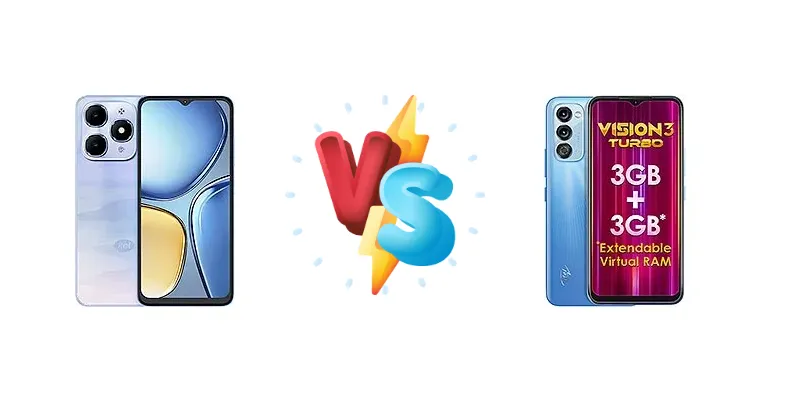
The itel Zeno 20 and Vision 3 Turbo represent itel’s commitment to the ultra-budget smartphone market. While both aim to deliver essential smartphone functionality at a low price point, they diverge in their core hardware, particularly in their chipsets and charging capabilities. This comparison dissects these differences to determine which device offers the best value for users prioritizing performance and convenience.
🏆 Quick Verdict
For the average user seeking a slightly more responsive experience, the itel Zeno 20 emerges as the better choice. Its Unisoc T7100 chipset, despite lacking detailed architectural information, represents a newer generation than the Vision 3 Turbo’s SC9863A, promising improved performance in everyday tasks and light multitasking. However, the Vision 3 Turbo’s 18W charging offers a slight edge in replenishment speed.
| Network |
|---|
| 2G bands | GSM 850 / 900 / 1800 / 1900 | GSM 850 / 900 / 1800 / 1900 |
| 3G bands | HSDPA 900 / 2100 | HSDPA 850 / 900 / 2100 |
| 4G bands | 1, 3, 5, 8, 38, 40, 41 | LTE |
| Speed | HSPA, LTE | HSPA, LTE |
| Technology | GSM / HSPA / LTE | GSM / HSPA / LTE |
| Launch |
|---|
| Announced | 2025, August 23 | 2022 |
| Status | Available. Released 2025, August 25 | Available. Released 2022 |
| Body |
|---|
| Dimensions | 8.6 mm thickness | - |
| SIM | Dual SIM | Dual SIM |
| Weight | 187 g (6.60 oz) | - |
| Display |
|---|
| Resolution | 720 x 1612 pixels, 20:9 ratio (~267 ppi density) | 720 x 1600 pixels, 20:9 ratio (~266 ppi density) |
| Size | 6.6 inches, 104.6 cm2 | 6.6 inches, 105.2 cm2 |
| Type | IPS LCD, 90Hz, 480 nits (typ), 1500 nits (peak) | IPS LCD |
| Platform |
|---|
| CPU | Octa-core 1.8 GHz | Octa-core (4x1.6 GHz Cortex-A55 & 4x1.2 GHz Cortex-A55) |
| Chipset | Unisoc T7100 | Unisoc SC9863A (28 nm) |
| GPU | PowerVR GE8322 | IMG8322 |
| OS | Android 14 (Go edition), itel OS 14 | Android 11 (Go edition) |
| Memory |
|---|
| Card slot | microSDXC (dedicated slot) | microSDXC |
| Internal | 64GB 3GB RAM, 128GB 4GB RAM | 64GB 3GB RAM |
| Main Camera |
|---|
| Features | LED flash, HDR, panorama | LED flash |
| Single | 13 MP | 8 MP (wide)
Auxiliary lens |
| Video | 1080p@30fps | 1080p@30fps |
| Selfie camera |
|---|
| Single | 5 MP | 5 MP |
| Video | Yes | Yes |
| Sound |
|---|
| 35mm jack | Yes | Yes |
| Loudspeaker | Yes | Yes |
| Comms |
|---|
| Bluetooth | Yes | Yes |
| NFC | No | No |
| Positioning | GPS | GPS |
| Radio | Unspecified | Unspecified |
| USB | USB Type-C 2.0, OTG | microUSB |
| WLAN | Yes | Yes |
| Features |
|---|
| Sensors | Fingerprint (side-mounted), accelerometer | Fingerprint (rear-mounted), accelerometer |
| Battery |
|---|
| Charging | 15W wired | 18W wired |
| Type | 5000 mAh | 5000 mAh |
| Misc |
|---|
| Colors | Starlit Black, Space Titanium, Aurora Blue | Blue |
| Models | A6610L | - |
| Price | ₹ 6,899 | - |
| SAR | 0.82 W/kg (head) 0.46 W/kg (body) | - |
itel Zeno 20
- Newer Unisoc T7100 chipset for potentially better performance
- Likely more efficient processor architecture
- Slightly more modern design (assumption based on branding)
- Slower 15W charging
- Limited information on display quality
itel Vision 3 Turbo
- Faster 18W wired charging
- Potentially lower price point
- Established Unisoc SC9863A chipset
- Older and less efficient Unisoc SC9863A chipset
- Split core CPU configuration may impact multitasking
Display Comparison
Unfortunately, detailed display specifications like brightness (nits), panel type (IPS, TFT), and color accuracy are unavailable for either device. Given their price point, it’s reasonable to assume both utilize TFT panels with modest brightness levels. Bezels are likely to be substantial on both models. Without concrete data, a direct comparison is impossible, but users should expect a basic viewing experience on both.
Camera Comparison
Camera details are sparse. Both phones likely feature a multi-camera setup, but the quality will heavily depend on the main sensor and image processing algorithms. Without sensor size or aperture information, it’s difficult to assess image quality. The presence of a 2MP macro camera on either device is unlikely to significantly enhance the photography experience; these sensors typically lack the resolution and detail needed for compelling macro shots. Image processing will likely be basic on both, prioritizing speed over advanced features.
Performance
The core difference lies in the chipsets. The itel Zeno 20 features the Unisoc T7100, an octa-core processor clocked at 1.8 GHz. The itel Vision 3 Turbo utilizes the Unisoc SC9863A (28nm), an octa-core chip with a split core configuration: 4x1.6 GHz Cortex-A55 and 4x1.2 GHz Cortex-A55. The T7100, being a newer generation, likely benefits from architectural improvements and potentially a more efficient manufacturing process, even without knowing the node size. The SC9863A’s 28nm process is older and less efficient, potentially leading to higher power consumption for similar tasks. The Zeno 20 should offer a smoother experience in app switching and general navigation. RAM specifications are not provided, but both likely utilize LPDDR4X to keep costs down.
Battery Life
The itel Vision 3 Turbo boasts 18W wired charging, a slight advantage over the itel Zeno 20’s 15W charging. While neither is exceptionally fast by modern standards, the 18W charging should translate to a quicker 0-100% charge time. Battery capacity is not specified for either device, but given the budget nature of these phones, capacities are likely in the 4000-5000 mAh range. The Vision 3 Turbo’s faster charging could be more beneficial for users who frequently need to top up their battery throughout the day.
Buying Guide
Buy the itel Zeno 20 if you need a phone that feels a bit snappier for basic tasks like social media, messaging, and web browsing. Its newer chipset provides a more fluid user experience. Buy the itel Vision 3 Turbo if you prioritize faster charging and are willing to accept a potentially slower overall performance profile, especially when multitasking or running more demanding applications. It’s a good option for users who frequently find themselves needing to quickly top up their battery.
Frequently Asked Questions
❓ Will the Unisoc T7100 in the Zeno 20 handle popular apps like WhatsApp and Facebook smoothly?
Yes, the Unisoc T7100 is expected to handle everyday apps like WhatsApp, Facebook, and web browsing without significant lag. While not a powerhouse, it’s a more modern chipset than the SC9863A and should provide a more responsive experience for these common tasks.
❓ How long will it take to fully charge the itel Vision 3 Turbo with the 18W charger?
While a precise charging time is unavailable, the 18W charging should take approximately 2.5 to 3.5 hours for a full charge, assuming a battery capacity in the 4000-5000 mAh range. This is faster than the Zeno 20’s 15W charging.
❓ Is the difference in performance between the two chipsets noticeable for casual gaming?
For very casual gaming (e.g., simple puzzle games), the difference may be minimal. However, for more demanding games, the Unisoc T7100 in the Zeno 20 is likely to provide a smoother and more stable frame rate due to its newer architecture and potentially better GPU performance.
❓ Do either of these phones support fast charging protocols beyond the advertised wattage?
It's unlikely. Given their budget nature, neither phone is expected to support advanced fast charging protocols like Power Delivery or Quick Charge. They will likely only charge at their advertised wattage with a compatible charger.