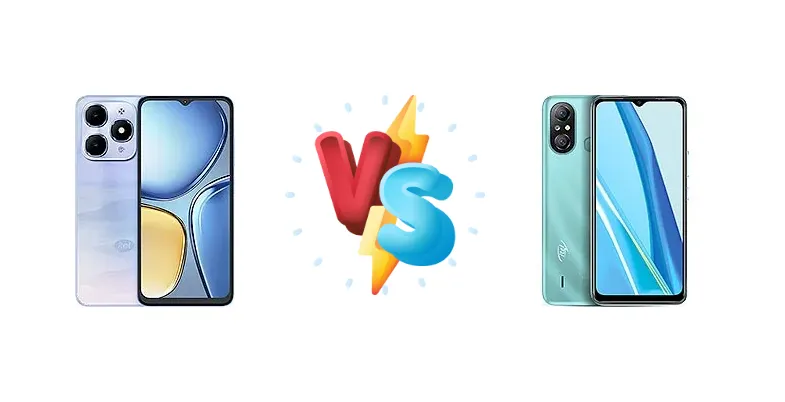
The itel Zeno 20 and itel A49 represent itel’s commitment to the ultra-budget smartphone market. While both aim to deliver essential smartphone functionality at a low price point, they differ significantly in their internal hardware. This comparison dissects those differences, focusing on how the chipset choices impact real-world performance and usability.
🏆 Quick Verdict
For most users, the itel Zeno 20 is the superior choice. Its Unisoc T7100 chipset, with its octa-core CPU, provides a noticeably smoother experience for multitasking and app usage compared to the quad-core Unisoc SC9832E in the A49. While both phones are entry-level, the Zeno 20 offers a better long-term user experience.
| Network |
|---|
| 2G bands | GSM 850 / 900 / 1800 / 1900 | GSM 850 / 900 / 1800 / 1900 |
| 3G bands | HSDPA 900 / 2100 | HSDPA 850 / 900 / 2100 |
| 4G bands | 1, 3, 5, 8, 38, 40, 41 | LTE |
| Speed | HSPA, LTE | HSPA, LTE |
| Technology | GSM / HSPA / LTE | GSM / HSPA / LTE |
| Launch |
|---|
| Announced | 2025, August 23 | 2022 |
| Status | Available. Released 2025, August 25 | Available. Released 2022 |
| Body |
|---|
| Dimensions | 8.6 mm thickness | - |
| SIM | Dual SIM | Dual SIM |
| Weight | 187 g (6.60 oz) | - |
| Display |
|---|
| Resolution | 720 x 1612 pixels, 20:9 ratio (~267 ppi density) | 720 x 1600 pixels, 20:9 ratio (~266 ppi density) |
| Size | 6.6 inches, 104.6 cm2 | 6.6 inches, 105.2 cm2 |
| Type | IPS LCD, 90Hz, 480 nits (typ), 1500 nits (peak) | IPS LCD |
| Platform |
|---|
| CPU | Octa-core 1.8 GHz | Quad-core 1.4 GHz |
| Chipset | Unisoc T7100 | Unisoc SC9832E (28 nm) |
| GPU | PowerVR GE8322 | Mali-T820 MP1 |
| OS | Android 14 (Go edition), itel OS 14 | Android 11 (Go edition) |
| Memory |
|---|
| Card slot | microSDXC (dedicated slot) | microSDXC |
| Internal | 64GB 3GB RAM, 128GB 4GB RAM | 32GB 2GB RAM |
| Main Camera |
|---|
| Features | LED flash, HDR, panorama | LED flash |
| Single | 13 MP | 5 MP |
| Video | 1080p@30fps | Yes |
| Selfie camera |
|---|
| Single | 5 MP | 5 MP |
| Video | Yes | Yes |
| Sound |
|---|
| 35mm jack | Yes | Yes |
| Loudspeaker | Yes | Yes |
| Comms |
|---|
| Bluetooth | Yes | Yes |
| NFC | No | No |
| Positioning | GPS | GPS |
| Radio | Unspecified | Unspecified |
| USB | USB Type-C 2.0, OTG | microUSB |
| WLAN | Yes | Yes |
| Features |
|---|
| Sensors | Fingerprint (side-mounted), accelerometer | Fingerprint (rear-mounted), accelerometer |
| Battery |
|---|
| Charging | 15W wired | - |
| Type | 5000 mAh | 4000 mAh |
| Misc |
|---|
| Colors | Starlit Black, Space Titanium, Aurora Blue | Blue |
| Models | A6610L | - |
| Price | ₹ 6,899 | - |
| SAR | 0.82 W/kg (head) 0.46 W/kg (body) | - |
itel Zeno 20
- Faster Octa-Core Processor
- More Responsive User Experience
- Potentially Better Camera Image Processing
- May be slightly more expensive
- 15W charging is slow
itel A49
- Extremely Affordable
- Suitable for Basic Communication
- Simple and Easy to Use
- Slow Quad-Core Processor
- Laggy Performance with Multiple Apps
- Limited Multitasking Capabilities
Display Comparison
Neither itel provides display specifications beyond size, so a detailed comparison is limited. However, given the price points, both likely utilize LCD panels. The Zeno 20’s more powerful chipset *suggests* a potentially higher resolution display, though this is unconfirmed. Bezels are likely substantial on both devices, reflecting their budget nature. Color accuracy is expected to be standard for this segment, prioritizing power efficiency over color fidelity.
Camera Comparison
Camera details are sparse for both devices. It’s safe to assume both feature basic camera setups, likely with a primary sensor and potentially a secondary depth or macro lens. Without knowing sensor sizes or apertures, it’s difficult to make a definitive statement. However, the Zeno 20’s more powerful ISP (Image Signal Processor) within the T7100 chipset will likely result in better image processing, potentially leading to sharper images and improved low-light performance. The A49’s SC9832E will likely produce softer, less detailed images.
Performance
The core difference lies in the chipsets. The itel Zeno 20’s Unisoc T7100 is an octa-core processor clocked at 1.8 GHz, offering significantly more processing power than the itel A49’s Unisoc SC9832E, a quad-core 1.4 GHz chip. This translates to faster app launch times, smoother multitasking, and a more responsive user interface on the Zeno 20. The T7100’s architecture is also more modern, potentially offering improved efficiency. The A49’s SC9832E, built on a 28nm process, will likely struggle with demanding tasks and may exhibit noticeable lag. RAM configurations are unknown, but even with similar RAM, the T7100 will outperform the SC9832E.
Battery Life
Both devices feature 15W wired charging. Battery capacity is not specified, but given the target market, both are likely in the 3000-4000 mAh range. The Zeno 20’s more efficient chipset *could* translate to slightly better battery life despite potentially powering a higher-resolution display. The 15W charging speed is relatively slow on both devices, meaning a full charge will take several hours. The difference in charge times will likely be minimal.
Buying Guide
Buy the itel Zeno 20 if you need a phone capable of handling more than just basic calling and texting – light social media, web browsing, and occasional app use will be significantly smoother. Buy the itel A49 if your primary need is a very affordable device for essential communication and you prioritize absolute minimum cost over performance. The A49 is best suited for first-time smartphone users or as a temporary backup device.
Frequently Asked Questions
❓ Will the itel Zeno 20 handle popular social media apps like Facebook and WhatsApp smoothly?
Yes, the Unisoc T7100 chipset in the Zeno 20 provides enough processing power to run Facebook, WhatsApp, and similar apps without significant lag. While it won’t offer a flagship-level experience, it will be a noticeable improvement over the A49 for these common tasks.
❓ Is the itel A49 suitable for someone who rarely uses smartphones and only needs it for calls and texts?
Absolutely. The itel A49 is perfectly adequate for basic calling and texting. Its quad-core processor is sufficient for these essential functions, and its lower price point makes it an ideal choice for users with minimal smartphone needs.
❓ Can the itel Zeno 20 run multiple apps at the same time without slowing down?
The Zeno 20 can handle a limited amount of multitasking. While it won’t perform as well as higher-end phones, the octa-core processor and potentially more RAM (specifications are unknown) will allow you to switch between a few apps without experiencing severe slowdowns. However, running many demanding apps simultaneously is not recommended.
❓ What type of charging cable do both phones use?
Both the itel Zeno 20 and itel A49 utilize a Micro-USB port for charging and data transfer. This is a common standard for budget smartphones, but it's slower and less convenient than the USB-C port found on many newer devices.