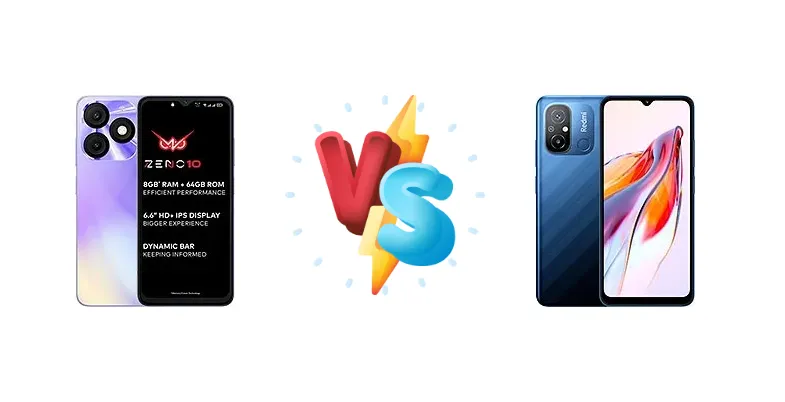
The sub-$150 smartphone market is fiercely competitive. The itel Zeno 10 and Xiaomi Redmi 12C represent two compelling options for users prioritizing affordability. However, beneath the similar price points lie significant differences in chipset architecture and performance capabilities, making a direct comparison crucial for informed buyers.
🏆 Quick Verdict
For most users, the Xiaomi Redmi 12C emerges as the better choice. Its Mediatek Helio G85 chipset, built on a 12nm process, provides a noticeable performance advantage over the itel Zeno 10’s Unisoc T603, particularly in gaming and multitasking. While both offer 10W charging, the Redmi 12C’s stronger processor justifies the slight price difference.
| Network |
|---|
| 2G bands | GSM 850 / 900 / 1800 / 1900 | GSM 850 / 900 / 1800 / 1900 |
| 3G bands | HSDPA 850 / 900 / 2100 | HSDPA 850 / 900 / 2100 |
| 4G bands | LTE | 1, 3, 5, 7, 8, 20, 28, 38, 40, 41 - International |
| Speed | HSPA, LTE | HSPA, LTE |
| Technology | GSM / HSPA / LTE | GSM / CDMA / HSPA / EVDO / LTE |
| | - | CDMA2000 1xEV-DO |
| Launch |
|---|
| Announced | 2025, January 02 | 2022, December 31 |
| Status | Available. Released 2025, January 10 | Available. Released 2023, January 01 |
| Body |
|---|
| Dimensions | 164 x 76 x 9 mm (6.46 x 2.99 x 0.35 in) | 168.8 x 76.4 x 8.8 mm (6.65 x 3.01 x 0.35 in) |
| SIM | Dual SIM | Nano-SIM + Nano-SIM |
| Weight | 186 g (6.56 oz) | 192 g (6.77 oz) |
| Display |
|---|
| Resolution | 720 x 1612 pixels, 20:9 ratio (~267 ppi density) | 720 x 1650 pixels (~268 ppi density) |
| Size | 6.6 inches, 104.6 cm2 (~84.0% screen-to-body ratio) | 6.71 inches, 106.5 cm2 (~82.6% screen-to-body ratio) |
| Type | IPS LCD | IPS LCD, 500 nits (typ) |
| Platform |
|---|
| CPU | Octa-core | Octa-core (2x2.0 GHz Cortex-A75 & 6x1.8 GHz Cortex-A55) |
| Chipset | Unisoc T603 | Mediatek MT6769Z Helio G85 (12 nm) |
| GPU | - | Mali-G52 MC2 |
| OS | Android 14 (Go edition) | Android 12, MIUI 13 |
| Memory |
|---|
| Card slot | microSDXC | microSDXC (dedicated slot) |
| Internal | 64GB 3GB RAM, 64GB 4GB RAM | 32GB 2GB RAM, 32GB 3GB RAM, 32GB 4GB RAM, 64GB 3GB RAM, 64GB 4GB RAM, 128GB 3GB RAM, 128GB 4GB RAM, 128GB 6GB RAM |
| | - | eMMC 5.1 |
| Main Camera |
|---|
| Dual | - | 50 MP, (wide), PDAF
0.08 MP (depth) |
| Features | LED flash | LED flash, HDR |
| Single | 8 MP
auxiliary lens | 50 MP, f/1.8, (wide), 1/2.76", PDAF
Auxiliary lens |
| Video | Yes | 1080p@30fps |
| Selfie camera |
|---|
| Single | 5 MP | 5 MP, f/2.2, (wide) |
| Video | Yes | 1080p@30fps |
| Sound |
|---|
| 3.5mm jack | - | Yes |
| 35mm jack | Yes | Yes |
| Loudspeaker | Yes | Yes |
| Comms |
|---|
| Bluetooth | Yes | 5.1, A2DP, LE |
| NFC | No | Yes (market/region dependent) |
| Positioning | GPS | GPS, GLONASS, BDS, GALILEO |
| Radio | Unspecified | FM radio |
| USB | USB Type-C 2.0 | microUSB 2.0 |
| WLAN | Yes | Wi-Fi 802.11 a/b/g/n/ac, dual-band, Wi-Fi Direct |
| Features |
|---|
| Sensors | Fingerprint (side-mounted); unspecified sensors | Fingerprint (rear-mounted), accelerometer |
| | - | Virtual proximity sensing |
| Battery |
|---|
| Charging | 10W wired | 10W wired |
| Type | 5000 mAh | Li-Po 5000 mAh |
| Misc |
|---|
| Colors | Opal purple, Phantom crystal | Graphite Gray, Ocean Blue, Mint Green, Lavender Purple |
| Models | - | 22120RN86G, 22120RN86I, 22126RN91Y, 2212ARNC4L |
| Price | About 70 EUR | £ 132.99 / € 107.41 |
| SAR | - | 1.08 W/kg (head) 0.64 W/kg (body) |
| SAR EU | - | 0.98 W/kg (head) 0.99 W/kg (body) |
itel Zeno 10
- Potentially lower price point
- Simple and straightforward user experience
- Adequate for basic communication tasks
- Significantly weaker processor performance
- Limited gaming capabilities
- Slower app launch times
Xiaomi Redmi 12C
- More powerful Mediatek Helio G85 chipset
- Better performance for gaming and multitasking
- Larger user base and community support
- Slightly higher price
- 10W charging is slow
- May include pre-installed bloatware
Display Comparison
Neither itel nor Xiaomi provide display specifications beyond basic resolution. However, given the price bracket, both likely utilize LCD panels. The key differentiator will be color accuracy and peak brightness, areas where Xiaomi typically demonstrates a slight edge. The Redmi 12C’s larger user base suggests more optimization for display calibration. Without specific nit ratings, it’s reasonable to assume the Redmi 12C offers a marginally more vibrant viewing experience.
Camera Comparison
Both devices are likely to feature similar camera setups focused on affordability. Without detailed sensor information, it’s safe to assume both rely on primary sensors around the 13MP mark, paired with lower-resolution auxiliary lenses. The image processing capabilities of the Mediatek Helio G85 in the Redmi 12C likely offer more sophisticated noise reduction and dynamic range optimization compared to the Unisoc T603. The Redmi 12C’s larger user base also means more community-driven camera tuning and software updates.
Performance
The core difference lies in the chipsets. The Xiaomi Redmi 12C’s Mediatek Helio G85 (12nm) features a more sophisticated CPU configuration – 2x2.0 GHz Cortex-A75 and 6x1.8 GHz Cortex-A55 cores – compared to the itel Zeno 10’s Unisoc T603’s octa-core setup. The Cortex-A75 cores in the Helio G85 provide significantly higher single-core performance, crucial for app launch speeds and general responsiveness. The 12nm fabrication process of the Helio G85 also contributes to better power efficiency under load, potentially leading to sustained performance during gaming. While both are octa-core, the architectural differences heavily favor the Redmi 12C.
Battery Life
Both the itel Zeno 10 and Xiaomi Redmi 12C are equipped with 10W wired charging. This slow charging speed means a full charge will take well over two hours. Battery capacity is not specified, but given the target market, both likely house batteries in the 5000mAh range. The Helio G85’s improved power efficiency, however, could translate to slightly longer real-world battery life for the Redmi 12C, despite potentially having a similar capacity.
Buying Guide
Buy the itel Zeno 10 if you need a basic smartphone for essential tasks like calls, messaging, and light social media use, and are prioritizing the absolute lowest possible price. Buy the Xiaomi Redmi 12C if you prefer a more responsive experience for everyday tasks, enjoy occasional mobile gaming, and value a chipset with a proven track record for handling demanding applications.
Frequently Asked Questions
❓ Will the Redmi 12C struggle with popular games like PUBG Mobile or Call of Duty?
The Helio G85 in the Redmi 12C is capable of running PUBG Mobile and Call of Duty, but you’ll likely need to lower the graphics settings to medium or low to achieve a consistently smooth frame rate. The itel Zeno 10’s Unisoc T603 will likely struggle even at the lowest settings.
❓ Does the Xiaomi Redmi 12C have a noticeable amount of bloatware pre-installed?
Xiaomi phones are known to include some pre-installed apps (bloatware). However, many of these can be uninstalled, freeing up storage space and improving the user experience. The amount of bloatware varies by region and carrier.
❓ Is the Unisoc T603 chipset in the itel Zeno 10 suitable for running multiple apps simultaneously?
The Unisoc T603 is a basic chipset designed for light multitasking. Running several apps concurrently may result in noticeable lag and slowdowns. It's best suited for running one app at a time.
❓ How long does it take to fully charge both phones from 0%?
With both phones utilizing 10W charging, expect a full charge to take approximately 2.5 to 3.5 hours. This is a relatively slow charging speed compared to modern smartphones.