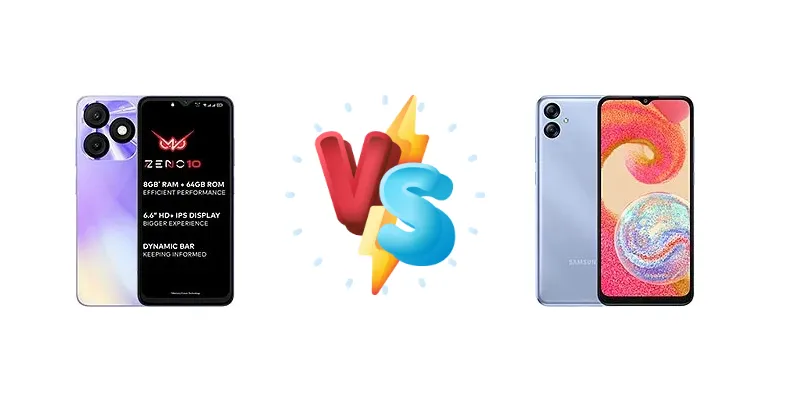
The sub-$150 smartphone market is fiercely competitive. Both the itel Zeno 10 and the Samsung Galaxy A04e aim to deliver essential smartphone functionality at an incredibly accessible price point. This comparison dissects their core components to determine which device offers the best value for users prioritizing affordability and basic functionality.
🏆 Quick Verdict
For the average user, the Samsung Galaxy A04e is the slightly better choice, primarily due to its broader availability and established brand recognition. However, the itel Zeno 10 presents a compelling alternative if the Unisoc T603 chipset delivers comparable real-world performance in your region, and it's available at a significantly lower price.
| Network |
|---|
| 2G bands | GSM 850 / 900 / 1800 / 1900 | GSM 850 / 900 / 1800 / 1900 |
| 3G bands | HSDPA 850 / 900 / 2100 | HSDPA 850 / 900 / 2100 |
| 4G bands | LTE | 1, 3, 5, 7, 8, 20, 28, 38, 40, 41 |
| Speed | HSPA, LTE | HSPA, LTE |
| Technology | GSM / HSPA / LTE | GSM / HSPA / LTE |
| Launch |
|---|
| Announced | 2025, January 02 | 2022, October 21 |
| Status | Available. Released 2025, January 10 | Available. Released 2022, November 07 |
| Body |
|---|
| Build | - | Glass front, plastic back, plastic frame |
| Dimensions | 164 x 76 x 9 mm (6.46 x 2.99 x 0.35 in) | 164.2 x 75.9 x 9.1 mm (6.46 x 2.99 x 0.36 in) |
| SIM | Dual SIM | · Nano-SIM· Nano-SIM + Nano-SIM |
| Weight | 186 g (6.56 oz) | 188 g (6.63 oz) |
| Display |
|---|
| Resolution | 720 x 1612 pixels, 20:9 ratio (~267 ppi density) | 720 x 1600 pixels, 20:9 ratio (~270 ppi density) |
| Size | 6.6 inches, 104.6 cm2 (~84.0% screen-to-body ratio) | 6.5 inches, 102.0 cm2 (~81.8% screen-to-body ratio) |
| Type | IPS LCD | PLS LCD |
| Platform |
|---|
| CPU | Octa-core | Octa-core (4x2.3 GHz Cortex-A53 & 4x1.8 GHz Cortex-A53) |
| Chipset | Unisoc T603 | Mediatek MT6765 Helio P35 (12 nm) |
| GPU | - | PowerVR GE8320 |
| OS | Android 14 (Go edition) | Android 12, One UI Core 4.1 |
| Memory |
|---|
| Card slot | microSDXC | microSDXC (dedicated slot) |
| Internal | 64GB 3GB RAM, 64GB 4GB RAM | 32GB 2GB RAM, 32GB 3GB RAM, 32GB 4GB RAM, 64GB 2GB RAM, 64GB 3GB RAM, 64GB 4GB RAM, 128GB 4GB RAM |
| Main Camera |
|---|
| Dual | - | 13 MP, f/2.2, (wide), AF
Auxiliary lens |
| Features | LED flash | LED flash |
| Single | 8 MP
auxiliary lens | 5 MP, f/2.2 |
| Video | Yes | 1080p@30fps |
| Selfie camera |
|---|
| Single | 5 MP | 5 MP, f/2.2 |
| Video | Yes | Yes |
| Sound |
|---|
| 3.5mm jack | - | Yes |
| 35mm jack | Yes | Yes |
| Loudspeaker | Yes | Yes |
| Comms |
|---|
| Bluetooth | Yes | 5.0, A2DP, LE |
| NFC | No | No |
| Positioning | GPS | GPS, GLONASS, GALILEO, BDS |
| Radio | Unspecified | Unspecified |
| USB | USB Type-C 2.0 | USB Type-C 2.0, OTG |
| WLAN | Yes | Wi-Fi 802.11 b/g/n, Wi-Fi Direct |
| Features |
|---|
| Sensors | Fingerprint (side-mounted); unspecified sensors | Accelerometer, proximity |
| Battery |
|---|
| Charging | 10W wired | - |
| Type | 5000 mAh | Li-Po 5000 mAh |
| Misc |
|---|
| Colors | Opal purple, Phantom crystal | Black, Copper, Light Blue |
| Models | - | SM-A042F, SM-A042F/DS, SM-A042M, SM-A042M/DS |
| Price | About 70 EUR | ₹ 7,999 |
| SAR EU | - | 0.29 W/kg (head) 1.11 W/kg (body) |
itel Zeno 10
- Potentially competitive performance with Unisoc T603
- May offer a lower price point
- Could be a good option as a secondary device
- Less established brand reputation
- Limited availability in some regions
- Unknown software support longevity
Samsung Galaxy A04e
- Established brand reliability (Samsung)
- Wider availability and support network
- Mature chipset (Helio P35) with known performance
- May be slightly more expensive
- Performance is entry-level and limited for demanding tasks
- Basic camera capabilities
Display Comparison
Neither device boasts a standout display. Both are likely to feature LCD panels, typical for this price bracket. Without specific resolution or brightness data, it's difficult to declare a clear winner. However, Samsung generally employs better color calibration even on its entry-level devices, potentially offering a more pleasant viewing experience. Bezels are expected to be substantial on both, minimizing screen real estate.
Camera Comparison
Camera performance is likely to be similar on both devices, leaning towards basic functionality. Both will likely feature a primary camera and potentially a depth or macro sensor. Without sensor size or aperture details, it's difficult to assess image quality. The A04e's image processing, benefiting from Samsung's software expertise, may yield slightly more refined results, but don't expect flagship-level photography. The inclusion of a 2MP macro camera on either device is largely a marketing tactic and offers limited practical benefit.
Performance
The core difference lies in the chipsets. The Samsung Galaxy A04e utilizes the Mediatek Helio P35, a 12nm process chip with an octa-core configuration split into 4x2.3 GHz Cortex-A53 and 4x1.8 GHz Cortex-A53 cores. The itel Zeno 10 features the Unisoc T603, an octa-core processor, but lacks detailed clock speed information. While both are entry-level, the Helio P35's architecture is more mature and widely tested. The 12nm process of the Helio P35 *could* translate to slightly better power efficiency compared to an unknown process node for the Unisoc T603. Real-world performance will depend heavily on RAM optimization and software.
Battery Life
Battery capacity is not specified for either device. However, both are likely to house batteries in the 4000-5000 mAh range, typical for this segment. The itel Zeno 10 charges at 10W, while the A04e's charging speed is also likely to be around 10W. Given the limited power draw of these chipsets, both devices should achieve all-day battery life with moderate usage. The slower charging speeds mean a full charge will take several hours.
Buying Guide
Buy the itel Zeno 10 if you need a secondary device for basic communication and light tasks, and are comfortable with a less-established brand. Its Unisoc T603 chipset *could* offer competitive performance at this price point, but availability is key. Buy the Samsung Galaxy A04e if you prioritize brand reliability, wider availability, and a known chipset (Helio P35) even if it means potentially sacrificing a small amount of performance for the price.
Frequently Asked Questions
❓ Is the Mediatek Helio P35 in the Galaxy A04e sufficient for playing games like PUBG Mobile?
The Helio P35 can run PUBG Mobile, but expect to play at the lowest graphics settings and potentially experience frame drops, especially in intense combat scenarios. It's not designed for demanding gaming experiences.
❓ How does the Unisoc T603 in the itel Zeno 10 compare to the Helio P35 in terms of multitasking?
Without detailed benchmarks, it's difficult to say definitively. However, the Helio P35's mature architecture and optimization suggest it may handle multitasking slightly more smoothly, particularly with multiple apps open simultaneously. The Zeno 10's performance will depend heavily on its RAM configuration and software optimization.
❓ What kind of software updates can I expect on the itel Zeno 10?
itel's software update track record is less consistent than Samsung's. Expect fewer major Android version updates and potentially shorter security patch support compared to the Galaxy A04e. This is a key consideration if long-term software support is important to you.
❓ Does the Samsung Galaxy A04e support fast charging?
No, the Samsung Galaxy A04e supports standard 10W charging. While not slow, it will take several hours to fully charge the device from 0%.