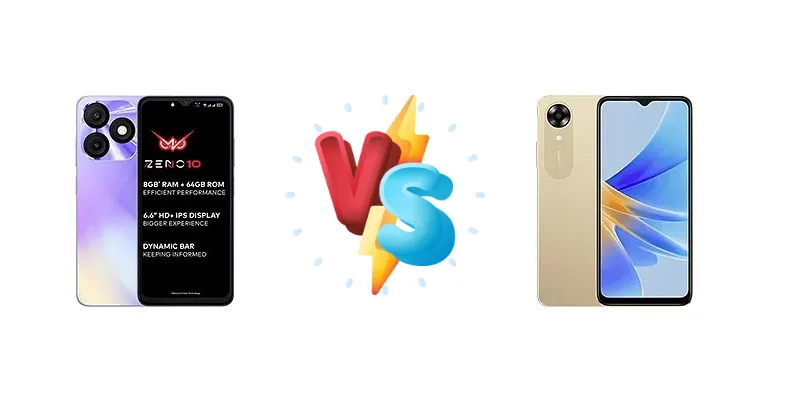
The itel Zeno 10 and Oppo A17k represent the fiercely competitive sub-$150 smartphone market. Both aim to deliver essential functionality at an accessible price point, but they achieve this with different chipsets and design philosophies. This comparison dissects their key specifications to determine which device offers the best value for budget-conscious consumers.
🏆 Quick Verdict
For the average user prioritizing slightly better real-world performance and a more established brand reputation, the Oppo A17k is the stronger choice. While the itel Zeno 10 offers a viable alternative, the Helio G35 in the A17k provides a marginal edge in application responsiveness and light gaming.
| Network |
|---|
| 2G bands | GSM 850 / 900 / 1800 / 1900 | GSM 850 / 900 / 1800 / 1900 |
| 3G bands | HSDPA 850 / 900 / 2100 | HSDPA 850 / 900 / 2100 |
| 4G bands | LTE | 1, 3, 5, 8, 38, 40, 41 |
| Speed | HSPA, LTE | HSPA, LTE |
| Technology | GSM / HSPA / LTE | GSM / HSPA / LTE |
| Launch |
|---|
| Announced | 2025, January 02 | 2022, October 13 |
| Status | Available. Released 2025, January 10 | Available. Released 2022, October 18 |
| Body |
|---|
| Dimensions | 164 x 76 x 9 mm (6.46 x 2.99 x 0.35 in) | 164.2 x 75.6 x 8.3 mm (6.46 x 2.98 x 0.33 in) |
| SIM | Dual SIM | Nano-SIM + Nano-SIM |
| Weight | 186 g (6.56 oz) | 189 g (6.67 oz) |
| | - | IPX4 water resistance |
| Display |
|---|
| Protection | - | Panda Glass |
| Resolution | 720 x 1612 pixels, 20:9 ratio (~267 ppi density) | 720 x 1612 pixels, 20:9 ratio (~269 ppi density) |
| Size | 6.6 inches, 104.6 cm2 (~84.0% screen-to-body ratio) | 6.56 inches, 103.4 cm2 (~83.3% screen-to-body ratio) |
| Type | IPS LCD | IPS LCD, 480 nits (typ), 600 nits (HBM) |
| Platform |
|---|
| CPU | Octa-core | Octa-core (4x2.3 GHz Cortex-A53 & 4x1.8 GHz Cortex-A53) |
| Chipset | Unisoc T603 | Mediatek MT6765 Helio G35 (12 nm) |
| GPU | - | PowerVR GE8320 |
| OS | Android 14 (Go edition) | Android 12, ColorOS 12.1 |
| Memory |
|---|
| Card slot | microSDXC | microSDXC |
| Internal | 64GB 3GB RAM, 64GB 4GB RAM | 64GB 3GB RAM |
| | - | eMMC 5.1 |
| Main Camera |
|---|
| Features | LED flash | LED flash, panorama |
| Single | 8 MP
auxiliary lens | 8 MP, f/2.0, (wide), AF |
| Video | Yes | 1080p@30fps |
| Selfie camera |
|---|
| Single | 5 MP | 5 MP, f/2.2, (wide) |
| Video | Yes | 1080p@30fps |
| Sound |
|---|
| 3.5mm jack | - | Yes |
| 35mm jack | Yes | Yes |
| Loudspeaker | Yes | Yes |
| Comms |
|---|
| Bluetooth | Yes | 5.3, A2DP, LE, aptX HD |
| NFC | No | No |
| Positioning | GPS | GPS, GLONASS, BDS, GALILEO |
| Radio | Unspecified | Unspecified |
| USB | USB Type-C 2.0 | microUSB 2.0, OTG |
| WLAN | Yes | Wi-Fi 802.11 a/b/g/n/ac, dual-band |
| Features |
|---|
| Sensors | Fingerprint (side-mounted); unspecified sensors | Fingerprint (side-mounted), accelerometer, proximity, compass |
| Battery |
|---|
| Charging | 10W wired | - |
| Type | 5000 mAh | Li-Po 5000 mAh |
| Misc |
|---|
| Colors | Opal purple, Phantom crystal | Navy Blue, Gold |
| Models | - | CPH2471 |
| Price | About 70 EUR | About 130 EUR |
itel Zeno 10
- Potentially lower price point
- Functional for basic smartphone tasks
- Octa-core processor offers multi-tasking capability
- Less established brand reputation
- Unisoc chipset may offer slightly lower performance than Helio G35
Oppo A17k
- Slightly better performance with Helio G35
- More established brand with wider service network
- Potentially better software support
- May be slightly more expensive
- 10W charging is slow
Display Comparison
Neither device boasts a standout display. Given the lack of detailed display specifications, we can assume both utilize LCD panels common in this price bracket. The focus here is on functionality over fidelity. Bezels are likely to be substantial on both, and color accuracy will be standard for budget phones. The absence of high refresh rates or advanced features like LTPO is expected.
Camera Comparison
Camera performance is likely to be similar, with both devices likely featuring a primary sensor paired with basic auxiliary lenses. Without detailed sensor information, it's safe to assume image quality will be adequate for social media sharing in good lighting conditions, but will struggle in low-light scenarios. The prevalence of 2MP macro lenses in this segment suggests they offer limited practical benefit. Image processing will likely prioritize speed over detail.
Performance
The core difference lies in the chipsets: the itel Zeno 10 uses the Unisoc T603, while the Oppo A17k features the MediaTek Helio G35. The Helio G35, fabricated on a 12nm process, has a clock speed advantage with its 4x2.3 GHz Cortex-A53 cores, compared to the Unisoc T603’s octa-core configuration without specified clock speeds. This suggests the A17k will exhibit slightly better single-core performance, translating to snappier app launches and smoother multitasking. While both are octa-core, the architecture and fabrication process give the Helio G35 a slight edge. Thermal management is unlikely to be a major concern on either device given the modest processing power.
Battery Life
Both devices feature modest battery capacities, and the 10W wired charging on the itel Zeno 10 is standard for this price range. The Oppo A17k’s charging speed is also likely to be 10W. The real-world impact will depend on software optimization and usage patterns. While a larger battery capacity would be preferable, the relatively low-power chipsets mean both devices should comfortably last a full day with moderate use. The difference in 0-100% charge times will be minimal.
Buying Guide
Buy the itel Zeno 10 if you need a functional smartphone for basic tasks like calling, texting, and light social media, and are comfortable with a less-known brand. Buy the Oppo A17k if you prefer a slightly more responsive experience for everyday use, potentially better software support, and a brand with a wider service network, even if it means a minimal price increase.
Frequently Asked Questions
❓ Will the Helio G35 in the Oppo A17k handle popular games like PUBG Mobile?
The Helio G35 can run PUBG Mobile, but expect to play at low to medium settings with reduced frame rates for a smooth experience. It's not a gaming-focused chipset, so demanding titles will likely require significant compromises in graphical fidelity.
❓ Is the Unisoc T603 chipset known for overheating under load?
The Unisoc T603 is a relatively low-power chipset and is unlikely to overheat significantly during typical usage. Prolonged gaming or intensive tasks might cause some warming, but it shouldn't lead to performance throttling.
❓ How much storage does each phone offer, and is it expandable?
While not specified, budget phones in this segment typically offer 32GB or 64GB of internal storage. Both the itel Zeno 10 and Oppo A17k are highly likely to include a microSD card slot for storage expansion, allowing users to add more space for photos, videos, and apps.
❓ What version of Android do these phones run, and will they receive software updates?
Both devices likely run a recent version of Android (potentially Android 12 or 13) with a custom UI overlay. However, software update support is often limited on budget smartphones. Expect at least one major Android update, but long-term support is not guaranteed.