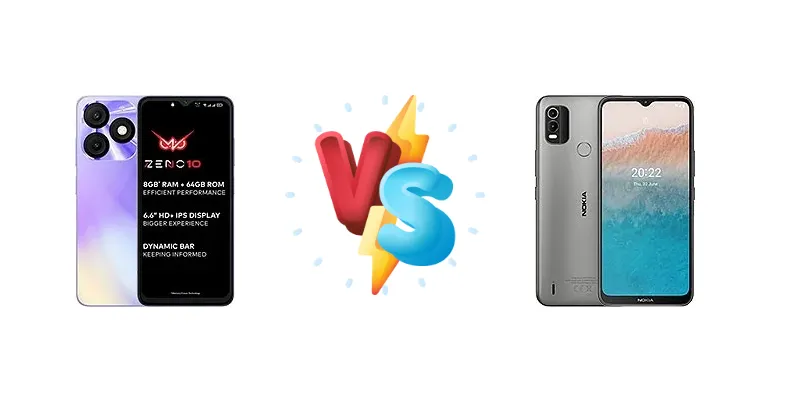
The itel Zeno 10 and Nokia C21 Plus represent the ultra-budget end of the smartphone spectrum, targeting first-time buyers or those needing a reliable secondary device. Both rely on Unisoc chipsets, but differ in their specific implementations. This comparison dissects their key specifications to determine which offers the best value for money.
🏆 Quick Verdict
For most users, the itel Zeno 10 emerges as the slightly better choice. While both phones offer similar 10W charging and target the same price bracket, the Unisoc T603 in the Zeno 10 provides a more modern architecture and potentially better overall performance than the older SC9863A found in the Nokia C21 Plus.
| Network |
|---|
| 2G bands | GSM 850 / 900 / 1800 / 1900 | GSM 850 / 900 / 1800 / 1900 |
| 3G bands | HSDPA 850 / 900 / 2100 | HSDPA 850 / 900 / 2100 |
| 4G bands | LTE | LTE |
| Speed | HSPA, LTE | HSPA 42.2/5.76 Mbps, LTE Cat4 150/50 Mbps |
| Technology | GSM / HSPA / LTE | GSM / HSPA / LTE |
| | - | HSDPA 850 / 900 / 1700(AWS) / 1900 / 2100 |
| Launch |
|---|
| Announced | 2025, January 02 | 2022, February 28 |
| Status | Available. Released 2025, January 10 | Available. Released 2022, April 29 |
| Body |
|---|
| Build | - | Glass front, aluminum frame, plastic back |
| Dimensions | 164 x 76 x 9 mm (6.46 x 2.99 x 0.35 in) | 164.8 x 75.9 x 8.6 mm (6.49 x 2.99 x 0.34 in) |
| SIM | Dual SIM | · Nano-SIM· Nano-SIM + Nano-SIM |
| Weight | 186 g (6.56 oz) | 178 g or 191 g (6.28 oz) |
| | - | Splash protection |
| Display |
|---|
| Protection | - | Scratch-resistant glass |
| Resolution | 720 x 1612 pixels, 20:9 ratio (~267 ppi density) | 720 x 1600 pixels, 20:9 ratio (~269 ppi density) |
| Size | 6.6 inches, 104.6 cm2 (~84.0% screen-to-body ratio) | 6.52 inches, 102.6 cm2 (~82.1% screen-to-body ratio) |
| Type | IPS LCD | IPS LCD |
| Platform |
|---|
| CPU | Octa-core | Octa-core (4x1.6 GHz Cortex-A55 & 4x1.2 GHz Cortex-A55) |
| Chipset | Unisoc T603 | Unisoc SC9863A (28 nm) |
| GPU | - | IMG8322 |
| OS | Android 14 (Go edition) | Android 11 (Go edition) |
| Memory |
|---|
| Card slot | microSDXC | microSDXC (dedicated slot) |
| Internal | 64GB 3GB RAM, 64GB 4GB RAM | 32GB 2GB RAM, 32GB 3GB RAM, 64GB 2GB RAM, 64GB 3GB RAM, 64GB 4GB RAM |
| | - | eMMC 5.1 |
| Main Camera |
|---|
| Dual | - | 13 MP, (wide), AF
Auxiliary lens |
| Features | LED flash | LED flash, HDR, panorama |
| Single | 8 MP
auxiliary lens | 5 MP |
| Video | Yes | 1080p@30fps |
| Selfie camera |
|---|
| Features | - | LED flash |
| Single | 5 MP | 5 MP |
| Video | Yes | 720p |
| Sound |
|---|
| 3.5mm jack | - | Yes |
| 35mm jack | Yes | Yes |
| Loudspeaker | Yes | Yes |
| Comms |
|---|
| Bluetooth | Yes | 4.2, A2DP |
| NFC | No | No |
| Positioning | GPS | GPS |
| Radio | Unspecified | FM radio |
| USB | USB Type-C 2.0 | microUSB 2.0 |
| WLAN | Yes | Wi-Fi 802.11 b/g/n |
| Features |
|---|
| Sensors | Fingerprint (side-mounted); unspecified sensors | Fingerprint (rear-mounted), accelerometer, proximity |
| Battery |
|---|
| Charging | 10W wired | 10W wired |
| Type | 5000 mAh | Li-Ion 4000/5050 mAh |
| Misc |
|---|
| Colors | Opal purple, Phantom crystal | Dark Cyan, Warm Gray |
| Models | - | TA-1433, TA-1431, TA-1426, TA-1424 |
| Price | About 70 EUR | About 120 EUR |
| SAR | - | 0.57 W/kg (head) 0.65 W/kg (body) |
| SAR EU | - | 0.40 W/kg (head) 0.99 W/kg (body) |
itel Zeno 10
- More modern Unisoc T603 chipset
- Potentially better app performance
- Slightly improved power efficiency
- itel's brand recognition is lower than Nokia's
- Limited software update commitment
Nokia C21 Plus
- Nokia's reputation for software reliability
- Potentially longer software support
- Established brand trust
- Older Unisoc SC9863A chipset
- Slower overall performance
- Less efficient processor
Display Comparison
Neither itel nor Nokia provide display specifications beyond size. Given the price point, both likely utilize LCD panels with 720p+ resolution. The absence of details like peak brightness or color gamut suggests neither phone excels in display quality. The Nokia C21 Plus's 28nm chipset may contribute to slightly higher heat output, potentially impacting long-term panel longevity, though this is speculative without further testing.
Camera Comparison
Both phones are unlikely to deliver exceptional camera performance. Details are scarce, but the focus should be on usability for basic snapshots rather than image quality. The absence of OIS or large sensors on either device suggests low-light performance will be limited. Any camera differences will likely stem from software processing rather than hardware capabilities, making it difficult to definitively declare a winner without side-by-side image comparisons.
Performance
The core difference lies in the chipsets. The itel Zeno 10’s Unisoc T603 is an octa-core processor, while the Nokia C21 Plus uses the Unisoc SC9863A, also octa-core but with a split core configuration (4x1.6 GHz Cortex-A55 & 4x1.2 GHz Cortex-A55). The SC9863A, built on a 28nm process, is an older design. The T603, while not a powerhouse, benefits from a more recent architecture, potentially offering better efficiency and slightly improved graphics performance. This translates to snappier app loading and smoother multitasking for the Zeno 10, particularly with multiple apps open.
Battery Life
Both devices feature 10W wired charging, indicating similar charging speeds – expect over 3 hours for a full charge. Battery capacity isn't specified, but given the target market, both likely house batteries in the 4000-5000 mAh range. The Unisoc T603’s potentially better efficiency in the itel Zeno 10 could translate to slightly longer battery life during moderate usage, offsetting any capacity differences.
Buying Guide
Buy the itel Zeno 10 if you prioritize a slightly more responsive user experience and potentially better app performance, even if the difference isn't dramatic. Buy the Nokia C21 Plus if you value Nokia's brand reputation for software support and a potentially more refined, albeit slower, user interface. Both are suitable for basic tasks, but the Zeno 10 offers a small edge in processing power.
Frequently Asked Questions
❓ Will the Unisoc T603 in the itel Zeno 10 handle basic gaming like PUBG Mobile?
While the Unisoc T603 isn't a gaming powerhouse, it should be capable of running PUBG Mobile at low settings with reduced frame rates. Expect some stuttering and lag, especially in intense scenes. The Nokia C21 Plus with the SC9863A will likely struggle even more with demanding games.
❓ How reliable is the software support for the itel Zeno 10 compared to the Nokia C21 Plus?
Nokia generally provides more consistent software updates and security patches than itel. While the C21 Plus may not receive major Android version upgrades indefinitely, it's likely to receive security updates for a longer period. itel's software support track record is less predictable.
❓ Is the 10W charging speed on either phone sufficient for daily use?
10W charging is slow by modern standards. Both phones will take over three hours to fully charge from 0%. This is acceptable for overnight charging, but inconvenient if you need a quick top-up during the day. Neither phone supports fast charging technologies.