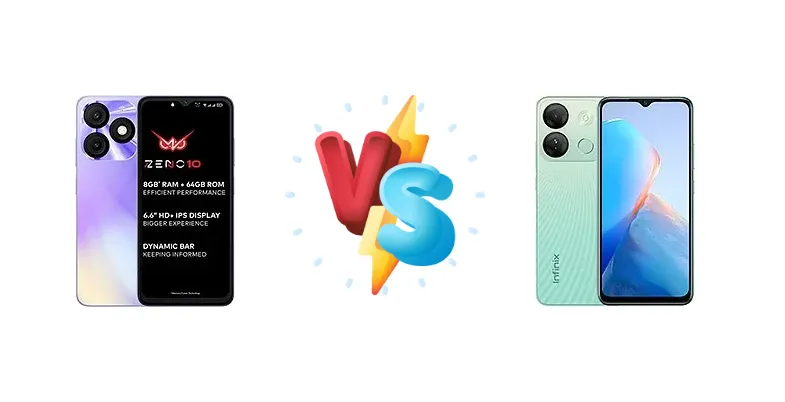
The itel Zeno 10 and Infinix Smart 7 HD represent the fiercely competitive sub-$150 smartphone market. Both aim to deliver essential smartphone functionality at an incredibly accessible price point. However, they take slightly different approaches to achieving this, with the itel Zeno 10 leveraging a Unisoc chipset while the Infinix Smart 7 HD opts for a MediaTek solution. This comparison will dissect their key differences to determine which device offers the best value.
🏆 Quick Verdict
For the average user prioritizing basic functionality and a slightly more modern chipset, the itel Zeno 10 emerges as the better choice. While both phones offer similar battery life and charging speeds, the Unisoc T603 provides a marginal performance advantage, potentially leading to a smoother user experience with everyday tasks.
| Network |
|---|
| 2G bands | GSM 850 / 900 / 1800 / 1900 | GSM 850 / 900 / 1800 / 1900 |
| 3G bands | HSDPA 850 / 900 / 2100 | HSDPA 850 / 900 / 2100 |
| 4G bands | LTE | 1, 3, 5, 8, 38, 40, 41 |
| Speed | HSPA, LTE | HSPA, LTE |
| Technology | GSM / HSPA / LTE | GSM / HSPA / LTE |
| | - | 1, 2, 3, 4, 5, 7, 8, 20, 28, 38, 40, 41 |
| Launch |
|---|
| Announced | 2025, January 02 | 2023, April 14 |
| Status | Available. Released 2025, January 10 | Available. Released 2023, April 14 |
| Body |
|---|
| Build | - | Glass front, plastic back, plastic frame |
| Dimensions | 164 x 76 x 9 mm (6.46 x 2.99 x 0.35 in) | 163.9 x 75.5 x 8.7 mm (6.45 x 2.97 x 0.34 in) |
| SIM | Dual SIM | Nano-SIM + Nano-SIM |
| Weight | 186 g (6.56 oz) | 196.5 g (6.95 oz) |
| Display |
|---|
| Resolution | 720 x 1612 pixels, 20:9 ratio (~267 ppi density) | 720 x 1612 pixels, 20:9 ratio (~267 ppi density) |
| Size | 6.6 inches, 104.6 cm2 (~84.0% screen-to-body ratio) | 6.6 inches, 104.6 cm2 (~84.6% screen-to-body ratio) |
| Type | IPS LCD | IPS LCD, 500 nits |
| Platform |
|---|
| CPU | Octa-core | Octa-core 1.6 GHz |
| Chipset | Unisoc T603 | - |
| OS | Android 14 (Go edition) | Android 12 (Go edition) |
| Memory |
|---|
| Card slot | microSDXC | microSDXC (dedicated slot) |
| Internal | 64GB 3GB RAM, 64GB 4GB RAM | 64GB 2GB RAM |
| | - | UFS 2.1 |
| Main Camera |
|---|
| Dual | - | 8 MP, f/2.0
0.08 MP, (depth) |
| Features | LED flash | Dual-LED flash, HDR, panorama |
| Single | 8 MP
auxiliary lens | 8 MP, f/2.0
Auxiliary lens |
| Video | Yes | 1080p@30fps |
| Selfie camera |
|---|
| Features | - | LED flash |
| Single | 5 MP | 5 MP, f/2.0 |
| Video | Yes | 720p@30fps |
| Sound |
|---|
| 3.5mm jack | - | Yes |
| 35mm jack | Yes | Yes |
| Loudspeaker | Yes | Yes |
| Comms |
|---|
| Bluetooth | Yes | 5.0, A2DP, LE |
| NFC | No | No |
| Positioning | GPS | GPS |
| Radio | Unspecified | FM radio |
| USB | USB Type-C 2.0 | microUSB 2.0, OTG |
| WLAN | Yes | Wi-Fi 802.11 b/g/n |
| Features |
|---|
| Sensors | Fingerprint (side-mounted); unspecified sensors | Fingerprint (rear-mounted), accelerometer, proximity |
| Battery |
|---|
| Charging | 10W wired | 10W wired |
| Type | 5000 mAh | 5000 mAh |
| Misc |
|---|
| Colors | Opal purple, Phantom crystal | Ink Black, Silk Blue, Jade White, Green Apple |
| Models | - | X6516 |
| Price | About 70 EUR | About 110 EUR |
itel Zeno 10
- Slightly more powerful Unisoc T603 chipset
- Potentially smoother multitasking
- Modern chipset architecture
- Brand recognition is lower than Infinix
- Limited information available on RAM and storage
Infinix Smart 7 HD
- Established brand within the budget segment
- Reliable performance for basic tasks
- Potentially wider availability
- Older chipset architecture
- Marginally lower CPU/GPU performance
- Limited information available on RAM and storage
Display Comparison
Neither itel nor Infinix provide display specifications beyond size. Given the price point, both likely utilize LCD panels with 720p+ resolution. The absence of detailed specs suggests neither phone will excel in color accuracy or brightness. Bezels are expected to be substantial on both devices, maximizing screen real estate within a compact form factor. The user experience will be similar, focused on readability rather than immersive visuals.
Camera Comparison
Both phones are likely to feature basic camera setups, and detailed specifications are scarce. Expect a primary camera accompanied by auxiliary sensors of limited utility. Without sensor size or aperture information, it's difficult to assess image quality. Image processing will likely be heavily reliant on software algorithms to enhance photos, but the limited processing power of both chipsets may result in noticeable compression artifacts. Users should not expect flagship-level camera performance from either device.
Performance
The core difference lies in the chipsets: the itel Zeno 10 features the Unisoc T603, an octa-core processor, while the Infinix Smart 7 HD utilizes an octa-core processor clocked at 1.6 GHz. While both are octa-core, the Unisoc T603 generally benchmarks slightly higher in CPU and GPU performance, suggesting a smoother experience with app loading and basic gaming. The lack of information regarding RAM configuration on both devices is a significant omission; however, the chipset difference suggests the itel Zeno 10 will handle multitasking marginally better. Thermal management is unlikely to be a concern with either device, given the low-power nature of the processors.
Battery Life
Both the itel Zeno 10 and Infinix Smart 7 HD support 10W wired charging. Battery capacity is not specified for either device, but given the target market, capacities likely range between 4000mAh and 5000mAh. With conservative usage, both phones should comfortably last a full day on a single charge. The 10W charging speed will result in relatively slow charging times – expect several hours to reach 100% from empty.
Buying Guide
Buy the itel Zeno 10 if you need a phone capable of handling slightly more demanding apps and multitasking, even if only marginally. Its Unisoc T603 chipset offers a small edge in processing power. Buy the Infinix Smart 7 HD if you prioritize a well-established brand within the budget segment and are primarily focused on core smartphone functions like calling, texting, and light social media use. The Smart 7 HD is a reliable option for those seeking simplicity.
Frequently Asked Questions
❓ Will the Unisoc T603 in the itel Zeno 10 handle popular apps like WhatsApp and Facebook smoothly?
Yes, the Unisoc T603 is capable of running popular apps like WhatsApp and Facebook without significant lag. While it's not a high-end processor, it's sufficient for everyday tasks and social media browsing. However, expect longer loading times compared to phones with more powerful chipsets.
❓ Is the Infinix Smart 7 HD a good option for someone who primarily uses their phone for calls and texts?
Absolutely. The Infinix Smart 7 HD is an excellent choice for users who prioritize basic communication features. Its reliable performance and long battery life make it well-suited for calls, texts, and essential smartphone functions. The chipset is adequate for these tasks, and the phone's simplicity is a benefit for those unfamiliar with complex smartphone features.
❓ Can either of these phones play PUBG Mobile, and if so, at what settings?
While technically possible to launch PUBG Mobile on both devices, the experience will be far from optimal. Expect extremely low frame rates and significant lag, even at the lowest graphics settings. These phones are not designed for demanding gaming applications.
❓ What type of storage does the itel Zeno 10 and Infinix Smart 7 HD use, and is it expandable?
Unfortunately, neither manufacturer provides information on the storage type (e.g., eMMC, UFS) or whether the storage is expandable via microSD card. Given the price point, it's likely both phones utilize eMMC storage and may or may not support microSD expansion. Users should confirm this information before purchasing if storage capacity is a concern.