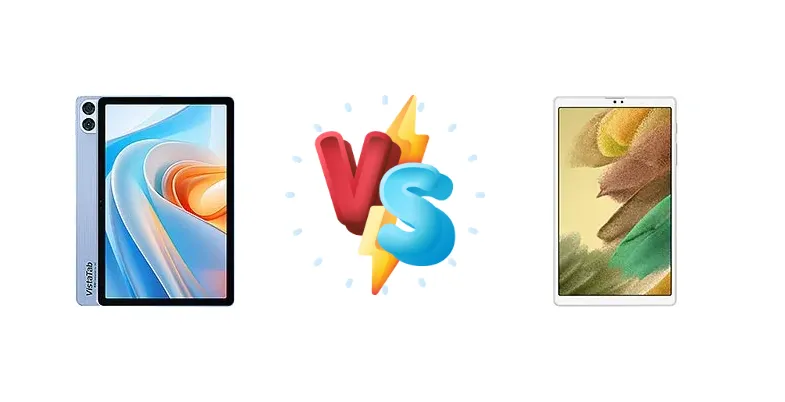
The sub-$150 Android tablet market is fiercely competitive. Both the itel VistaTab 30 and the Samsung Galaxy Tab A7 Lite aim to deliver a functional tablet experience without breaking the bank. However, they take different approaches to achieving this, with distinct chipset choices and varying charging capabilities. This comparison will dissect their strengths and weaknesses to determine which tablet offers the best value.
🏆 Quick Verdict
For the average user prioritizing a slightly smoother experience and brand recognition, the Samsung Galaxy Tab A7 Lite is the better choice. While the itel VistaTab 30 offers a competitive price, the Helio P22T in the Samsung tablet provides a more responsive user interface and better app compatibility, despite the slightly slower charging.
| Network |
|---|
| 2G bands | GSM 850 / 900 / 1800 / 1900 | GSM 850 / 900 / 1800 / 1900 |
| 3G bands | HSDPA 850 / 900 / 2100 | HSDPA 850 / 900 / 1700(AWS) / 1900 / 2100 |
| 4G bands | LTE | 1, 2, 3, 4, 5, 7, 8, 12, 17, 20, 28, 38, 40, 66 |
| Speed | HSPA, LTE | HSPA, LTE - cellular model only |
| Technology | GSM / HSPA / LTE | GSM / HSPA / LTE |
| Launch |
|---|
| Announced | 2024, September | 2021, May 27 |
| Status | Available. Released 2024, September | Available. Released 2021, June 18 |
| Body |
|---|
| Build | - | Glass front, aluminum back, aluminum frame, plastic ends |
| Dimensions | 8.0 mm thickness | 212.5 x 124.7 x 8 mm (8.37 x 4.91 x 0.31 in) |
| SIM | Nano-SIM | Nano-SIM (cellular model only) |
| Weight | 550 g (1.21 lb) | 366 g (Wi-Fi), 371 g (LTE) (12.91 oz) |
| Display |
|---|
| Resolution | 1200 x 1920 pixels, 16:10 ratio (~206 ppi density) | 800 x 1340 pixels, 5:3 ratio (~179 ppi density) |
| Size | 11.0 inches, 350.9 cm2 | 8.7 inches, 214.9 cm2 (~81.1% screen-to-body ratio) |
| Type | IPS LCD, 450 nits | TFT LCD |
| Platform |
|---|
| CPU | Octa-core (2x1.6 GHz Cortex-A75 & 6x1.6 GHz Cortex-A55) | Octa-core (4x2.3 GHz Cortex-A53 & 4x1.8 GHz Cortex-A53) |
| Chipset | Unisoc T606 (12 nm) | Mediatek MT8768T Helio P22T (12 nm) |
| GPU | Mali-G57 MP1 | PowerVR GE8320 |
| OS | Android 13 or Android 14 (market/region dependent) | Android 11, upgradable to Android 14, One UI 6.1 |
| Memory |
|---|
| Card slot | microSDXC | microSDXC (dedicated slot) |
| Internal | 128GB 4GB RAM | 32GB 2GB RAM, 32GB 3GB RAM, 64GB 4GB RAM |
| | - | eMMC 5.1 |
| Main Camera |
|---|
| Features | LED flash | - |
| Single | 8 MP | 8 MP, AF |
| Video | 1080p@30fps | 1080p@30fps |
| Selfie camera |
|---|
| Single | 5 MP | 2 MP |
| Video | Yes | - |
| Sound |
|---|
| 3.5mm jack | - | Yes |
| 35mm jack | No | Yes |
| Loudspeaker | Yes, with dual speakers | Yes, with stereo speakers |
| Comms |
|---|
| Bluetooth | Yes | 5.0, A2DP, LE |
| NFC | No | No |
| Positioning | Unspecified | GPS, GLONASS, BDS, GALILEO - cellular model only |
| Radio | Unspecified | No |
| USB | USB Type-C | USB Type-C 2.0 |
| WLAN | Yes | Wi-Fi 802.11 a/b/g/n/ac, dual-band, Wi-Fi Direct |
| Features |
|---|
| Sensors | Accelerometer | Accelerometer, compass |
| Battery |
|---|
| Charging | 10W wired | 15W wired |
| Type | 7000 mAh | Li-Po 5100 mAh |
| Misc |
|---|
| Colors | Light Blue, Deep Grey | Gray, Silver |
| Models | - | SM-T225, SM-T220, SM-T225N, SM-T227U |
| Price | - | About 140 EUR |
| SAR | - | 0.68 W/kg (body) |
| SAR EU | - | 0.64 W/kg (head) 0.99 W/kg (body) |
itel VistaTab 30
- Potentially lower price point
- Unisoc T606 offers a mix of performance and efficiency cores
- Adequate for basic tablet tasks
- Slower charging speed (10W)
- Unisoc chipset may have limited software optimization
- Less established brand reputation
Samsung Galaxy Tab A7 Lite
- Faster charging (15W)
- Mediatek Helio P22T provides a smoother user experience
- Samsung brand recognition and software support
- May be slightly more expensive
- Homogenous core configuration may limit peak performance
- Still a budget device with inherent limitations
Display Comparison
Neither itel nor Samsung provide detailed display specifications beyond the basic resolution. However, both tablets utilize 12nm chipsets, suggesting similar power constraints impacting display capabilities. We can infer that both likely employ IPS LCD panels, common in this price bracket. The lack of high refresh rates or advanced features like LTPO is expected. The real-world difference in viewing experience will likely be minimal, with color accuracy and brightness being the key differentiators, but without testing data, it's difficult to declare a clear winner.
Camera Comparison
Camera performance is unlikely to be a deciding factor for either tablet. Both are positioned as budget devices, and image quality will be adequate for basic scanning or video calls. Detailed camera specs are unavailable, but it's safe to assume both feature modest sensors. Focusing on the chipset's ISP capabilities, the Mediatek Helio P22T generally offers slightly better image processing than comparable Unisoc chips, potentially resulting in marginally better photos from the A7 Lite. However, the difference will be minimal.
Performance
The core difference lies in the chipsets. The itel VistaTab 30 features the Unisoc T606, an octa-core processor with a mix of Cortex-A75 and A55 cores. This architecture prioritizes performance with the A75 cores, but the 12nm process node limits efficiency. The Samsung Galaxy Tab A7 Lite uses the Mediatek Helio P22T, also 12nm, but with a homogenous octa-core Cortex-A53 setup. While the A53 cores are less powerful individually than the A75, the Helio P22T operates at a higher clock speed (2.3 GHz vs 1.6 GHz), potentially offsetting the architectural difference. This suggests the A7 Lite will feel more responsive in everyday tasks, despite the less sophisticated core arrangement. The A75 cores in the itel may provide a slight edge in burst performance, but sustained workloads will likely favor the A7 Lite's more efficient core configuration.
Battery Life
Both tablets utilize 12nm chipsets, suggesting similar power consumption profiles. The itel VistaTab 30 supports 10W wired charging, while the Samsung Galaxy Tab A7 Lite steps up to 15W. While the battery capacity isn't specified, the faster charging on the A7 Lite is a tangible benefit. A 5W difference may not seem significant, but it translates to a noticeably quicker top-up time, especially important for users who rely on their tablet throughout the day. The A7 Lite's faster charging partially mitigates any potential disadvantage from a slightly smaller battery capacity.
Buying Guide
Buy the itel VistaTab 30 if you need a tablet primarily for basic tasks like reading ebooks, light web browsing, and occasional video playback, and are extremely budget-conscious. The Unisoc T606 is adequate for these workloads. Buy the Samsung Galaxy Tab A7 Lite if you prefer a more polished software experience, slightly better performance for multitasking and gaming, and the peace of mind that comes with the Samsung brand. The A7 Lite is better suited for students or anyone who needs a tablet for more than just casual use.
Frequently Asked Questions
❓ Will the Unisoc T606 in the itel VistaTab 30 struggle with multitasking?
The Unisoc T606 can handle light multitasking, such as switching between a web browser and a note-taking app. However, running multiple demanding applications simultaneously may result in noticeable slowdowns. The Samsung Galaxy Tab A7 Lite with the Helio P22T is better equipped for more intensive multitasking scenarios.
❓ Is the 15W charging on the Samsung Galaxy Tab A7 Lite a significant improvement over the itel VistaTab 30's 10W charging?
Yes, the 15W charging on the A7 Lite translates to a faster 0-100% charge time. While the exact difference depends on battery capacity, you can expect a noticeably quicker top-up, reducing downtime and improving convenience. This is particularly beneficial for users who rely on their tablet throughout the day.
❓ How does the software experience differ between the itel VistaTab 30 and the Samsung Galaxy Tab A7 Lite?
Samsung's One UI offers a more polished and feature-rich software experience compared to the typically more stock Android experience found on itel devices. One UI includes optimizations for tablets, such as multi-window support and DeX mode, enhancing productivity. Samsung also provides more consistent software updates and security patches.