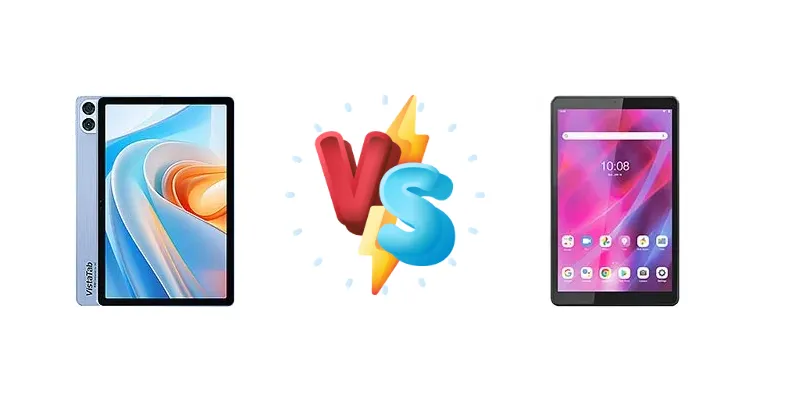
The sub-$150 tablet market is fiercely competitive, offering options for casual users, students, and those seeking a dedicated media consumption device. The itel VistaTab 30 and Lenovo Tab M8 (3rd Gen) represent two popular choices, but significant differences in their underlying chipsets dictate their performance characteristics. This comparison dives deep into the hardware to determine which tablet delivers the best experience for your needs.
🏆 Quick Verdict
For most users, the itel VistaTab 30 offers a more compelling experience. While both tablets target the budget segment, the Unisoc T606’s Cortex-A75 cores provide a noticeable performance advantage over the Lenovo Tab M8’s older Cortex-A53 architecture, making it better suited for multitasking and demanding apps.
| Network |
|---|
| 2G bands | GSM 850 / 900 / 1800 / 1900 | GSM 850 / 900 / 1800 / 1900 |
| 3G bands | HSDPA 850 / 900 / 2100 | HSDPA 850 / 900 / 1700(AWS) / 1900 / 2100 - International |
| 4G bands | LTE | 1, 2, 3, 4, 5, 19, 7, 8, 20, 26, 28, 38, 40, 41 - International |
| Speed | HSPA, LTE | HSPA, LTE - cellular model only |
| Technology | GSM / HSPA / LTE | GSM / CDMA / HSPA / LTE |
| | - | 1, 3, 5, 7, 8, 34, 38, 39, 40, 41 - China |
| Launch |
|---|
| Announced | 2024, September | 2021, June 28 |
| Status | Available. Released 2024, September | Available. Released 2022, February |
| Body |
|---|
| Build | - | Glass front, aluminum back, aluminum frame |
| Dimensions | 8.0 mm thickness | 199.1 x 121.8 x 8.2 mm (7.84 x 4.80 x 0.32 in) |
| SIM | Nano-SIM | Nano-SIM (cellular model only) |
| Weight | 550 g (1.21 lb) | 305 g (10.76 oz) |
| Display |
|---|
| Resolution | 1200 x 1920 pixels, 16:10 ratio (~206 ppi density) | 800 x 1280 pixels, 16:10 ratio (~189 ppi density) |
| Size | 11.0 inches, 350.9 cm2 | 8.0 inches, 185.6 cm2 (~76.5% screen-to-body ratio) |
| Type | IPS LCD, 450 nits | TDDI IPS LCD, 350 nits (typ) |
| Platform |
|---|
| CPU | Octa-core (2x1.6 GHz Cortex-A75 & 6x1.6 GHz Cortex-A55) | Octa-core (4x2.3 GHz Cortex-A53 & 4x1.8 GHz Cortex-A53) |
| Chipset | Unisoc T606 (12 nm) | Mediatek MT8768T Helio P22T (12 nm) |
| GPU | Mali-G57 MP1 | PowerVR GE8320 |
| OS | Android 13 or Android 14 (market/region dependent) | Android 11 (Go edition) - 2 GB RAM versionAndroid 11 - 3 GB RAM version |
| Memory |
|---|
| Card slot | microSDXC | microSDXC (dedicated slot) |
| Internal | 128GB 4GB RAM | 32GB 2GB RAM, 32GB 3GB RAM |
| | - | eMMC 5.1 |
| Main Camera |
|---|
| Features | LED flash | - |
| Single | 8 MP | 5 MP, AF |
| Video | 1080p@30fps | 1080p |
| Selfie camera |
|---|
| Single | 5 MP | 2 MP |
| Video | Yes | 720p |
| Sound |
|---|
| 3.5mm jack | - | Yes |
| 35mm jack | No | Yes |
| Loudspeaker | Yes, with dual speakers | Yes |
| Comms |
|---|
| Bluetooth | Yes | 5.0, A2DP, LE |
| NFC | No | No |
| Positioning | Unspecified | GPS, GLONASS, BDS - cellular model only |
| Radio | Unspecified | FM radio |
| USB | USB Type-C | USB Type-C 2.0, OTG |
| WLAN | Yes | Wi-Fi 802.11 a/b/g/n, dual-band, Wi-Fi Direct |
| Features |
|---|
| Sensors | Accelerometer | Accelerometer, proximity |
| Battery |
|---|
| Charging | 10W wired | - |
| Type | 7000 mAh | Li-Po 5100 mAh |
| Misc |
|---|
| Colors | Light Blue, Deep Grey | Iron Grey, Platinum Grey |
itel VistaTab 30
- More powerful processor (Unisoc T606)
- Modern CPU architecture (Cortex-A75 cores)
- Better suited for multitasking
- Slower charging speed (10W)
- Battery capacity unknown
Lenovo Tab M8 (3rd Gen)
- Potentially more established brand reputation
- Compact 8-inch screen
- May have slightly faster charging (speculation)
- Older, less powerful processor (Helio P22T)
- Less efficient CPU architecture (Cortex-A53 cores)
- Slower overall performance
Display Comparison
Neither tablet boasts a standout display. Both are likely to feature IPS LCD panels, common in this price bracket. However, detailed specs like resolution and peak brightness are missing. The Lenovo Tab M8’s smaller 8-inch screen may offer a slightly higher pixel density, but the difference will be minimal. Color accuracy is expected to be basic on both, suitable for general use but not color-critical work. Bezels are likely to be substantial on both devices, reflecting their budget positioning.
Camera Comparison
Camera performance is unlikely to be a deciding factor for either tablet. Both will likely feature basic camera setups, and detailed specs are unavailable. Expect low-resolution sensors and limited image quality. Focusing on camera specs would be misleading without further information; these tablets are not designed for photography.
Performance
This is where the key difference lies. The itel VistaTab 30’s Unisoc T606, built on a 12nm process, features a heterogeneous core configuration with 2x 1.6 GHz Cortex-A75 cores and 6x 1.6 GHz Cortex-A55 cores. This architecture provides a significant uplift in single-core and multi-core performance compared to the Lenovo Tab M8’s MediaTek MT8768T Helio P22T, which utilizes 4x 2.3 GHz Cortex-A53 cores and 4x 1.8 GHz Cortex-A53 cores. The A75 cores in the itel tablet are substantially more powerful than the A53 cores in the Lenovo, resulting in smoother app launches, faster web browsing, and improved multitasking. While both chipsets are 12nm, the architectural advantage favors the itel.
Battery Life
Battery capacity is not specified for either device. However, the itel VistaTab 30’s 10W wired charging is slower than what is commonly found on Lenovo tablets, even in the budget segment. This means longer charging times, potentially offsetting any battery life advantages gained from software optimization. Real-world battery life will depend heavily on usage patterns, but the slower charging speed is a clear disadvantage for the itel.
Buying Guide
Buy the itel VistaTab 30 if you prioritize responsiveness and the ability to run multiple apps simultaneously, even if it means slightly slower charging. It’s ideal for students, casual gamers, and users who want a tablet that feels more modern. Buy the Lenovo Tab M8 (3rd Gen) if you primarily need a tablet for static tasks like video playback or reading, and value a potentially more established brand reputation within the budget space.
Frequently Asked Questions
❓ Will the Unisoc T606 in the itel VistaTab 30 handle light gaming?
Yes, the Unisoc T606 is capable of handling light gaming titles. The Cortex-A75 cores provide a performance boost over the Helio P22T, allowing for smoother frame rates in less demanding games. However, don't expect to play graphically intensive games at high settings.
❓ Is the Lenovo Tab M8 (3rd Gen) a good choice for reading ebooks and browsing the web?
The Lenovo Tab M8 (3rd Gen) is adequate for basic tasks like reading ebooks and browsing the web. However, the older processor may result in slightly slower page loading times and less responsive scrolling compared to the itel VistaTab 30. If these are your primary uses, it's a viable option, but the itel offers a more future-proof experience.
❓ How does the software experience differ between the itel VistaTab 30 and Lenovo Tab M8?
Both tablets likely run a near-stock version of Android, but itel and Lenovo may include their own custom launchers and pre-installed apps. The software experience is unlikely to be a major differentiator, but users should be aware of potential bloatware.