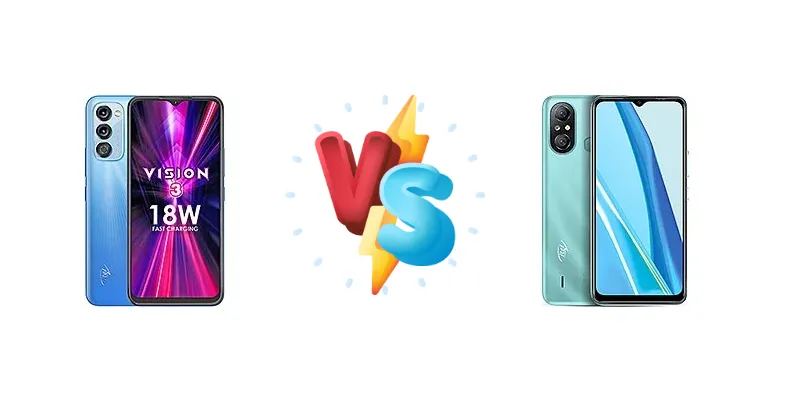
The itel Vision 3 and itel A49 represent itel’s commitment to the ultra-budget smartphone market. While both aim to deliver essential smartphone functionality at a low price point, significant differences in their core hardware – specifically the chipset – dictate their performance capabilities. This comparison dissects these differences to determine which device offers the best value for users prioritizing speed and responsiveness.
🏆 Quick Verdict
For most users, the itel Vision 3 is the superior choice. Its Unisoc SC9863A chipset, featuring an octa-core CPU, provides a noticeably smoother experience for multitasking and app usage compared to the quad-core SC9832E in the A49. While both phones are entry-level, the Vision 3 offers a more future-proofed experience.
| Network |
|---|
| 2G bands | GSM 850 / 900 / 1800 / 1900 | GSM 850 / 900 / 1800 / 1900 |
| 3G bands | HSDPA 850 / 900 / 2100 | HSDPA 850 / 900 / 2100 |
| 4G bands | LTE | LTE |
| Speed | HSPA, LTE | HSPA, LTE |
| Technology | GSM / HSPA / LTE | GSM / HSPA / LTE |
| Launch |
|---|
| Announced | 2022 | 2022 |
| Status | Available. Released 2022 | Available. Released 2022 |
| Body |
|---|
| Dimensions | - | - |
| SIM | Dual SIM | Dual SIM |
| Weight | - | - |
| Display |
|---|
| Resolution | 720 x 1600 pixels, 20:9 ratio (~266 ppi density) | 720 x 1600 pixels, 20:9 ratio (~266 ppi density) |
| Size | 6.6 inches, 105.2 cm2 | 6.6 inches, 105.2 cm2 |
| Type | IPS LCD | IPS LCD |
| Platform |
|---|
| CPU | Octa-core (4x1.6 GHz Cortex-A55 & 4x1.2 GHz Cortex-A55) | Quad-core 1.4 GHz |
| Chipset | Unisoc SC9863A (28 nm) | Unisoc SC9832E (28 nm) |
| GPU | IMG8322 | Mali-T820 MP1 |
| OS | Android 11 (Go edition) | Android 11 (Go edition) |
| Memory |
|---|
| Card slot | microSDXC | microSDXC |
| Internal | 32GB 2GB RAM, 64GB 3GB RAM | 32GB 2GB RAM |
| Main Camera |
|---|
| Features | LED flash | LED flash |
| Single | 8 MP (wide)
Auxiliary lens | 5 MP |
| Video | 1080p@30fps | Yes |
| Selfie camera |
|---|
| Single | 5 MP | 5 MP |
| Video | Yes | Yes |
| Sound |
|---|
| 35mm jack | Yes | Yes |
| Loudspeaker | Yes | Yes |
| Comms |
|---|
| Bluetooth | Yes | Yes |
| NFC | No | No |
| Positioning | GPS | GPS |
| Radio | Unspecified | Unspecified |
| USB | microUSB | microUSB |
| WLAN | Yes | Yes |
| Features |
|---|
| Sensors | Fingerprint (rear-mounted), accelerometer | Fingerprint (rear-mounted), accelerometer |
| Battery |
|---|
| Charging | 18W wired | - |
| Type | 5000 mAh | 4000 mAh |
itel Vision 3
- Faster Octa-Core Processor
- 18W Fast Charging
- More Responsive User Experience
- Likely Higher Price Point
- May have similar display quality to A49
itel A49
- Lower Price
- Sufficient for Basic Tasks
- Good Battery Life (estimated)
- Slow Quad-Core Processor
- Slow Charging Speed
- Struggles with Multitasking
Display Comparison
Both the itel Vision 3 and A49 likely feature similar LCD panels, given their price bracket. Specific details like resolution and brightness are not provided, but we can assume they are optimized for power efficiency rather than visual fidelity. The absence of information regarding refresh rates suggests both operate at the standard 60Hz. Bezels are likely to be substantial on both devices, maximizing screen real estate within their respective form factors. Color accuracy is expected to be standard for this segment, prioritizing cost over calibration.
Camera Comparison
Without detailed camera specifications, a direct comparison is difficult. However, it’s safe to assume both phones feature basic camera setups geared towards casual photography. The absence of information regarding sensor size or aperture suggests both utilize entry-level sensors. Image processing will likely be limited, focusing on basic features like HDR. Given the price point, expecting high-quality images, especially in low-light conditions, is unrealistic. Any additional cameras (often 2MP macro lenses) are likely to offer minimal benefit.
Performance
The core differentiator between these two devices is the chipset. The itel Vision 3’s Unisoc SC9863A is an octa-core processor, utilizing a big.LITTLE architecture with four Cortex-A55 cores clocked at 1.6 GHz and four at 1.2 GHz. This allows for efficient power management – using the slower cores for light tasks and the faster cores when more processing power is needed. In contrast, the itel A49 is equipped with the Unisoc SC9832E, a quad-core processor clocked at 1.4 GHz. This simpler configuration will result in noticeably slower performance, particularly when multitasking or running demanding applications. The Vision 3 will offer a more responsive user experience, with quicker app launch times and smoother scrolling. While neither chipset is designed for intensive gaming, the Vision 3 will handle casual games more effectively.
Battery Life
Battery capacity is not specified for either device. However, given their target market, both likely feature batteries in the 3000-4000 mAh range. The itel Vision 3’s 18W wired charging is a significant advantage over the A49, which likely supports standard 5W or 10W charging. This faster charging capability will translate to significantly reduced charging times, allowing users to quickly top up their battery when needed. While a larger battery capacity is always desirable, the faster charging speed of the Vision 3 can mitigate the impact of a slightly smaller battery.
Buying Guide
Buy the itel Vision 3 if you need a phone capable of handling more than just basic tasks like calls and messaging. It’s ideal for users who occasionally browse the web, use social media, or play light games. Buy the itel A49 if your primary needs are limited to essential communication and you prioritize absolute affordability above all else. It’s a suitable option for first-time smartphone users or as a reliable backup device.
Frequently Asked Questions
❓ Will the itel Vision 3 handle popular apps like WhatsApp and Facebook smoothly?
Yes, the octa-core Unisoc SC9863A processor in the Vision 3 is more than capable of running apps like WhatsApp and Facebook smoothly, even with multiple apps open in the background. The A49 may experience noticeable lag when switching between these apps.
❓ Is the difference in processing power between the two phones noticeable for everyday use?
Absolutely. The quad-core processor in the itel A49 is designed for basic tasks. The Vision 3’s octa-core processor provides a significantly more responsive experience, making everyday tasks like browsing the web and opening apps feel much faster and smoother.
❓ Can I play games on either of these phones?
Both phones can handle very light games. However, the itel Vision 3 will provide a better gaming experience due to its more powerful processor. Don't expect to play graphically demanding games at high settings on either device.