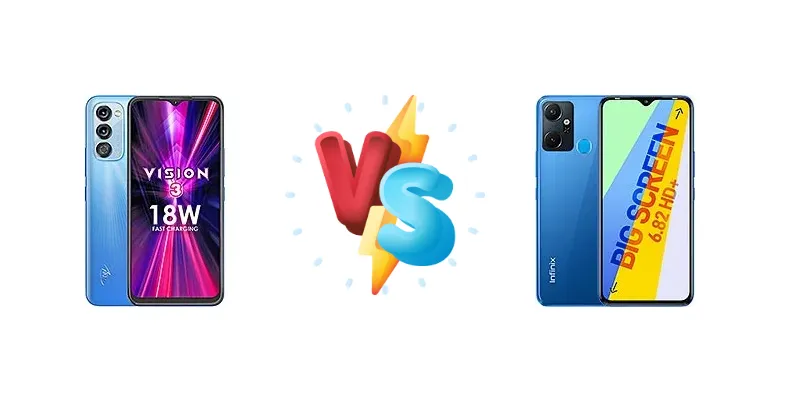
The itel Vision 3 and Infinix Smart 6 Plus (India) represent the fiercely competitive entry-level smartphone market. Both aim to deliver essential smartphone functionality at an incredibly affordable price point, but they take different approaches to achieving this. This comparison dissects their core components to determine which device offers the best value for users prioritizing performance, battery life, and overall usability.
🏆 Quick Verdict
For the average user seeking a slightly more responsive experience, the Infinix Smart 6 Plus emerges as the better choice. Its Mediatek Helio G25 chipset, built on a more efficient 12nm process, provides a noticeable performance edge over the itel Vision 3’s Unisoc SC9863A, despite both utilizing Cortex-A53/A55 cores. However, the itel Vision 3 remains a viable option for extremely basic usage.
| Network |
|---|
| 2G bands | GSM 850 / 900 / 1800 / 1900 | GSM 850 / 900 / 1800 / 1900 |
| 3G bands | HSDPA 850 / 900 / 2100 | HSDPA 850 / 900 / 2100 |
| 4G bands | LTE | 1, 3, 5, 8, 38, 40, 41 |
| Speed | HSPA, LTE | HSPA, LTE |
| Technology | GSM / HSPA / LTE | GSM / HSPA / LTE |
| Launch |
|---|
| Announced | 2022 | 2022, July 29 |
| Status | Available. Released 2022 | Available. Released 2022, August 03 |
| Body |
|---|
| Build | - | Glass front, plastic back, plastic frame |
| Dimensions | - | 172.6 x 77.7 x 8.7 mm (6.80 x 3.06 x 0.34 in) |
| SIM | Dual SIM | Nano-SIM + Nano-SIM |
| Weight | - | 202 g (7.13 oz) |
| Display |
|---|
| Protection | - | Panda Glass |
| Resolution | 720 x 1600 pixels, 20:9 ratio (~266 ppi density) | 720 x 1600 pixels, 20:9 ratio (~257 ppi density) |
| Size | 6.6 inches, 105.2 cm2 | 6.82 inches, 112.3 cm2 (~83.7% screen-to-body ratio) |
| Type | IPS LCD | IPS LCD, 440 nits (typ) |
| Platform |
|---|
| CPU | Octa-core (4x1.6 GHz Cortex-A55 & 4x1.2 GHz Cortex-A55) | Octa-core (4x2.0 GHz Cortex-A53 & 4x1.5 GHz Cortex-A53) |
| Chipset | Unisoc SC9863A (28 nm) | Mediatek MT6762G Helio G25 (12 nm) |
| GPU | IMG8322 | PowerVR GE8320 |
| OS | Android 11 (Go edition) | Android 12 (Go edition) |
| Memory |
|---|
| Card slot | microSDXC | microSDXC (dedicated slot) |
| Internal | 32GB 2GB RAM, 64GB 3GB RAM | 64GB 2GB RAM, 64GB 3GB RAM |
| | - | eMMC 5.1 |
| Main Camera |
|---|
| Dual | - | 8 MP, f/2.0, AF
Auxiliary lens |
| Features | LED flash | Dual-LED flash, HDR, panorama |
| Single | 8 MP (wide)
Auxiliary lens | 5 MP, f/2.0 |
| Video | 1080p@30fps | 1080p@30fps |
| Selfie camera |
|---|
| Features | - | LED flash |
| Single | 5 MP | 5 MP, f/2.0 |
| Video | Yes | 720p@30fps |
| Sound |
|---|
| 3.5mm jack | - | Yes |
| 35mm jack | Yes | Yes |
| Loudspeaker | Yes | Yes |
| Comms |
|---|
| Bluetooth | Yes | 5.0, A2DP, LE |
| NFC | No | No |
| Positioning | GPS | GPS |
| Radio | Unspecified | FM radio |
| USB | microUSB | microUSB 2.0, OTG |
| WLAN | Yes | Wi-Fi 802.11 a/b/g/n |
| Features |
|---|
| Sensors | Fingerprint (rear-mounted), accelerometer | Fingerprint (rear-mounted), accelerometer, proximity |
| Battery |
|---|
| Charging | 18W wired | - |
| Type | 5000 mAh | 5000 mAh |
| Misc |
|---|
| Colors | Blue | Tranquil Sea Blue, Miracle Black |
| Models | - | X6823C, X6823 |
| Price | - | About 100 EUR |
itel Vision 3
- 18W Fast Charging (potentially faster top-ups)
- Lower upfront cost (likely)
- Functional for basic smartphone tasks
- Less powerful Unisoc SC9863A chipset
- Older 28nm manufacturing process
- Likely slower app loading and multitasking
Infinix Smart 6 Plus (India)
- More efficient Mediatek Helio G25 chipset
- 12nm manufacturing process for better performance
- Smoother user experience for everyday tasks
- Potentially better gaming performance
- May have slower charging speeds
- Slightly higher price point (likely)
Display Comparison
Neither device boasts a standout display. Both likely feature LCD panels, typical for this price segment. The key difference lies under the hood: the Infinix Smart 6 Plus benefits from the more modern manufacturing process of its chipset, potentially allowing for slightly better power management of the display. However, without specific brightness or color accuracy data, it's difficult to definitively declare a winner. Expect both to struggle in direct sunlight.
Camera Comparison
Camera performance is likely to be similar, and generally underwhelming. Both devices will likely feature a primary camera paired with basic auxiliary sensors. Without specific sensor size or aperture information, it’s safe to assume image quality will be adequate for casual snapshots in good lighting conditions, but struggle in low light. The presence of a 2MP macro camera on either device is largely a marketing gimmick, offering minimal practical benefit due to the low resolution and lack of autofocus.
Performance
The performance gap is the most significant differentiator. The Infinix Smart 6 Plus’s Mediatek Helio G25 (12nm) is a clear upgrade over the itel Vision 3’s Unisoc SC9863A (28nm). The 12nm process node allows for greater transistor density and improved power efficiency, translating to better sustained performance and less heat generation. While both utilize octa-core configurations, the Helio G25’s Cortex-A53 cores clocked at 2.0 GHz offer a performance advantage over the Vision 3’s 1.6 GHz Cortex-A55 cores. This will be most noticeable when multitasking or running slightly more demanding applications. The Unisoc chip will likely exhibit more noticeable slowdowns under load.
Battery Life
Both devices will likely offer all-day battery life with moderate usage. The itel Vision 3’s 18W charging is a slight advantage, potentially allowing for faster top-ups compared to the Infinix Smart 6 Plus, assuming the latter supports a lower wattage. However, the more efficient Helio G25 in the Infinix Smart 6 Plus could offset this difference by consuming less power during typical use, resulting in comparable real-world battery endurance.
Buying Guide
Buy the itel Vision 3 if you need a smartphone for absolutely essential tasks – calls, texts, and very light app usage – and prioritize minimizing upfront cost. It’s a functional device for first-time smartphone users or as a backup phone. Buy the Infinix Smart 6 Plus (India) if you prefer a smoother, more responsive experience for everyday tasks like social media browsing, video streaming, and light gaming. The Helio G25 chipset offers a tangible improvement in performance, making it a better long-term investment.
Frequently Asked Questions
❓ Will the Helio G25 in the Infinix Smart 6 Plus handle popular games like PUBG Mobile?
The Helio G25 can run PUBG Mobile, but expect to play at lower graphics settings and frame rates to maintain a stable experience. It's not a gaming-focused chipset, so don't expect flagship-level performance. The itel Vision 3’s Unisoc SC9863A will struggle significantly with PUBG Mobile.
❓ Is the battery life significantly different between these two phones?
While both should offer all-day battery life with moderate use, the Infinix Smart 6 Plus’s more efficient Helio G25 chipset may provide slightly longer endurance. The itel Vision 3’s 18W charging could offset this with faster top-ups, but overall usage patterns will be the biggest factor.
❓ How much storage do these phones typically come with, and is it expandable?
Both phones typically ship with 32GB of internal storage, which is quite limited. Fortunately, both support microSD card expansion, allowing you to add up to 512GB or 1TB of additional storage for photos, videos, and apps. This is crucial given the limited base storage.
❓ Are these phones dual SIM capable?
Yes, both the itel Vision 3 and the Infinix Smart 6 Plus (India) are dual SIM phones, allowing you to use two SIM cards simultaneously. This is a common feature in this price segment and is useful for separating work and personal calls or taking advantage of different carrier plans.