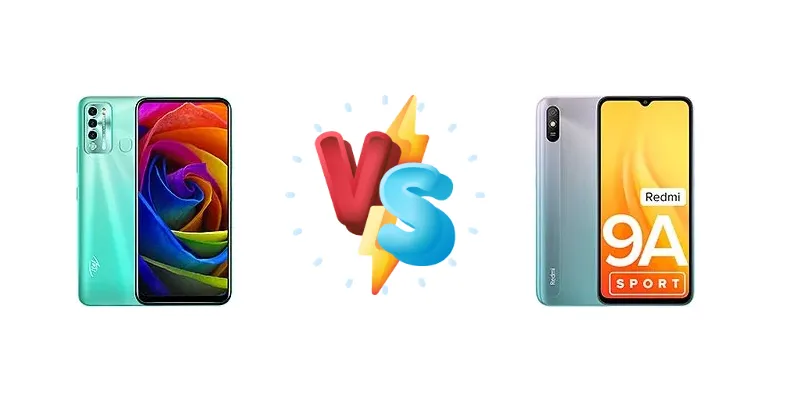
The sub-$100 smartphone market is fiercely competitive. Both the itel Vision 2 and Xiaomi Redmi 9A Sport aim to deliver essential smartphone functionality at an incredibly accessible price point. However, they take different approaches to achieving this, primarily through their chipset choices. This comparison will dissect those differences and determine which device offers the best experience for the money.
🏆 Quick Verdict
For the average user prioritizing basic functionality and a slightly more efficient processor, the Xiaomi Redmi 9A Sport emerges as the better choice. Its 12nm Helio G25 chipset offers a modest performance advantage and 10W charging, while the itel Vision 2 struggles with a less refined and older 28nm Unisoc SC9863A.
| Network |
|---|
| 2G bands | GSM 850 / 900 / 1800 / 1900 | GSM 850 / 900 / 1800 / 1900 |
| 3G bands | HSDPA 850 / 900 / 2100 | HSDPA 850 / 900 / 2100 |
| 4G bands | LTE | 1, 3, 5, 8, 40, 41 |
| Speed | HSPA, LTE | HSPA, LTE |
| Technology | GSM / HSPA / LTE | GSM / HSPA / LTE |
| Launch |
|---|
| Announced | 2021 | 2021, September 28 |
| Status | Available. Released 2021 | Available. Released 2021, September 28 |
| Body |
|---|
| Dimensions | - | 164.9 x 77.1 x 9 mm (6.49 x 3.04 x 0.35 in) |
| SIM | Dual SIM | Nano-SIM + Nano-SIM |
| Weight | - | 194 g (6.84 oz) |
| | - | Water-repellent coating |
| Display |
|---|
| Resolution | 720 x 1600 pixels, 20:9 ratio (~266 ppi density) | 720 x 1600 pixels, 20:9 ratio (~269 ppi density) |
| Size | 6.6 inches, 105.2 cm2 | 6.53 inches, 102.9 cm2 (~81.0% screen-to-body ratio) |
| Type | IPS LCD | IPS LCD, 400 nits (typ) |
| Platform |
|---|
| CPU | Octa-core (4x1.6 GHz Cortex-A55 & 4x1.2 GHz Cortex-A55) | Octa-core (4x2.0 GHz Cortex-A53 & 4x1.5 GHz Cortex-A53) |
| Chipset | Unisoc SC9863A (28 nm) | Mediatek MT6762G Helio G25 (12 nm) |
| GPU | IMG8322 | PowerVR GE8320 |
| OS | Android 10 (Go edition) | Android 10, MIUI 12 |
| Memory |
|---|
| Card slot | microSDXC (dedicated slot) | microSDXC (dedicated slot) |
| Internal | 32GB 2GB RAM | 32GB 2GB RAM, 32GB 3GB RAM |
| | - | eMMC 5.1 |
| Main Camera |
|---|
| Dual | 13 MP, (wide)
2 MP (macro)
Auxiliary lens | - |
| Features | LED flash | LED flash, HDR |
| Single | - | 13 MP, f/2.2, 28mm (wide), 1.0µm, PDAF |
| Video | 1080p@30fps | 1080p@30/60fps |
| Selfie camera |
|---|
| Features | - | HDR |
| Single | 8 MP | 5 MP, f/2.2, (wide), 1.12µm |
| Video | Yes | 1080p@30fps |
| Sound |
|---|
| 3.5mm jack | - | Yes |
| 35mm jack | Yes | Yes |
| Loudspeaker | Yes | Yes |
| Comms |
|---|
| Bluetooth | Yes | 5.0, A2DP, LE |
| NFC | No | No |
| Positioning | GPS | GPS, GLONASS, BDS |
| Radio | Unspecified | FM radio |
| USB | microUSB | microUSB 2.0, OTG |
| WLAN | Yes | Wi-Fi 802.11 a/b/g/n, Wi-Fi Direct |
| Features |
|---|
| Sensors | Fingerprint (rear-mounted), accelerometer | Accelerometer, proximity |
| Battery |
|---|
| Charging | - | 10W wired |
| Type | 4000 mAh | Li-Po 5000 mAh |
| Misc |
|---|
| Colors | Green | Carbon Black, Coral Green, Metallic Blue |
| Price | - | About 100 EUR |
itel Vision 2
- Potentially lower price point
- Large 5000mAh battery (estimated)
- Android Go Edition may offer smoother experience on limited hardware
- Less powerful Unisoc SC9863A chipset
- Older 28nm manufacturing process
- Likely slower charging speeds
Xiaomi Redmi 9A Sport
- More efficient MediaTek Helio G25 chipset
- 12nm manufacturing process
- 10W wired charging
- May be slightly more expensive
- Still limited performance for demanding tasks
- Android Go Edition may limit app compatibility
Display Comparison
Neither device boasts a standout display. Both likely feature LCD panels, typical for this price bracket. However, details like resolution and peak brightness are missing. The Redmi 9A Sport’s slightly larger screen size (typically 6.53 inches vs. the Vision 2’s 6.5 inches) may offer a marginally more immersive viewing experience. Without specific brightness measurements, it’s difficult to assess outdoor visibility, but generally, displays in this segment struggle in direct sunlight.
Camera Comparison
Camera performance is likely to be similar, and largely unimpressive, on both devices. Details on sensor sizes and apertures are unavailable, but both likely feature a primary camera paired with basic depth or macro sensors. The Redmi 9A Sport may benefit from slightly better image processing capabilities due to the more powerful chipset, but don't expect flagship-level results. The inclusion of a 2MP macro camera on either device is largely a marketing gimmick, offering limited practical benefit.
Performance
The core difference lies in the chipsets. The Xiaomi Redmi 9A Sport’s MediaTek Helio G25, built on a 12nm process, represents a significant architectural leap over the itel Vision 2’s Unisoc SC9863A (28nm). While both are octa-core CPUs, the Helio G25 utilizes Cortex-A53 cores clocked at 2.0 GHz, compared to the Vision 2’s mix of A55 cores clocked at 1.6 GHz and 1.2 GHz. The A53 architecture is older, but the higher clock speed and more efficient manufacturing process give the Helio G25 an edge in both single-core and multi-core performance. This translates to snappier app loading times and smoother multitasking on the Redmi 9A Sport. The 28nm process of the Unisoc chip will also result in higher power consumption and potentially more heat generation.
Battery Life
Both phones likely house batteries in the 5000mAh range, common for this segment. However, the Redmi 9A Sport benefits from 10W wired charging, while the itel Vision 2’s charging speed is unspecified but likely slower. This means the Redmi 9A Sport can replenish its battery more quickly, reducing downtime. While both will likely offer all-day battery life with moderate use, the faster charging on the Redmi 9A Sport is a tangible advantage.
Buying Guide
Buy the itel Vision 2 if you absolutely need the lowest possible price and are willing to compromise on performance and charging speed. It's suitable for very light users who primarily need a device for calls and basic messaging. Buy the Xiaomi Redmi 9A Sport if you want a slightly more responsive experience, even for light gaming, and appreciate the convenience of faster (albeit still slow) 10W charging. It's a better all-rounder for everyday tasks.
Frequently Asked Questions
❓ Will the Redmi 9A Sport handle popular games like PUBG Mobile?
While the Helio G25 can run PUBG Mobile, expect to play at the lowest graphics settings and frame rates for a playable experience. It's not designed for demanding gaming, and you'll likely encounter lag and stuttering. The itel Vision 2 will struggle even more with this title.
❓ Does the itel Vision 2 support software updates?
Software update support for the itel Vision 2 is likely to be limited. itel typically provides minimal long-term software support for its entry-level devices. The Redmi 9A Sport may receive slightly more frequent updates, but don't expect major Android version upgrades.
❓ Which phone is better for watching videos on YouTube?
Both phones are adequate for casual YouTube viewing, but the Redmi 9A Sport’s slightly larger screen and potentially better image processing might offer a marginally more enjoyable experience. Neither device will deliver a high-quality viewing experience, however.
❓ Is the Android Go Edition on the itel Vision 2 a benefit or a drawback?
Android Go Edition is a mixed bag. It's designed for low-RAM devices, offering a streamlined experience and reduced app sizes. However, it also means some apps are simplified versions with fewer features. For very basic users, it can be beneficial, but power users may find it limiting.