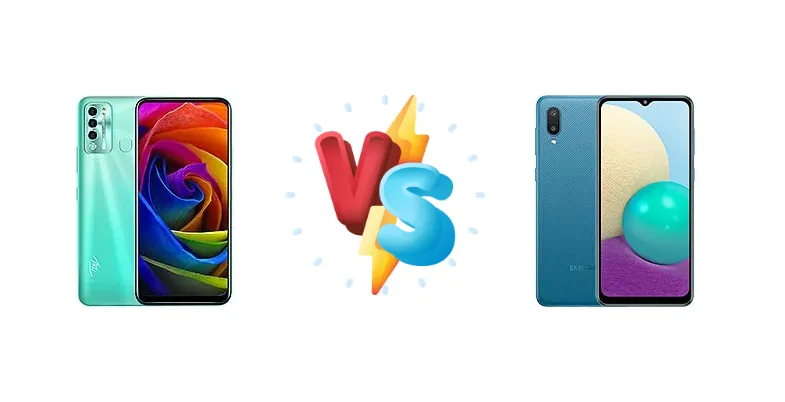
The sub-$200 smartphone market is fiercely competitive. Both the itel Vision 2 and Samsung Galaxy A02 aim to deliver essential smartphone functionality at an incredibly low price point. However, they take different approaches to achieving this, particularly in their core processing power. This comparison dissects the key differences to help you choose the best option for your needs.
🏆 Quick Verdict
For the average user prioritizing multitasking and a smoother overall experience, the itel Vision 2 emerges as the better choice. Its Unisoc SC9863A octa-core processor demonstrably outperforms the Samsung Galaxy A02’s quad-core Mediatek MT6739W, offering a more responsive user interface and better app handling.
| Network |
|---|
| 2G bands | GSM 850 / 900 / 1800 / 1900 | GSM 850 / 900 / 1800 / 1900 |
| 3G bands | HSDPA 850 / 900 / 2100 | HSDPA 850 / 900 / 2100 |
| 4G bands | LTE | 1, 3, 5, 7, 8, 20, 28, 38, 40, 41 |
| Speed | HSPA, LTE | HSPA 42.2/5.76 Mbps, LTE Cat4 150/50 Mbps |
| Technology | GSM / HSPA / LTE | GSM / HSPA / LTE |
| Launch |
|---|
| Announced | 2021 | 2021, January 27 |
| Status | Available. Released 2021 | Available. Released 2021, January 27 |
| Body |
|---|
| Build | - | Glass front, plastic back, plastic frame |
| Dimensions | - | 164 x 75.9 x 9.1 mm (6.46 x 2.99 x 0.36 in) |
| SIM | Dual SIM | · Nano-SIM· Nano-SIM + Nano-SIM |
| Weight | - | 206 g (7.27 oz) |
| Display |
|---|
| Resolution | 720 x 1600 pixels, 20:9 ratio (~266 ppi density) | 720 x 1600 pixels, 20:9 ratio (~270 ppi density) |
| Size | 6.6 inches, 105.2 cm2 | 6.5 inches, 102.0 cm2 (~81.9% screen-to-body ratio) |
| Type | IPS LCD | PLS LCD |
| Platform |
|---|
| CPU | Octa-core (4x1.6 GHz Cortex-A55 & 4x1.2 GHz Cortex-A55) | Quad-core 1.5 GHz Cortex-A53 |
| Chipset | Unisoc SC9863A (28 nm) | Mediatek MT6739W (28 nm) |
| GPU | IMG8322 | PowerVR GE8100 |
| OS | Android 10 (Go edition) | Android 10, upgradable to Android 11, One UI Core 3.1 |
| Memory |
|---|
| Card slot | microSDXC (dedicated slot) | microSDXC (dedicated slot) |
| Internal | 32GB 2GB RAM | 32GB 2GB RAM, 32GB 3GB RAM, 32GB 4GB RAM, 64GB 3GB RAM |
| | - | eMMC 5.1 |
| Main Camera |
|---|
| Dual | 13 MP, (wide)
2 MP (macro)
Auxiliary lens | 13 MP, f/1.9, (wide), AF
2 MP (macro) |
| Features | LED flash | LED flash |
| Video | 1080p@30fps | 1080p@30fps |
| Selfie camera |
|---|
| Single | 8 MP | 5 MP, f/2.0 |
| Video | Yes | - |
| Sound |
|---|
| 3.5mm jack | - | Yes |
| 35mm jack | Yes | Yes |
| Loudspeaker | Yes | Yes |
| Comms |
|---|
| Bluetooth | Yes | 5.1, A2DP, LE |
| NFC | No | No |
| Positioning | GPS | GPS, GLONASS |
| Radio | Unspecified | FM radio |
| USB | microUSB | microUSB 2.0 |
| WLAN | Yes | Wi-Fi 802.11 b/g/n, Wi-Fi Direct |
| Features |
|---|
| Sensors | Fingerprint (rear-mounted), accelerometer | Accelerometer |
| | - | Virtual proximity sensing |
| Battery |
|---|
| Type | 4000 mAh | Li-Po 5000 mAh |
| Misc |
|---|
| Colors | Green | Black, Blue |
| Models | - | SM-A022F, SM-A022F/DS, SM-A022M, SM-A022M/DS, SM-A022G, SM-A022G/DS |
| Price | - | € 97.46 |
| SAR EU | - | 0.65 W/kg (head) 1.71 W/kg (body) |
| Pricing |
|---|
| 32GB 2GB RAM | - | $ 149.99 |
| 32GB 3GB RAM | - | $ 129.99 |
| 64GB 3GB RAM | - | $ 199.99 |
| RENEWED | - | £ 113.00 |
itel Vision 2
- Superior processing power with octa-core CPU
- More efficient Cortex-A55 cores
- Potentially smoother multitasking experience
- Brand recognition is lower than Samsung
- Software update support may be limited
Samsung Galaxy A02
- Established brand reputation (Samsung)
- Multiple storage/RAM configurations available
- Potentially better software support (though not guaranteed)
- Significantly weaker processor (quad-core Cortex-A53)
- Slower performance in demanding tasks
- May struggle with multitasking
Display Comparison
Neither device boasts a standout display. Both utilize 28nm chipsets, suggesting a focus on cost reduction over display technology. Specific display specs (resolution, panel type, brightness) are not provided, but given the price point, expect basic LCD panels. The absence of details suggests neither phone will excel in outdoor visibility or color accuracy. The user experience will likely be similar in terms of visual quality.
Camera Comparison
Camera performance is likely to be similar, and underwhelming, on both devices. Details are scarce, but the market segment suggests basic sensors and limited image processing capabilities. The Galaxy A02’s available configurations (32GB/2GB, 32GB/3GB, 64GB/3GB) don't specify camera resolution, but it's reasonable to assume both phones feature a primary camera alongside basic depth or macro sensors. Given the price, image quality will be acceptable for casual snapshots in good lighting conditions, but struggle in low light. Focusing on megapixel counts alone would be misleading; image processing and sensor size are more critical, and neither device provides details on these aspects.
Performance
The core difference lies in the chipset. The itel Vision 2’s Unisoc SC9863A is an octa-core processor, featuring four Cortex-A55 cores clocked at 1.6 GHz and four at 1.2 GHz. This contrasts sharply with the Samsung Galaxy A02’s Mediatek MT6739W, a quad-core processor with Cortex-A53 cores clocked at 1.5 GHz. While both are built on a 28nm process, the higher core count and newer Cortex-A55 architecture of the Unisoc chip provide a significant advantage in multi-threaded tasks and overall responsiveness. The A55 cores are more efficient than the A53, potentially leading to slightly better battery life under load. The Galaxy A02’s RAM options (2GB or 3GB) further exacerbate the performance gap, especially when compared to the Vision 2’s likely 2GB or 3GB configurations (not specified).
Battery Life
Battery capacity isn't specified for either device. However, given the 28nm chipsets and basic feature sets, both phones should offer all-day battery life with moderate usage. Charging wattage is also unknown. The Unisoc SC9863A’s more efficient architecture *could* translate to slightly longer battery life, but this would be dependent on software optimization and battery capacity. Without specific numbers, it’s difficult to definitively declare a winner in this category.
Buying Guide
Buy the itel Vision 2 if you need a phone capable of handling multiple apps simultaneously, enjoy occasional light gaming, and value raw processing power within a tight budget. Buy the Samsung Galaxy A02 if you prioritize brand recognition, potentially better software support (though not guaranteed), and are primarily focused on basic communication tasks like calls and messaging, and are willing to accept slower performance.
Frequently Asked Questions
❓ Will the Mediatek MT6739W in the Galaxy A02 struggle with popular apps like Facebook or WhatsApp?
While the Galaxy A02 can run these apps, the Mediatek MT6739W’s quad-core processor and limited RAM (especially in the 2GB variant) may result in noticeable lag and slower loading times, particularly when multitasking or using the apps for extended periods. The itel Vision 2’s octa-core processor will provide a smoother experience.
❓ Is the difference in processor architecture (Cortex-A53 vs A55) really that noticeable in everyday use?
Yes, the Cortex-A55 cores in the Unisoc SC9863A are more efficient and offer improved performance per clock cycle compared to the older Cortex-A53 cores in the Galaxy A02. This translates to faster app launches, smoother scrolling, and a more responsive user interface, even in basic tasks.
❓ Does the Samsung Galaxy A02 benefit from Samsung's One UI software optimization?
While Samsung's One UI is generally well-regarded, its benefits are diminished on a device with limited processing power like the Galaxy A02. The software features may feel sluggish and unresponsive due to the hardware constraints. The itel Vision 2, while likely running a less polished OS, will feel faster due to its superior chipset.