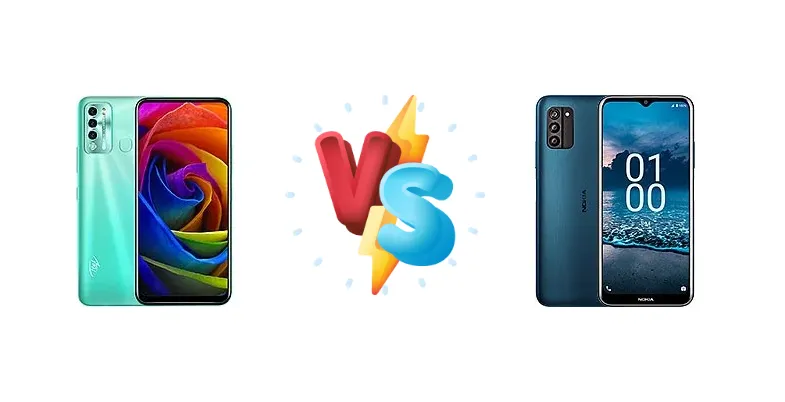
The sub-$150 smartphone market is fiercely competitive. The itel Vision 2 and Nokia G100 represent two distinct approaches to delivering value. The itel focuses on affordability, while the Nokia leverages Qualcomm's Snapdragon platform. This comparison dissects their key differences to help you choose the right device for your needs.
🏆 Quick Verdict
For most users, the Nokia G100 is the superior choice. Its Snapdragon 662 chipset, built on an 11nm process, delivers significantly better performance and efficiency than the itel Vision 2’s Unisoc SC9863A. While the itel is cheaper, the Nokia’s smoother experience justifies the price difference.
| Network |
|---|
| 2G bands | GSM 850 / 900 / 1800 / 1900 | GSM 850 / 900 / 1800 / 1900 |
| 3G bands | HSDPA 850 / 900 / 2100 | HSDPA 850 / 1700(AWS) / 1900 |
| 4G bands | LTE | 2, 4, 5, 7, 12, 13, 17, 44, 66, 71 |
| Speed | HSPA, LTE | HSPA, LTE |
| Technology | GSM / HSPA / LTE | GSM / HSPA / LTE |
| Launch |
|---|
| Announced | 2021 | 2022, September 22 |
| Status | Available. Released 2021 | Available. Released 2022, October |
| Body |
|---|
| Build | - | Glass front, plastic frame, plastic back |
| Dimensions | - | 166.6 x 76.7 x 8.9 mm (6.56 x 3.02 x 0.35 in) |
| SIM | Dual SIM | Nano-SIM |
| Weight | - | 195.1 g (6.88 oz) |
| Display |
|---|
| Resolution | 720 x 1600 pixels, 20:9 ratio (~266 ppi density) | 720 x 1600 pixels, 20:9 ratio (~269 ppi density) |
| Size | 6.6 inches, 105.2 cm2 | 6.52 inches, 102.6 cm2 (~80.3% screen-to-body ratio) |
| Type | IPS LCD | IPS LCD |
| Platform |
|---|
| CPU | Octa-core (4x1.6 GHz Cortex-A55 & 4x1.2 GHz Cortex-A55) | Octa-core (4x2.0 GHz Kryo 260 Gold & 4x1.8 GHz Kryo 260 Silver) |
| Chipset | Unisoc SC9863A (28 nm) | Qualcomm SM6115 Snapdragon 662 (11 nm) |
| GPU | IMG8322 | Adreno 610 |
| OS | Android 10 (Go edition) | Android 12 |
| Memory |
|---|
| Card slot | microSDXC (dedicated slot) | microSDXC |
| Internal | 32GB 2GB RAM | 32GB 3GB RAM, 128GB 4GB RAM |
| Main Camera |
|---|
| Dual | 13 MP, (wide)
2 MP (macro)
Auxiliary lens | - |
| Features | LED flash | LED flash, HDR, panorama |
| Triple | - | 13 MP, f/1.8, (wide), AF
5 MP, f/2.2, 115˚ (ultrawide), 1/5.0"
Auxiliary lens |
| Video | 1080p@30fps | 1080p@30fps |
| Selfie camera |
|---|
| Single | 8 MP | 8 MP, f/2.0, (wide), 1/4.0", 1.12µm |
| Video | Yes | 1080p@30fps |
| Sound |
|---|
| 35mm jack | Yes | Yes |
| Loudspeaker | Yes | Yes |
| Comms |
|---|
| Bluetooth | Yes | 5.0, A2DP, LE |
| NFC | No | No |
| Positioning | GPS | GPS |
| Radio | Unspecified | FM radio |
| USB | microUSB | USB Type-C 2.0, OTG |
| WLAN | Yes | Wi-Fi 802.11 b/g/n/ac, dual-band |
| Features |
|---|
| Sensors | Fingerprint (rear-mounted), accelerometer | Fingerprint (side-mounted), accelerometer, gyro, proximity, barometer |
| Battery |
|---|
| Charging | - | 15W wired |
| Type | 4000 mAh | Li-Po 5000 mAh |
| Misc |
|---|
| Colors | Green | Nordic Blue |
| Price | - | About 60 EUR |
itel Vision 2
- Lowest possible price point
- Potentially longer standby time due to less powerful processor
- Simple and straightforward user experience
- Significantly slower performance
- Less efficient processor leading to potential overheating
- Likely limited software updates
Nokia G100
- Faster and more responsive performance
- More efficient processor for better battery life
- Qualcomm chipset offers better software support
- 15W fast charging
- Higher price compared to the itel Vision 2
- May not be significantly better in extremely low-light camera scenarios
- Still a budget device with inherent limitations
Display Comparison
Neither device boasts a standout display. Specifics like panel type and resolution are missing for the itel Vision 2, suggesting a basic LCD. The Nokia G100 also likely uses an LCD, but the focus here is on the chipset impact on UI smoothness. Both will likely struggle with outdoor visibility, but the Nokia’s more powerful GPU can potentially drive a slightly higher peak brightness.
Camera Comparison
Without detailed camera specs beyond the presence of cameras, a direct comparison is difficult. However, the Nokia G100 benefits from Qualcomm’s image signal processor (ISP), which generally provides better image processing and noise reduction compared to the ISP found in the Unisoc SC9863A. It’s reasonable to assume the Nokia will produce more detailed and vibrant photos, especially in challenging lighting conditions. The prevalence of 2MP macro lenses on both devices suggests limited utility; these sensors often deliver underwhelming results.
Performance
The core difference lies in the chipsets. The Nokia G100’s Qualcomm Snapdragon 662 (11nm) is a clear upgrade over the itel Vision 2’s Unisoc SC9863A (28nm). The 11nm fabrication process of the Snapdragon 662 results in significantly improved power efficiency and thermal management. The Snapdragon’s Kryo 260 Gold cores, clocked at 2.0 GHz, offer a substantial performance boost over the itel’s Cortex-A55 cores, peaking at 1.6 GHz. This translates to faster app loading times, smoother multitasking, and a more enjoyable gaming experience on the Nokia G100. The Unisoc chip, while adequate for basic tasks, will struggle with demanding applications.
Battery Life
The Nokia G100 includes 15W wired charging, a feature absent from the itel Vision 2’s specifications. While battery capacity isn’t specified for either device, the Snapdragon 662’s superior power efficiency means the Nokia G100 will likely offer comparable or better battery life despite potentially having a similar capacity. The 15W charging will also reduce the time needed to replenish the battery, offering a convenience advantage.
Buying Guide
Buy the itel Vision 2 if you absolutely need the lowest possible price and your usage is limited to basic tasks like calls, texts, and light social media. Buy the Nokia G100 if you prioritize a more responsive user experience, occasional gaming, and a chipset from a more established manufacturer known for software support.
Frequently Asked Questions
❓ Will the Unisoc SC9863A in the itel Vision 2 struggle with popular apps like WhatsApp and Facebook?
While the itel Vision 2 can run these apps, expect slower loading times and occasional lag, especially when multitasking. The Unisoc SC9863A is designed for basic tasks, and these apps can be resource-intensive.
❓ Is the Snapdragon 662 in the Nokia G100 capable of playing games like PUBG Mobile?
The Snapdragon 662 can handle PUBG Mobile, but you’ll likely need to play at lower graphics settings to maintain a stable frame rate. It’s not a gaming powerhouse, but it provides a playable experience for casual gamers.
❓ How does the 28nm process of the Unisoc chip affect the itel Vision 2's battery life?
The 28nm process is less efficient than the 11nm process used in the Snapdragon 662. This means the Unisoc chip consumes more power for the same tasks, potentially leading to shorter battery life and increased heat generation.
❓ Does the Nokia G100 receive regular software updates?
Nokia is known for providing relatively good software support for its budget devices. While not as frequent as flagship updates, the G100 is likely to receive security patches and potentially Android version upgrades for a reasonable period.