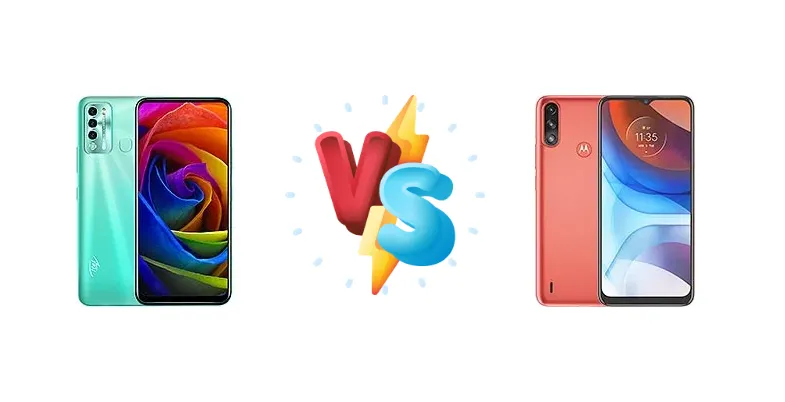
The sub-$150 smartphone market is fiercely competitive. Both the itel Vision 2 and Motorola Moto E7 Power aim to deliver essential smartphone functionality at an incredibly affordable price. However, they take different approaches to achieving this, with the itel relying on a Unisoc chipset and the Motorola opting for MediaTek’s Helio G25. This comparison will dissect their key differences to determine which device offers the best value.
🏆 Quick Verdict
For the average user prioritizing basic functionality and slightly better performance, the Motorola Moto E7 Power is the stronger choice. Its Helio G25 chipset, built on a more efficient 12nm process, provides a noticeable performance edge over the itel Vision 2’s Unisoc SC9863A, despite the clock speed differences. While the itel may offer a slightly larger display, the Motorola’s overall responsiveness and charging capability make it the more practical option.
| Network |
|---|
| 2G bands | GSM 850 / 900 / 1800 / 1900 | GSM 850 / 900 / 1800 / 1900 |
| 3G bands | HSDPA 850 / 900 / 2100 | HSDPA 850 / 900 / 1700(AWS) / 1900 / 2100 |
| 4G bands | LTE | 1, 3, 5, 7, 8, 20, 38, 40, 41 |
| Speed | HSPA, LTE | HSPA, LTE |
| Technology | GSM / HSPA / LTE | GSM / HSPA / LTE |
| Launch |
|---|
| Announced | 2021 | 2021, February 19 |
| Status | Available. Released 2021 | Available. Released 2021, February 26 |
| Body |
|---|
| Build | - | Glass front, plastic back, plastic frame |
| Dimensions | - | 165.1 x 75.9 x 9.2 mm (6.5 x 2.99 x 0.36 in) |
| SIM | Dual SIM | Nano-SIM + Nano-SIM |
| Weight | - | 200 g (7.05 oz) |
| | - | Water-repellent design |
| Display |
|---|
| Resolution | 720 x 1600 pixels, 20:9 ratio (~266 ppi density) | 720 x 1600 pixels, 20:9 ratio (~269 ppi density) |
| Size | 6.6 inches, 105.2 cm2 | 6.51 inches, 103.1 cm2 (~82.3% screen-to-body ratio) |
| Type | IPS LCD | IPS LCD, 380 nits (typ) |
| Platform |
|---|
| CPU | Octa-core (4x1.6 GHz Cortex-A55 & 4x1.2 GHz Cortex-A55) | Octa-core (4x2.0 GHz Cortex-A53 & 4x1.5 GHz Cortex-A53) |
| Chipset | Unisoc SC9863A (28 nm) | Mediatek MT6762G Helio G25 (12 nm) |
| GPU | IMG8322 | PowerVR GE8320 |
| OS | Android 10 (Go edition) | Android 10 |
| Memory |
|---|
| Card slot | microSDXC (dedicated slot) | microSDXC (uses shared SIM slot) |
| Internal | 32GB 2GB RAM | 32GB 2GB RAM, 64GB 4GB RAM |
| | - | eMCP |
| Main Camera |
|---|
| Dual | 13 MP, (wide)
2 MP (macro)
Auxiliary lens | 13 MP, f/2.0, 26mm (wide), 1/3.1", 1.12µm, PDAF
2 MP (macro) |
| Features | LED flash | LED flash, HDR, panorama |
| Video | 1080p@30fps | 1080p@30fps |
| Selfie camera |
|---|
| Features | - | HDR |
| Single | 8 MP | 5 MP, f/2.2, 27mm (wide), 1.12µm |
| Video | Yes | 1080p@30fps |
| Sound |
|---|
| 3.5mm jack | - | Yes |
| 35mm jack | Yes | Yes |
| Loudspeaker | Yes | Yes |
| Comms |
|---|
| Bluetooth | Yes | 5.0, A2DP, LE |
| NFC | No | No |
| Positioning | GPS | GPS, GLONASS, GALILEO |
| Radio | Unspecified | FM radio |
| USB | microUSB | USB Type-C 2.0, OTG |
| WLAN | Yes | Wi-Fi 802.11 b/g/n |
| Features |
|---|
| Sensors | Fingerprint (rear-mounted), accelerometer | Fingerprint (rear-mounted), accelerometer, proximity |
| Battery |
|---|
| Charging | - | 10W wired |
| Type | 4000 mAh | Li-Ion 5000 mAh |
| Misc |
|---|
| Colors | Green | Tahiti Blue, Coral Red |
| Models | - | PAMH0001IN, PAMH0010IN, PAMH0019IN |
| Price | - | About 140 EUR |
itel Vision 2
- Potentially larger display size
- Lower price point (likely)
- Octa-core processor
- Less efficient 28nm chipset
- Likely inferior display quality
- No specified charging capability
Motorola Moto E7 Power
- More efficient 12nm Helio G25 chipset
- 10W wired charging
- Better overall performance
- Potentially smaller display size
- May be slightly more expensive
- Limited gaming capabilities
Display Comparison
Both devices target the entry-level market, so display expectations should be tempered. While specific display specs (resolution, brightness) are missing for the itel Vision 2, it’s likely to feature a lower-quality panel than the Moto E7 Power. The Motorola’s display benefits from the more modern chipset’s image signal processor, potentially offering slightly better color reproduction. Bezels are expected to be substantial on both devices, reflecting their budget nature. The larger screen size of the itel Vision 2 may be preferable for video viewing, but the overall visual experience will likely be inferior to the Moto E7 Power.
Camera Comparison
Camera performance on both devices will be basic. Details regarding sensor sizes and apertures are unavailable, but given the price point, expect low-resolution sensors with limited dynamic range. The Motorola’s Helio G25 chipset includes an image signal processor (ISP) that will likely offer slightly better image processing capabilities than the Unisoc SC9863A, resulting in marginally better photos in good lighting conditions. The presence of a 2MP macro camera on either device is largely a marketing gimmick and should not be a deciding factor. Expect both cameras to struggle in low-light scenarios.
Performance
The core difference lies in the chipsets. The Motorola Moto E7 Power’s MediaTek Helio G25, fabricated on a 12nm process, offers a significant advantage in power efficiency compared to the itel Vision 2’s Unisoc SC9863A (28nm). While the itel boasts an octa-core CPU with a slightly higher peak clock speed (1.6GHz vs 2.0GHz), the Helio G25’s Cortex-A53 cores are generally more efficient than the itel’s Cortex-A55 cores. This translates to smoother multitasking and a more responsive user interface on the Motorola. The 12nm process also implies better thermal management, reducing the likelihood of performance throttling during sustained use. The itel’s older 28nm process will likely struggle with heat under load. Gaming performance will be limited on both, but the Helio G25 will provide a marginally better experience.
Battery Life
The Motorola Moto E7 Power includes 10W wired charging, a significant advantage over the itel Vision 2, which lacks any specified charging capability. While the itel Vision 2 may have a larger battery capacity (specifics unavailable), the more efficient Helio G25 chipset in the Motorola will likely result in comparable, if not better, real-world battery life. The 10W charging on the Motorola allows for a predictable and relatively quick top-up, while the itel may require significantly longer to reach a full charge.
Buying Guide
Buy the itel Vision 2 if you need a larger screen for media consumption and are primarily focused on extremely basic tasks like calls, texts, and light social media use. The lower price point may also be attractive. Buy the Motorola Moto E7 Power if you prefer a more responsive user experience, slightly better gaming capabilities, and the convenience of 10W charging, even if it means a smaller battery capacity. It’s the better all-rounder for everyday use.
Frequently Asked Questions
❓ Will the Helio G25 in the Moto E7 Power handle popular games like PUBG Mobile?
While the Helio G25 can *run* PUBG Mobile, expect to play at the lowest graphics settings and frame rates for a playable experience. It's not a gaming-focused chipset, and performance will be limited. The itel Vision 2 will likely struggle even more due to its less efficient processor.
❓ How long will it take to fully charge the Motorola Moto E7 Power with the 10W charger?
Given the likely battery capacity (around 4000-5000mAh, though unconfirmed), expect a full charge from 0% to 100% to take approximately 3-4 hours with the included 10W charger. This is a standard charging time for budget smartphones with this wattage.
❓ Is the Unisoc SC9863A chipset known to overheat during prolonged use?
The Unisoc SC9863A, built on a 28nm process, is prone to thermal throttling under sustained load. This means that performance will decrease over time as the chip heats up, making it less suitable for demanding tasks like video editing or extended gaming sessions.
❓ Does either phone support fast charging standards like Quick Charge or Power Delivery?
Neither the itel Vision 2 nor the Motorola Moto E7 Power support fast charging standards like Quick Charge or Power Delivery. Both are limited to standard 5W or 10W charging, reflecting their budget positioning.