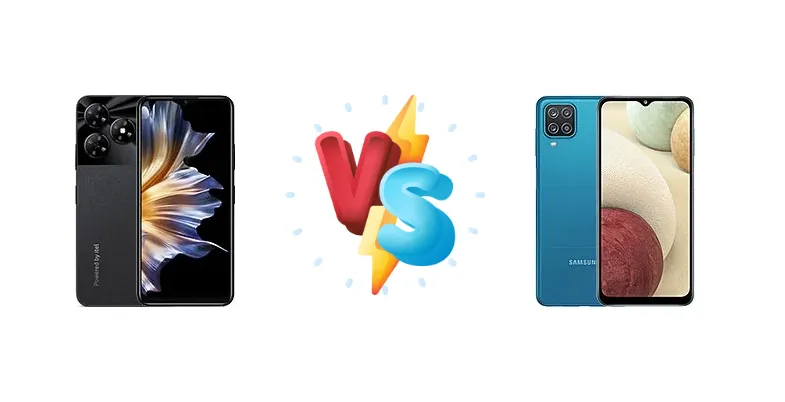
The sub-₹10,000 (approximately $120 USD) smartphone segment is fiercely competitive. We pit the itel TS Pro, a newcomer aiming for value, against the established Samsung Galaxy A12 (India variant) to determine which offers the best blend of features and performance for the price-conscious consumer.
🏆 Quick Verdict
For most users, the Samsung Galaxy A12 (India) is the better choice. While the itel TS Pro attempts to undercut on price, the A12’s significantly more powerful Exynos 850 chipset delivers a smoother, more responsive experience, justifying the slight price premium. The 15W charging is also a welcome addition.
| Network |
|---|
| 2G bands | GSM 850 / 900 / 1800 / 1900 | GSM 850 / 900 / 1800 / 1900 |
| 3G bands | HSDPA 850 / 900 / 2100 | HSDPA 850 / 900 / 2100 |
| 4G bands | LTE | 1, 3, 5, 7, 8, 20, 28, 38, 40, 41 |
| Speed | HSPA, LTE | HSPA 42.2/5.76 Mbps, LTE Cat4 150/50 Mbps |
| Technology | GSM / HSPA / LTE | GSM / HSPA / LTE |
| Launch |
|---|
| Announced | 2025, October | 2021, August 12 |
| Status | Available. Released 2025, October | Available. Released 2021, August 12 |
| Body |
|---|
| Build | Glass front, plastic frame, plastic back | Glass front, plastic back, plastic frame |
| Dimensions | 165 x 76.7 x 9 mm (6.50 x 3.02 x 0.35 in) | 164 x 75.8 x 8.9 mm (6.46 x 2.98 x 0.35 in) |
| SIM | Dual SIM | · Nano-SIM· Nano-SIM + Nano-SIM |
| Weight | 188 g (6.63 oz) | 205 g (7.23 oz) |
| Display |
|---|
| Resolution | 720 x 1600 pixels, 20:9 ratio (~269 ppi density) | 720 x 1600 pixels, 20:9 ratio (~270 ppi density) |
| Size | 6.52 inches, 102.6 cm2 (~81.1% screen-to-body ratio) | 6.5 inches, 102.0 cm2 (~82.1% screen-to-body ratio) |
| Type | IPS LCD | PLS LCD |
| Platform |
|---|
| CPU | Octa-core | Octa-core (4x2.0 GHz Cortex-A55 & 4x2.0 GHz Cortex-A55) |
| Chipset | Unisoc T603 | Exynos 850 (8 nm) |
| GPU | - | Mali-G52 |
| OS | Android 14 | Android 11, upgradable to Android 13, One UI 5.1 |
| Memory |
|---|
| Card slot | microSDXC | microSDXC (dedicated slot) |
| Internal | 64GB 4GB RAM | 64GB 4GB RAM, 128GB 4GB RAM, 128GB 6GB RAM |
| | - | eMMC 5.1 |
| Main Camera |
|---|
| Features | LED flash | LED flash, panorama, HDR |
| Quad | - | 48 MP, f/2.0, 26mm (wide), AF
5 MP, f/2.2, 123˚ (ultrawide)
2 MP (macro)
Auxiliary lens |
| Single | 8 MP | - |
| Video | Yes | 1080p@30fps |
| Selfie camera |
|---|
| Single | 5 MP | 8 MP, f/2.2 |
| Video | Yes | 1080p@30fps |
| Sound |
|---|
| 3.5mm jack | - | Yes |
| 35mm jack | Yes | Yes |
| Loudspeaker | Yes | Yes |
| Comms |
|---|
| Bluetooth | Yes | 5.0, A2DP, LE |
| NFC | No | No |
| Positioning | GPS | GPS, GLONASS, GALILEO, BDS |
| Radio | Unspecified | FM radio, RDS, recording |
| USB | USB Type-C 2.0 | USB Type-C 2.0 |
| WLAN | Yes | Wi-Fi 802.11 b/g/n, Wi-Fi Direct |
| Features |
|---|
| Sensors | Fingerprint (side-mounted); unspecified sensors | Fingerprint (side-mounted), accelerometer |
| | - | Virtual proximity sensing |
| Battery |
|---|
| Charging | 10W wired | 15W wired |
| Type | 4000 mAh | Li-Po 5000 mAh |
| Misc |
|---|
| Colors | Black | Black, Blue, White |
| Models | V651L | SM-A127F, SM-A127F/DS |
| Price | About 50 EUR | About 160 EUR |
| SAR | - | 0.79 W/kg (head) |
itel TS Pro
- Potentially lower price point
- Functional for basic smartphone tasks
- May include features like a headphone jack
- Significantly weaker performance
- Slower charging speed (10W)
- Likely inferior camera quality
Samsung Galaxy A12 (India)
- More powerful Exynos 850 chipset
- Faster 15W charging
- Better camera image processing
- Slightly higher price
- May include bloatware
- Basic LCD display
Display Comparison
Neither device boasts a standout display. Specifics like panel type (IPS vs. TFT) and resolution are missing for the itel TS Pro, suggesting a basic implementation. The Samsung Galaxy A12, while also utilizing a standard LCD, benefits from Samsung’s display tuning. The real difference lies in processing power impacting UI smoothness, not display quality itself. Both likely feature similar 60Hz refresh rates, making them adequate for everyday use but not ideal for fast-paced content.
Camera Comparison
Camera performance is likely to be a weak point on both devices, but the Samsung Galaxy A12 has a slight edge. While both will likely feature a primary camera alongside depth and macro sensors (the latter often being of limited utility), the Exynos 850’s image signal processor (ISP) will offer superior image processing capabilities. The A12’s larger sensor (spec not provided, but typical for Samsung’s A-series) will capture more light, resulting in better low-light photos. Expect significant compromises in image quality on the itel TS Pro, particularly in challenging lighting conditions.
Performance
The Samsung Galaxy A12’s Exynos 850 (8nm) represents a substantial leap in performance over the itel TS Pro’s Unisoc T603. The 8nm fabrication process of the Exynos 850 translates to better power efficiency and, crucially, sustained performance. While both are octa-core CPUs, the Exynos 850’s Cortex-A55 cores, clocked at 2.0 GHz, are more efficient than those likely found in the TS Pro. This means faster app loading times, smoother multitasking, and a more enjoyable gaming experience on the A12. The Unisoc T603 will struggle with demanding applications.
Battery Life
Battery life will be comparable, but charging speeds differ. Both devices likely house batteries in the 4000-5000 mAh range (specific capacity for the itel TS Pro is unknown). However, the Samsung Galaxy A12 supports 15W wired charging, while the itel TS Pro is limited to 10W. This translates to a noticeably faster 0-100% charge time on the A12, reducing downtime. While the A12’s faster charging doesn’t inherently increase battery *life*, it improves the overall user experience.
Buying Guide
Buy the itel TS Pro if your primary need is a basic smartphone for essential tasks like calls, messaging, and light social media use, and you are operating on an extremely tight budget. Buy the Samsung Galaxy A12 (India) if you prioritize a more fluid user experience, occasional gaming, and a more reliable brand reputation, even if it means spending a little more.
Frequently Asked Questions
❓ Does the Exynos 850 in the Galaxy A12 get hot during prolonged gaming sessions?
While the Exynos 850 isn't a flagship chip, its 8nm process helps manage thermals reasonably well. Expect some warming during extended gaming, but it's unlikely to experience significant throttling that severely impacts performance. The itel TS Pro’s Unisoc T603 is more likely to throttle under load due to its less efficient architecture.
❓ Is the 2MP macro camera on either phone actually useful for taking detailed close-up photos?
Generally, 2MP macro cameras on budget smartphones are of limited utility. The low resolution results in images lacking detail and sharpness. They are often included as a marketing feature rather than a genuinely useful camera component. Expect better results simply using the main camera and digitally zooming.
❓ Can the Samsung Galaxy A12 (India) handle popular games like PUBG Mobile at acceptable frame rates?
The Galaxy A12 can run PUBG Mobile, but you'll likely need to stick to medium graphics settings and a moderate frame rate (around 30-40fps) for a smooth experience. The Exynos 850 is capable, but it's not a dedicated gaming chip. The itel TS Pro will struggle to provide a playable experience even at the lowest settings.