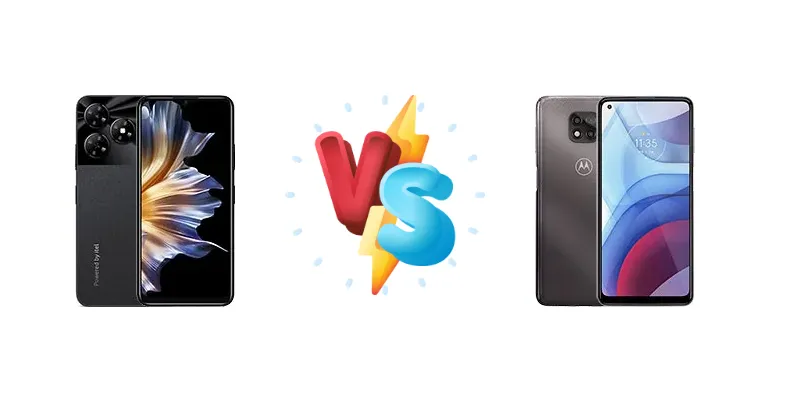
The sub-$200 smartphone market is fiercely competitive. The itel TS Pro and Motorola Moto G Power (2021) both aim to deliver essential features at an accessible price. However, they take different approaches to achieving this, with the Motorola leveraging a more established chipset while the itel opts for a newer, less-proven solution. This comparison dives deep into the specifics to determine which device offers the best value.
🏆 Quick Verdict
For the average user prioritizing consistent performance and a smoother experience, the Motorola Moto G Power (2021) is the better choice. Its Qualcomm Snapdragon 662 chipset provides a noticeable advantage in application loading times and multitasking, outweighing the itel TS Pro’s potentially longer battery life due to its less efficient processor.
| Network |
|---|
| 2G bands | GSM 850 / 900 / 1800 / 1900 | GSM 850 / 900 / 1800 / 1900 |
| 3G bands | HSDPA 850 / 900 / 2100 | HSDPA 850 / 900 / 1700(AWS) / 1900 / 2100 |
| 4G bands | LTE | 1, 2, 3, 4, 5, 7, 8, 12, 13, 14, 17, 25, 26, 29, 30, 38, 41, 66, 71 |
| Speed | HSPA, LTE | HSPA, LTE |
| Technology | GSM / HSPA / LTE | GSM / CDMA / HSPA / EVDO / LTE |
| | - | CDMA2000 1xEV-DO |
| Launch |
|---|
| Announced | 2025, October | 2021, January 08 |
| Status | Available. Released 2025, October | Available. Released 2021, January 14 |
| Body |
|---|
| Build | Glass front, plastic frame, plastic back | Glass front, plastic back, plastic frame |
| Dimensions | 165 x 76.7 x 9 mm (6.50 x 3.02 x 0.35 in) | 165.3 x 75.9 x 9.5 mm (6.51 x 2.99 x 0.37 in) |
| SIM | Dual SIM | Nano-SIM |
| Weight | 188 g (6.63 oz) | 206.5 g (7.30 oz) |
| | - | Water-repellent coating |
| Display |
|---|
| Resolution | 720 x 1600 pixels, 20:9 ratio (~269 ppi density) | 720 x 1600 pixels, 20:9 ratio (~266 ppi density) |
| Size | 6.52 inches, 102.6 cm2 (~81.1% screen-to-body ratio) | 6.6 inches, 105.2 cm2 (~83.8% screen-to-body ratio) |
| Type | IPS LCD | IPS LCD |
| Platform |
|---|
| CPU | Octa-core | Octa-core (4x2.0 GHz Kryo 260 Gold & 4x1.8 GHz Kryo 260 Silver) |
| Chipset | Unisoc T603 | Qualcomm SM6115 Snapdragon 662 (11 nm) |
| GPU | - | Adreno 610 |
| OS | Android 14 | Android 10 |
| Memory |
|---|
| Card slot | microSDXC | microSDXC (dedicated slot) |
| Internal | 64GB 4GB RAM | 32GB 3GB RAM, 64GB 4GB RAM |
| | - | eMMC 5.1 |
| Main Camera |
|---|
| Features | LED flash | LED flash, HDR, panorama |
| Single | 8 MP | - |
| Triple | - | 48 MP, f/1.7, (wide), 1/2.0", 0.8µm, PDAF
2 MP (macro)
Auxiliary lens |
| Video | Yes | 1080p@30/60fps, gyro-EIS |
| Selfie camera |
|---|
| Features | - | HDR |
| Single | 5 MP | 8 MP, f/2.0, 1.12µm |
| Video | Yes | 1080p@30fps, gyro-EIS |
| Sound |
|---|
| 3.5mm jack | - | Yes |
| 35mm jack | Yes | Yes |
| Loudspeaker | Yes | Yes |
| Comms |
|---|
| Bluetooth | Yes | 5.0, A2DP, LE |
| NFC | No | No |
| Positioning | GPS | GPS, GLONASS, GALILEO |
| Radio | Unspecified | FM radio |
| USB | USB Type-C 2.0 | USB Type-C 2.0 |
| WLAN | Yes | Wi-Fi 802.11 a/b/g/n/ac, dual-band, Wi-Fi Direct |
| Features |
|---|
| Sensors | Fingerprint (side-mounted); unspecified sensors | Fingerprint (side-mounted), accelerometer, gyro, proximity, compass, barometer |
| Battery |
|---|
| Charging | 10W wired | 15W wired |
| Type | 4000 mAh | Li-Po 5000 mAh |
| Misc |
|---|
| Colors | Black | Flash Gray, Polar Silver |
| Models | V651L | - |
| Price | About 50 EUR | About 60 EUR |
itel TS Pro
- Potentially longer battery life due to less powerful chipset.
- Lower price point (likely).
- May offer expandable storage via microSD card (common in this segment).
- Significantly weaker performance compared to the Snapdragon 662.
- Slower 10W charging.
- Unisoc chipset may have limited software support.
Motorola Moto G Power (2021)
- Superior performance with the Qualcomm Snapdragon 662.
- Faster 15W charging.
- More established brand reputation and software support.
- Better image processing capabilities.
- Potentially shorter battery life compared to the itel TS Pro.
- May be slightly more expensive.
Display Comparison
Neither device is expected to boast a premium display experience. Specifics like panel type (IPS vs. LCD) and resolution are not provided, but both likely target a 720p+ resolution. The key difference lies in processing power impacting UI smoothness. The Motorola’s more powerful chipset will contribute to a more fluid scrolling experience. Bezels are likely comparable given the price point, and color accuracy is unlikely to be a strong suit for either.
Camera Comparison
Without detailed sensor information, a direct camera comparison is difficult. However, it’s safe to assume both phones feature a primary camera alongside supporting lenses (likely depth or macro). The Motorola’s image signal processor (ISP) within the Snapdragon 662 will likely offer superior image processing capabilities, resulting in better dynamic range and noise reduction. The itel TS Pro’s Unisoc chipset likely has a less sophisticated ISP. Focusing on the main sensor is crucial; any 2MP macro or depth sensors on either device will likely offer limited practical benefit.
Performance
The Motorola Moto G Power (2021) holds a significant advantage in performance thanks to its Qualcomm Snapdragon 662 (11nm). This chipset features a Kryo CPU architecture with a clear performance split – 4x2.0 GHz cores for demanding tasks and 4x1.8 GHz cores for efficiency. The itel TS Pro, powered by the Unisoc T603, lacks this architectural refinement. While both are octa-core, the Snapdragon 662’s manufacturing process (11nm) is more efficient and delivers superior sustained performance, reducing the likelihood of throttling during extended use. This translates to faster app loading, smoother multitasking, and a more enjoyable gaming experience on the Motorola.
Battery Life
The Motorola Moto G Power (2021) features 15W wired charging, while the itel TS Pro is limited to 10W. While the Motorola’s battery capacity isn’t specified, the G Power line is known for prioritizing battery life. The Unisoc T603 in the itel TS Pro, being less power-efficient, may require more frequent charging despite potentially having a larger battery capacity. The faster charging speed of the Motorola will also reduce downtime, making it more convenient for users who need to quickly top up their device.
Buying Guide
Buy the itel TS Pro if you absolutely prioritize maximizing battery life above all else and primarily use your phone for very basic tasks like calls, texts, and light social media. Buy the Motorola Moto G Power (2021) if you want a more responsive and capable device for everyday use, including streaming video, browsing the web, and occasional gaming, even if it means slightly less battery endurance.
Frequently Asked Questions
❓ Will the Unisoc T603 in the itel TS Pro struggle with popular apps like TikTok or Instagram?
Yes, the Unisoc T603 is a lower-tier chipset and may exhibit noticeable lag or slowdowns when running demanding apps like TikTok or Instagram, especially with multiple apps open simultaneously. The Motorola Moto G Power (2021)'s Snapdragon 662 will handle these apps much more smoothly.
❓ How long will it realistically take to fully charge the Motorola Moto G Power (2021) with the 15W charger?
While Motorola doesn't provide exact figures, expect a full charge from 0% to 100% to take approximately 2-3 hours with the included 15W charger. This is significantly faster than the itel TS Pro's 10W charging, which could take upwards of 4 hours.
❓ Is the Motorola Moto G Power (2021) a good choice for mobile gaming?
The Motorola Moto G Power (2021) can handle casual mobile games without issue. However, for graphically intensive titles like PUBG Mobile or Call of Duty Mobile, you'll likely need to lower the graphics settings to achieve a playable frame rate. The Unisoc T603 in the itel TS Pro will struggle even more with these games.