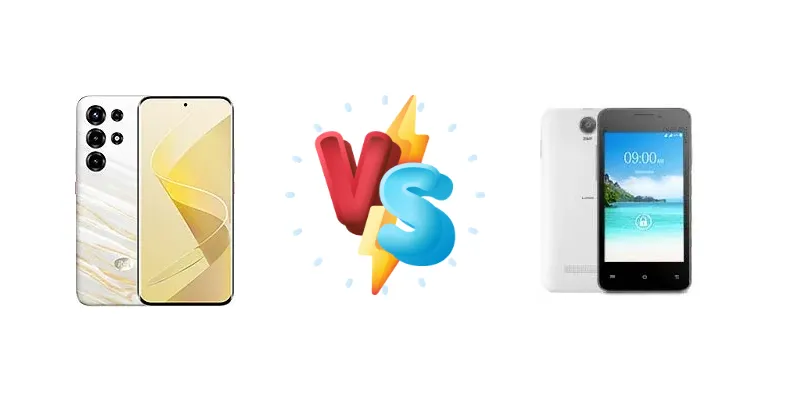
The itel Super 26 Ultra and Lava A32 represent opposite ends of the entry-level smartphone spectrum. The itel boasts a modern 6nm chipset, while the Lava relies on a significantly older and slower 1 GHz processor. This comparison dissects the implications of this core difference, and examines where each phone finds its niche.
🏆 Quick Verdict
For the vast majority of users, the itel Super 26 Ultra is the clear winner. Its Unisoc T7300 chipset delivers a dramatically smoother and more responsive experience than the Lava A32’s 1 GHz processor, making it suitable for more than just basic calling and texting. The Lava A32 may appeal to those with extremely minimal needs.
| Network |
|---|
| 2G bands | GSM 850 / 900 / 1800 / 1900 | GSM 900 / 1800 - SIM 1 & SIM 2 |
| 3G bands | HSDPA 850 / 900 / 2100 | HSDPA 2100 |
| 4G bands | LTE | - |
| Speed | HSPA, LTE | HSPA |
| Technology | GSM / HSPA / LTE | GSM / HSPA |
| Launch |
|---|
| Announced | 2025, September 05 | 2016, July. Released 2016, July |
| Status | Available. Released 2025, September 15 | Discontinued |
| Body |
|---|
| Dimensions | 6.8 mm thickness | 124.4 x 64.6 x 10.8 mm (4.90 x 2.54 x 0.43 in) |
| SIM | Nano-SIM + Nano-SIM | Dual SIM |
| Weight | 168 g (5.93 oz) | 92 g (3.25 oz) |
| Display |
|---|
| Protection | Corning Gorilla Glass 7i | - |
| Resolution | 1080 x 2436 pixels (~392 ppi density) | 480 x 800 pixels, 5:3 ratio (~233 ppi density) |
| Size | 6.8 inches, 110.5 cm2 | 4.0 inches, 45.5 cm2 (~56.7% screen-to-body ratio) |
| Type | AMOLED, 1B colors, 144Hz, PWM, HDR, 4500 nits (peak) | TFT, 256K colors |
| Platform |
|---|
| CPU | Octa-core (2x2.2 GHz Cortex-A78 & 6x2.0 GHz Cortex-A55) | 1 GHz |
| Chipset | Unisoc T7300 (6 nm) | - |
| GPU | Mali-G57 MP2 | - |
| OS | Android 15, itel OS 15 | Android OS |
| Memory |
|---|
| Card slot | Unspecified | microSDHC |
| Internal | 128GB 8GB RAM, 256GB 8GB RAM | 512MB 256MB RAM |
| Main Camera |
|---|
| Dual | 50 MP, f/1.6, (wide), AF
XX MP (macro)
Auxiliary lens | - |
| Features | LED flash, HDR, panorama | LED flash |
| Single | - | 2 MP |
| Video | 1440p@30fps, 1080p@30fps | Yes |
| Selfie camera |
|---|
| Single | 32 MP | VGA |
| Video | 1440p@30fps, 1080p@30fps | - |
| Sound |
|---|
| 3.5mm jack | - | Yes |
| 35mm jack | No | Yes |
| Loudspeaker | Yes | Yes |
| Comms |
|---|
| Bluetooth | Yes | 2.1 |
| Infrared port | Yes | - |
| NFC | Yes (market/region dependent) | No |
| Positioning | GPS | GPS |
| Radio | Unspecified | FM radio |
| USB | USB Type-C 2.0 | microUSB 2.0 |
| WLAN | Yes | Wi-Fi 802.11 b/g/n, hotspot |
| Features |
|---|
| Sensors | Fingerprint (under display, optical), unspecified sensors | Accelerometer |
| Battery |
|---|
| Charging | 18W wired | - |
| Type | 6000 mAh | Li-Ion 1500 mAh, removable |
| Misc |
|---|
| Colors | Silver, Blue, Gold, Silver/Gold | Black, White |
itel Super 26 Ultra
- Significantly faster processor for smooth performance
- More efficient 6nm chipset for better battery life
- Faster 18W wired charging
- Potential for better camera image processing
- Specific display details are unknown
- May be slightly more expensive than the Lava A32
Lava A32
- Extremely affordable
- Simple and easy to use for basic tasks
- Potentially longer standby time due to minimal power draw
- Extremely slow processor leading to significant lag
- Poor multitasking capabilities
- Limited app compatibility
- Slow charging (likely)
Display Comparison
Display specifications are not provided for either device. However, given the price points, it's reasonable to assume both utilize LCD panels. The itel Super 26 Ultra's more powerful chipset suggests it could potentially drive a higher resolution or refresh rate display, offering a sharper and smoother visual experience. Without specific data, it's difficult to assess color accuracy or brightness levels, but the chipset advantage hints at a superior display capability for the itel.
Camera Comparison
Camera details are limited. Without sensor size or aperture information, a direct comparison is difficult. However, the itel Super 26 Ultra’s processing power allows for more sophisticated image processing algorithms, potentially resulting in better dynamic range and noise reduction. The Lava A32’s limited processing capabilities will likely result in slower image capture and less effective image processing. Any 2MP macro or depth sensors on either device are likely to offer minimal benefit due to their small sensor size.
Performance
The performance gap between these two devices is immense. The itel Super 26 Ultra’s Unisoc T7300, built on a 6nm process, features an octa-core configuration with Cortex-A78 performance cores clocked at 2.2 GHz, paired with six Cortex-A55 efficiency cores at 2.0 GHz. This architecture is designed for efficient multitasking and moderate gaming. In stark contrast, the Lava A32’s 1 GHz CPU is a single-core processor, likely based on an older ARM architecture. This means the Lava A32 will struggle with even basic tasks like web browsing or opening multiple apps, experiencing significant lag and slowdown. The 6nm fabrication process of the Unisoc T7300 also contributes to better thermal efficiency, reducing throttling during sustained workloads.
Battery Life
Battery capacity is not specified for either device. The itel Super 26 Ultra’s 18W wired charging is a significant advantage, allowing for faster replenishment of the battery. The Lava A32’s charging speed is unknown, but likely significantly slower. While a larger battery capacity on the Lava A32 could offset the slower charging, the more efficient Unisoc T7300 in the itel Super 26 Ultra will likely result in comparable or even better real-world battery life, despite potentially having a smaller capacity.
Buying Guide
Buy the itel Super 26 Ultra if you need a phone capable of handling modern apps, multitasking, and occasional gaming. Its superior processing power ensures a fluid user experience. Buy the Lava A32 if your primary requirement is a device for basic communication – calls and texts – and you prioritize simplicity above all else, and are on an extremely tight budget.
Frequently Asked Questions
❓ Will the itel Super 26 Ultra be able to run popular social media apps like Facebook and Instagram smoothly?
Yes, the Unisoc T7300 chipset in the itel Super 26 Ultra is more than capable of running popular social media apps smoothly. The octa-core processor and ample RAM (spec not provided, but likely sufficient for these apps) will ensure a responsive experience, unlike the Lava A32 which would likely struggle.
❓ Is the Lava A32 suitable for someone who primarily uses their phone for making calls and sending text messages?
Yes, the Lava A32 is perfectly adequate for basic communication – making calls and sending text messages. However, it's important to understand that it will be significantly slower and less responsive than modern smartphones when attempting anything beyond these core functions.
❓ Can I play games on the itel Super 26 Ultra?
The itel Super 26 Ultra can handle casual gaming. While it won't run demanding titles at maximum settings, the Unisoc T7300 chipset provides enough power for less graphically intensive games. The Lava A32 is unlikely to be able to run most modern games at all.