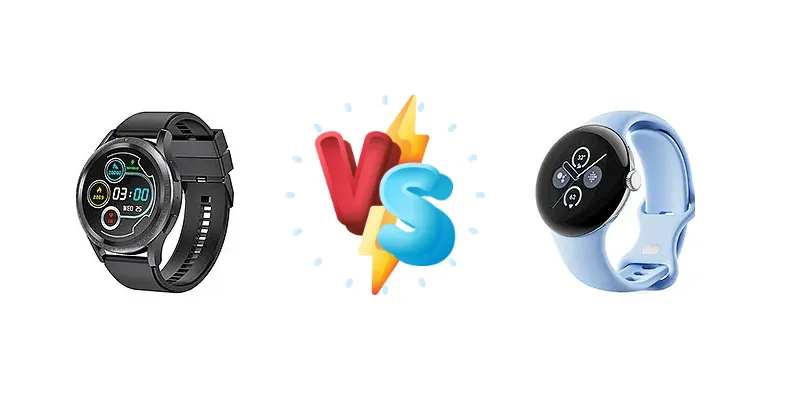
The smartwatch market caters to a wide range of budgets and needs. We pit the entry-level itel Smartwatch 1GS against Google’s premium Pixel Watch 2 to determine which offers the best value and functionality. This comparison focuses on understanding the trade-offs between affordability and advanced features, particularly given the limited publicly available specifications for the itel device.
🏆 Quick Verdict
For the average user prioritizing a feature-rich experience and seamless integration with the Google ecosystem, the Google Pixel Watch 2 is the clear winner. However, if budget is the primary concern and basic smartwatch functionality is sufficient, the itel Smartwatch 1GS presents a potentially viable, though largely unknown, option.
| Network |
|---|
| 2G bands | N/A | GSM 850 / 900 / 1800 / 1900 |
| 3G bands | N/A | HSDPA 850 / 900 / 1700(AWS) / 1900 / 2100 |
| 4G bands | N/A | LTE |
| EDGE | No | - |
| GPRS | No | - |
| Speed | No | HSPA, LTE |
| Technology | No cellular connectivity | GSM / HSPA / LTE |
| Launch |
|---|
| Announced | 2022 | 2023, October 04 |
| Status | Available. Released 2022 | Available. Released 2023, October 12 |
| Body |
|---|
| Build | Aluminum frame, plastic back | Glass front (Gorilla Glass 5), aluminum frame |
| Dimensions | - | 41 x 41 x 12.3 mm (1.61 x 1.61 x 0.48 in) |
| SIM | No | eSIM |
| Weight | - | 31 g (1.09 oz) |
| Display |
|---|
| Protection | - | Corning Gorilla Glass 5 |
| Resolution | 360 x 360 pixels (~386 ppi density) | 450 x 450 pixels (~320 ppi density) |
| Size | 1.32 inches | 1.2 inches |
| Type | IPS LCD | AMOLED, 1000 nits (peak) |
| Platform |
|---|
| Chipset | - | Qualcomm 5100 |
| OS | Proprietary OS | Android Wear OS 4 |
| Memory |
|---|
| Card slot | No | No |
| Internal | Unspecified storage | 32GB 2GB RAM |
| Sound |
|---|
| 35mm jack | No | No |
| Loudspeaker | Yes | Yes |
| Comms |
|---|
| Bluetooth | Yes | 5.0, A2DP, LE |
| NFC | No | Yes |
| Positioning | No | GPS, GLONASS, GALILEO, BDS, QZSS |
| Radio | No | No |
| USB | No | No |
| WLAN | No | Wi-Fi 802.11 b/g/n |
| Features |
|---|
| Sensors | Accelerometer, heart rate, SpO2 | Accelerometer, gyro, heart rate, altimeter, compass, SpO2, thermometer (skin temperature), skin conductance |
| Battery |
|---|
| Charging | - | Wired, 80% in 45 min |
| Type | 250 mAh | Li-Ion 306 mAh |
| Misc |
|---|
| Colors | Black | Polished Silver, Matte Black, Champagne Gold |
| Models | - | G4TSL, GC3G8, GD2WG |
| Price | - | About 160 EUR |
itel Smartwatch 1GS
- Potentially very affordable price point
- Basic smartwatch functionality (notifications, time)
- May offer acceptable battery life for basic use
- Limited specifications and unknown performance
- Likely inferior display quality
- Limited feature set compared to competitors
Google Pixel Watch 2
- Powerful Qualcomm 5100 chipset for smooth performance
- Advanced health tracking features (ECG, SpO2)
- Seamless Google Assistant integration
- Higher price point
- Battery life may require daily charging
- Smaller display size compared to some competitors
Display Comparison
Given the lack of display specifications for the itel Smartwatch 1GS, a direct comparison is difficult. The Google Pixel Watch 2 features a circular AMOLED display, likely with high brightness for outdoor visibility. The Pixel Watch 2’s display benefits from the Qualcomm 5100’s image processing capabilities, ensuring vibrant colors and sharp details. Itel likely utilizes a lower-resolution LCD or TFT panel to maintain its price point, potentially impacting color accuracy and viewing angles. The Pixel Watch 2’s display is also protected by Corning Gorilla Glass, offering superior scratch resistance.
Camera Comparison
Neither device is marketed for its camera capabilities, and the itel Smartwatch 1GS is unlikely to include a camera at all. The Pixel Watch 2 does not feature a camera. Therefore, this comparison is largely irrelevant, focusing instead on the processing power needed for features like image display and data analysis from connected sensors.
Performance
The Google Pixel Watch 2 is powered by the Qualcomm 5100 chipset, a significant advantage over the itel Smartwatch 1GS, which likely uses a significantly less powerful, and unconfirmed, processor. The 5100’s architecture allows for smoother animations, faster app loading times, and more responsive interactions. While the itel device may handle basic notifications and timekeeping adequately, it will likely struggle with more demanding tasks or complex watch faces. The Qualcomm chipset also enables advanced features like always-on display and sophisticated health tracking algorithms.
Battery Life
The Google Pixel Watch 2 offers 80% charge in 45 minutes, indicating a reasonable charging speed. The itel Smartwatch 1GS’s battery capacity and charging time are unknown, but given its lower price point, it likely features a smaller battery and slower charging. The Qualcomm 5100 in the Pixel Watch 2 is designed for power efficiency, potentially offsetting its higher processing demands. Users prioritizing all-day battery life will likely find the Pixel Watch 2 more reliable, especially with its optimized power management features.
Buying Guide
Buy the itel Smartwatch 1GS if you need a basic smartwatch for notifications, timekeeping, and rudimentary fitness tracking, and are operating on a very tight budget. Buy the Google Pixel Watch 2 if you prioritize advanced health tracking (ECG, SpO2), a premium design, seamless Google Assistant integration, and a more responsive user experience powered by the Qualcomm 5100 chipset.
Frequently Asked Questions
❓ Given the limited information on the itel Smartwatch 1GS, how reliable is its fitness tracking compared to the Pixel Watch 2's advanced sensors?
The Pixel Watch 2 utilizes sophisticated sensors and algorithms powered by the Qualcomm 5100 to provide accurate heart rate monitoring, ECG readings, and SpO2 measurements. The itel Smartwatch 1GS likely employs simpler sensors, resulting in less precise data and a limited range of tracked metrics. Users prioritizing accurate health insights should opt for the Pixel Watch 2.
❓ Does the Qualcomm 5100 chipset in the Pixel Watch 2 contribute to a noticeable improvement in app responsiveness and overall user experience?
Yes, the Qualcomm 5100 significantly enhances the Pixel Watch 2’s performance. Its architecture allows for faster app loading times, smoother animations, and more fluid interactions. This is particularly noticeable when using complex watch faces or running multiple apps simultaneously. The itel Smartwatch 1GS, with its likely less powerful processor, will likely exhibit lag and slower response times.
❓ What kind of software updates can itel Smartwatch 1GS users expect, and how does this compare to Google's commitment to Pixel Watch 2 updates?
Google provides guaranteed software updates for the Pixel Watch 2, including feature enhancements and security patches, for several years. Itel's track record with software support for its smartwatches is less established. Users of the itel Smartwatch 1GS should anticipate fewer updates, potentially limiting the device's longevity and access to new features.