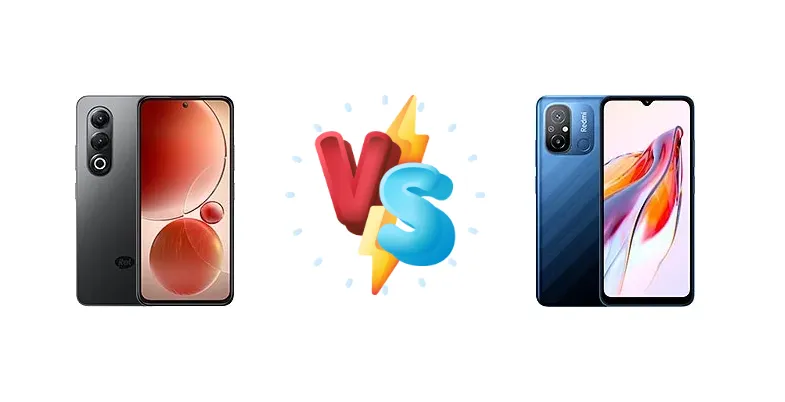
The sub-$150 smartphone market is fiercely competitive. Both the itel S25 and Xiaomi Redmi 12C aim to deliver essential features at an accessible price point. However, they take different approaches to achieving this, primarily through their chipset choices and charging capabilities. This comparison dissects those differences to determine which phone offers the best value.
🏆 Quick Verdict
For users prioritizing sustained performance and faster charging, the itel S25 emerges as the stronger contender. Its Unisoc T620, while not a powerhouse, offers a slightly more efficient architecture and supports 18W charging, a significant advantage over the Redmi 12C’s 10W charging.
| Network |
|---|
| 2G bands | GSM 850 / 900 / 1800 / 1900 | GSM 850 / 900 / 1800 / 1900 |
| 3G bands | HSDPA 850 / 900 / 2100 | HSDPA 850 / 900 / 2100 |
| 4G bands | LTE | 1, 3, 5, 7, 8, 20, 28, 38, 40, 41 - International |
| Speed | HSPA, LTE | HSPA, LTE |
| Technology | GSM / HSPA / LTE | GSM / CDMA / HSPA / EVDO / LTE |
| | - | CDMA2000 1xEV-DO |
| Launch |
|---|
| Announced | 2024, November 09 | 2022, December 31 |
| Status | Available. Released 2024, November | Available. Released 2023, January 01 |
| Body |
|---|
| Dimensions | 7.3 mm thickness | 168.8 x 76.4 x 8.8 mm (6.65 x 3.01 x 0.35 in) |
| SIM | Nano-SIM + Nano-SIM | Nano-SIM + Nano-SIM |
| Weight | 185 g (6.53 oz) | 192 g (6.77 oz) |
| Display |
|---|
| Resolution | 1080 x 2436 pixels (~393 ppi density) | 720 x 1650 pixels (~268 ppi density) |
| Size | 6.78 inches, 109.9 cm2 | 6.71 inches, 106.5 cm2 (~82.6% screen-to-body ratio) |
| Type | AMOLED, 1B colors, 120Hz, 1200 nits (HBM), 1800 nits (peak) | IPS LCD, 500 nits (typ) |
| Platform |
|---|
| CPU | Octa-core (2x2.2 GHz Cortex-A75 & 6xX.X GHz Cortex-A55) | Octa-core (2x2.0 GHz Cortex-A75 & 6x1.8 GHz Cortex-A55) |
| Chipset | Unisoc T620 (12 nm) | Mediatek MT6769Z Helio G85 (12 nm) |
| GPU | - | Mali-G52 MC2 |
| OS | Android 14, up to 2 major Android upgrades, itel OS 14.5 | Android 12, MIUI 13 |
| Memory |
|---|
| Card slot | Unspecified | microSDXC (dedicated slot) |
| Internal | 128GB 6GB RAM, 128GB 8GB RAM | 32GB 2GB RAM, 32GB 3GB RAM, 32GB 4GB RAM, 64GB 3GB RAM, 64GB 4GB RAM, 128GB 3GB RAM, 128GB 4GB RAM, 128GB 6GB RAM |
| | - | eMMC 5.1 |
| Main Camera |
|---|
| Dual | - | 50 MP, (wide), PDAF
0.08 MP (depth) |
| Features | Ring-LED flash, panorama, HDR | LED flash, HDR |
| Single | 50 MP, f/1.6, (wide), 0.64µm, AF
Auxiliary lens | 50 MP, f/1.8, (wide), 1/2.76", PDAF
Auxiliary lens |
| Video | 1440p@30fps, 1080p@30fps | 1080p@30fps |
| Selfie camera |
|---|
| Single | 32 MP, f/2.2, 22mm (wide) | 5 MP, f/2.2, (wide) |
| Video | 1440p@30fps, 1080p@30fps | 1080p@30fps |
| Sound |
|---|
| 3.5mm jack | - | Yes |
| 35mm jack | Yes | Yes |
| Loudspeaker | Yes | Yes |
| Comms |
|---|
| Bluetooth | Yes | 5.1, A2DP, LE |
| Infrared port | Yes | - |
| NFC | Yes (market/region dependent) | Yes (market/region dependent) |
| Positioning | GPS | GPS, GLONASS, BDS, GALILEO |
| Radio | Unspecified | FM radio |
| USB | USB Type-C 2.0 | microUSB 2.0 |
| WLAN | Yes | Wi-Fi 802.11 a/b/g/n/ac, dual-band, Wi-Fi Direct |
| Features |
|---|
| Sensors | Fingerprint (under display, optical), unspecified sensors | Fingerprint (rear-mounted), accelerometer |
| | - | Virtual proximity sensing |
| Battery |
|---|
| Charging | 18W wired, bypass charging | 10W wired |
| Type | 5000 mAh | Li-Po 5000 mAh |
| Misc |
|---|
| Colors | Bromo Black, Mambo Mint, Sahara Gleam | Graphite Gray, Ocean Blue, Mint Green, Lavender Purple |
| Models | S685LN | 22120RN86G, 22120RN86I, 22126RN91Y, 2212ARNC4L |
| Price | About 100 EUR | £ 132.99 / € 107.41 |
| SAR | - | 1.08 W/kg (head) 0.64 W/kg (body) |
| SAR EU | - | 0.98 W/kg (head) 0.99 W/kg (body) |
itel S25
- Faster 18W charging with bypass charging
- Potentially better single-core performance due to higher clocked A75 cores
- Slightly more efficient chipset architecture
- Less brand recognition than Xiaomi
- Camera performance likely similar to Redmi 12C
Xiaomi Redmi 12C
- Strong brand reputation and community support
- Potentially slightly better GPU performance for gaming
- Wider availability in some markets
- Significantly slower 10W charging
- Lower clocked A75 cores compared to itel S25
- Less efficient chipset
Display Comparison
Neither device boasts a standout display. Both likely utilize LCD panels, common in this price bracket. Detailed specs like peak brightness and color gamut coverage are unavailable, but we can infer that both will offer adequate, but not exceptional, viewing experiences. Bezels are likely comparable, prioritizing cost-effectiveness over premium aesthetics. The absence of high refresh rates is expected.
Camera Comparison
Camera performance is likely to be similar, relying heavily on software processing. Both phones likely feature a primary camera and depth/macro sensors. Without specific sensor size or aperture information, it’s difficult to make a definitive judgment. The Redmi 12C’s camera system is likely more widely discussed due to Xiaomi’s larger user base, but the itel S25’s image processing could offer a different aesthetic. The inclusion of a 2MP macro camera on both devices is largely a marketing tactic, offering limited practical benefit.
Performance
The core difference lies in the chipsets. The itel S25’s Unisoc T620 (12nm) features a dual-cluster configuration with 2x2.2 GHz Cortex-A75 cores and 6xX.X GHz Cortex-A55 cores. The Redmi 12C’s MediaTek Helio G85 (12nm) also employs a similar dual-cluster setup, but with slightly lower clocked 2x2.0 GHz Cortex-A75 cores and 6x1.8 GHz Cortex-A55 cores. While both are 12nm chips, the higher clock speeds on the A75 cores of the T620 suggest a slight edge in single-core performance, beneficial for app launch times and responsiveness. The Helio G85 is known for its decent GPU performance, potentially offering a marginal advantage in gaming, but the T620’s architecture may provide better sustained performance due to potentially improved thermal management.
Battery Life
Both phones likely house batteries in the 5000mAh range, typical for this segment. However, the charging speeds are drastically different. The itel S25 supports 18W wired charging with bypass charging, allowing for simultaneous charging and usage. The Redmi 12C is limited to 10W charging. This translates to a significantly faster 0-100% charge time for the itel S25, a crucial advantage for users who need to quickly top up their battery.
Buying Guide
Buy the itel S25 if you need a phone that can handle moderate multitasking and benefits from quicker charging times, making it ideal for users who are frequently on the go. Buy the Xiaomi Redmi 12C if you prioritize brand recognition within the Xiaomi ecosystem and are comfortable with slower charging speeds, focusing on basic smartphone functionality.
Frequently Asked Questions
❓ Will the Unisoc T620 in the itel S25 struggle with demanding games like PUBG Mobile?
While the Unisoc T620 isn't a gaming powerhouse, it should be capable of running PUBG Mobile at medium settings with reasonable frame rates. However, expect some frame drops during intense action. The Helio G85 in the Redmi 12C might offer a slight edge in GPU performance, but the T620’s architecture could provide more consistent performance over longer gaming sessions.
❓ How much faster is the 18W charging on the itel S25 compared to the 10W charging on the Redmi 12C?
The difference is substantial. 18W charging will significantly reduce the time it takes to fully charge the itel S25, potentially shaving off over an hour compared to the Redmi 12C. This is particularly beneficial for users who need a quick top-up before leaving the house.
❓ Does the itel S25 support reverse charging?
No, neither the itel S25 nor the Xiaomi Redmi 12C support reverse wireless charging. Both phones focus on providing basic charging functionality rather than advanced features like reverse charging.
❓ Is the difference in CPU clock speed between the Unisoc T620 and Helio G85 noticeable in everyday use?
The difference is subtle but present. The higher clock speed on the itel S25’s A75 cores will result in slightly faster app launch times and smoother multitasking. However, for basic tasks like browsing and social media, the difference will be minimal.