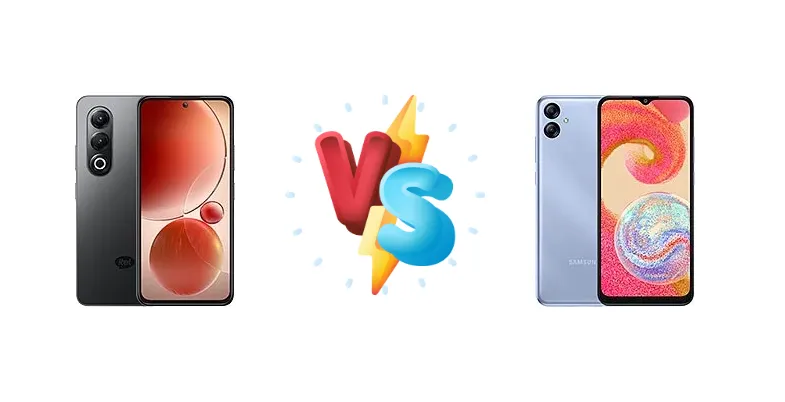
The itel S25 and Samsung Galaxy A04e represent the extreme end of the budget smartphone spectrum. Both aim to deliver essential smartphone functionality at the lowest possible price point, but they take different approaches to achieving this. This comparison dissects their core components to determine which offers the best value for users prioritizing performance and everyday usability.
🏆 Quick Verdict
For the average user seeking a smoother, more responsive experience, the itel S25 emerges as the better choice. Its Unisoc T620 chipset, featuring Cortex-A75 cores, provides a noticeable performance advantage over the Samsung Galaxy A04e’s older Helio P35, making it better suited for multitasking and moderate gaming.
| Network |
|---|
| 2G bands | GSM 850 / 900 / 1800 / 1900 | GSM 850 / 900 / 1800 / 1900 |
| 3G bands | HSDPA 850 / 900 / 2100 | HSDPA 850 / 900 / 2100 |
| 4G bands | LTE | 1, 3, 5, 7, 8, 20, 28, 38, 40, 41 |
| Speed | HSPA, LTE | HSPA, LTE |
| Technology | GSM / HSPA / LTE | GSM / HSPA / LTE |
| Launch |
|---|
| Announced | 2024, November 09 | 2022, October 21 |
| Status | Available. Released 2024, November | Available. Released 2022, November 07 |
| Body |
|---|
| Build | - | Glass front, plastic back, plastic frame |
| Dimensions | 7.3 mm thickness | 164.2 x 75.9 x 9.1 mm (6.46 x 2.99 x 0.36 in) |
| SIM | Nano-SIM + Nano-SIM | · Nano-SIM· Nano-SIM + Nano-SIM |
| Weight | 185 g (6.53 oz) | 188 g (6.63 oz) |
| Display |
|---|
| Resolution | 1080 x 2436 pixels (~393 ppi density) | 720 x 1600 pixels, 20:9 ratio (~270 ppi density) |
| Size | 6.78 inches, 109.9 cm2 | 6.5 inches, 102.0 cm2 (~81.8% screen-to-body ratio) |
| Type | AMOLED, 1B colors, 120Hz, 1200 nits (HBM), 1800 nits (peak) | PLS LCD |
| Platform |
|---|
| CPU | Octa-core (2x2.2 GHz Cortex-A75 & 6xX.X GHz Cortex-A55) | Octa-core (4x2.3 GHz Cortex-A53 & 4x1.8 GHz Cortex-A53) |
| Chipset | Unisoc T620 (12 nm) | Mediatek MT6765 Helio P35 (12 nm) |
| GPU | - | PowerVR GE8320 |
| OS | Android 14, up to 2 major Android upgrades, itel OS 14.5 | Android 12, One UI Core 4.1 |
| Memory |
|---|
| Card slot | Unspecified | microSDXC (dedicated slot) |
| Internal | 128GB 6GB RAM, 128GB 8GB RAM | 32GB 2GB RAM, 32GB 3GB RAM, 32GB 4GB RAM, 64GB 2GB RAM, 64GB 3GB RAM, 64GB 4GB RAM, 128GB 4GB RAM |
| Main Camera |
|---|
| Dual | - | 13 MP, f/2.2, (wide), AF
Auxiliary lens |
| Features | Ring-LED flash, panorama, HDR | LED flash |
| Single | 50 MP, f/1.6, (wide), 0.64µm, AF
Auxiliary lens | 5 MP, f/2.2 |
| Video | 1440p@30fps, 1080p@30fps | 1080p@30fps |
| Selfie camera |
|---|
| Single | 32 MP, f/2.2, 22mm (wide) | 5 MP, f/2.2 |
| Video | 1440p@30fps, 1080p@30fps | Yes |
| Sound |
|---|
| 3.5mm jack | - | Yes |
| 35mm jack | Yes | Yes |
| Loudspeaker | Yes | Yes |
| Comms |
|---|
| Bluetooth | Yes | 5.0, A2DP, LE |
| Infrared port | Yes | - |
| NFC | Yes (market/region dependent) | No |
| Positioning | GPS | GPS, GLONASS, GALILEO, BDS |
| Radio | Unspecified | Unspecified |
| USB | USB Type-C 2.0 | USB Type-C 2.0, OTG |
| WLAN | Yes | Wi-Fi 802.11 b/g/n, Wi-Fi Direct |
| Features |
|---|
| Sensors | Fingerprint (under display, optical), unspecified sensors | Accelerometer, proximity |
| Battery |
|---|
| Charging | 18W wired, bypass charging | - |
| Type | 5000 mAh | Li-Po 5000 mAh |
| Misc |
|---|
| Colors | Bromo Black, Mambo Mint, Sahara Gleam | Black, Copper, Light Blue |
| Models | S685LN | SM-A042F, SM-A042F/DS, SM-A042M, SM-A042M/DS |
| Price | About 100 EUR | ₹ 7,999 |
| SAR EU | - | 0.29 W/kg (head) 1.11 W/kg (body) |
itel S25
- More powerful Unisoc T620 processor
- Faster 18W charging with bypass charging
- Potentially smoother multitasking experience
- Brand recognition is lower than Samsung
- Camera performance likely similar to A04e
Samsung Galaxy A04e
- Established Samsung brand reputation
- Potentially wider service network
- Functional for basic smartphone tasks
- Older and less powerful Helio P35 processor
- Likely slower charging speeds
- Performance struggles with multitasking
Display Comparison
Neither device boasts a standout display. Both utilize 12nm chipsets, suggesting similar power constraints impacting display capabilities. While specific display specs (resolution, brightness) are unavailable, the A04e’s reliance on a more basic panel is likely. The itel S25’s processor headroom *could* allow for slightly better image processing, but this is speculative. Bezels are expected to be substantial on both, reflecting their budget positioning.
Camera Comparison
Camera performance is likely to be similar, with both phones likely relying on basic image sensors and software processing. Given the market segment, both will likely feature a primary camera alongside depth or macro sensors of limited utility. Without specific sensor size or aperture information, it’s difficult to definitively declare a winner. However, the itel S25’s more powerful processor *could* enable slightly faster image processing and potentially better low-light performance, but this is dependent on software optimization. Expect both to struggle in challenging lighting conditions.
Performance
The core difference lies in the chipset. The itel S25’s Unisoc T620 features two Cortex-A75 cores clocked at 2.2 GHz, paired with six Cortex-A55 cores. This architecture is significantly more capable than the Samsung Galaxy A04e’s MediaTek Helio P35, which uses four Cortex-A53 cores at 2.3 GHz and another four at 1.8 GHz. The A75 cores in the itel S25 offer a substantial IPC (Instructions Per Clock) advantage, translating to faster app loading and smoother multitasking. While the A04e’s higher clock speed on its A53 cores might show a slight edge in single-core tasks, the itel S25’s superior architecture dominates in real-world usage. The Helio P35 is an older design, and its limitations will be apparent with even moderate use.
Battery Life
Battery capacity is not specified for either device. However, the itel S25’s 18W wired charging with bypass charging is a significant advantage. Bypass charging allows the phone to power directly from the charger, reducing heat buildup and potentially extending battery lifespan. The A04e’s charging speed is likely lower, resulting in longer charge times. While a larger battery capacity on the A04e could offset the slower charging, the itel S25’s faster charging and bypass technology provide a more convenient and potentially healthier charging experience.
Buying Guide
Buy the itel S25 if you need a phone capable of handling more demanding apps and multitasking without significant slowdowns. Its processor architecture is more modern, offering a better user experience for those who frequently switch between applications. Buy the Samsung Galaxy A04e if you prioritize brand recognition and a potentially wider service network, and your usage is limited to basic tasks like calls, texts, and light social media browsing. It’s a functional device, but performance is clearly a compromise.
Frequently Asked Questions
❓ Will the Helio P35 in the Galaxy A04e struggle with popular apps like Facebook or WhatsApp?
The Helio P35 is a relatively old processor. While it can handle basic apps like Facebook and WhatsApp, you may experience noticeable lag and slowdowns when multitasking or using more demanding features within those apps. The itel S25’s Unisoc T620 will provide a significantly smoother experience.
❓ Does the itel S25’s 18W charging significantly reduce charging time compared to the Galaxy A04e?
Yes, the itel S25’s 18W charging is a clear advantage. While the exact charging time for the Galaxy A04e is unknown, it’s likely to be significantly slower. The itel S25’s bypass charging also helps minimize heat buildup during charging, potentially extending battery lifespan.
❓ Is the difference in processor architecture (Cortex-A75 vs Cortex-A53) noticeable in everyday use?
Absolutely. The Cortex-A75 cores in the Unisoc T620 offer a substantial improvement in performance per clock cycle compared to the Cortex-A53 cores in the Helio P35. This translates to faster app loading times, smoother scrolling, and a more responsive overall user experience, especially when multitasking.