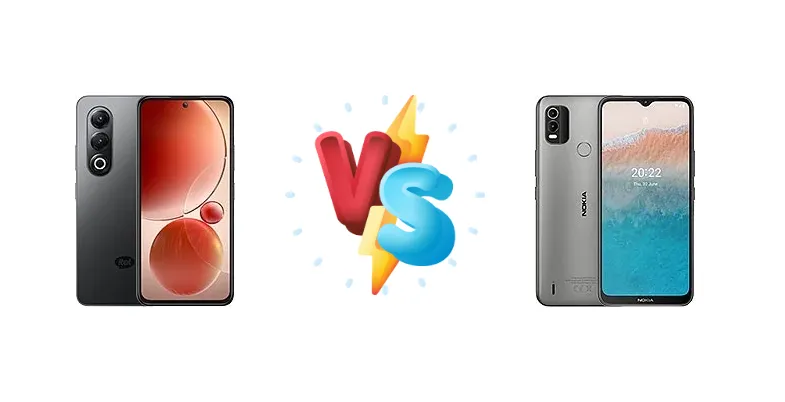
The itel S25 and Nokia C21 Plus represent two distinct approaches to the ultra-budget smartphone market. The itel S25 aims for a balance of features and performance, while the Nokia C21 Plus focuses on delivering a reliable, affordable experience, often running a streamlined Android Go edition. This comparison dissects their key differences to help you choose the right device.
🏆 Quick Verdict
For most users, the itel S25 emerges as the stronger choice. Its Unisoc T620 chipset provides a demonstrably faster experience than the Nokia C21 Plus’s SC9863A, making it better suited for multitasking and app usage. However, the Nokia C21 Plus remains a viable option for those prioritizing extreme affordability and a simple user interface.
| Network |
|---|
| 2G bands | GSM 850 / 900 / 1800 / 1900 | GSM 850 / 900 / 1800 / 1900 |
| 3G bands | HSDPA 850 / 900 / 2100 | HSDPA 850 / 900 / 2100 |
| 4G bands | LTE | LTE |
| Speed | HSPA, LTE | HSPA 42.2/5.76 Mbps, LTE Cat4 150/50 Mbps |
| Technology | GSM / HSPA / LTE | GSM / HSPA / LTE |
| | - | HSDPA 850 / 900 / 1700(AWS) / 1900 / 2100 |
| Launch |
|---|
| Announced | 2024, November 09 | 2022, February 28 |
| Status | Available. Released 2024, November | Available. Released 2022, April 29 |
| Body |
|---|
| Build | - | Glass front, aluminum frame, plastic back |
| Dimensions | 7.3 mm thickness | 164.8 x 75.9 x 8.6 mm (6.49 x 2.99 x 0.34 in) |
| SIM | Nano-SIM + Nano-SIM | · Nano-SIM· Nano-SIM + Nano-SIM |
| Weight | 185 g (6.53 oz) | 178 g or 191 g (6.28 oz) |
| | - | Splash protection |
| Display |
|---|
| Protection | - | Scratch-resistant glass |
| Resolution | 1080 x 2436 pixels (~393 ppi density) | 720 x 1600 pixels, 20:9 ratio (~269 ppi density) |
| Size | 6.78 inches, 109.9 cm2 | 6.52 inches, 102.6 cm2 (~82.1% screen-to-body ratio) |
| Type | AMOLED, 1B colors, 120Hz, 1200 nits (HBM), 1800 nits (peak) | IPS LCD |
| Platform |
|---|
| CPU | Octa-core (2x2.2 GHz Cortex-A75 & 6xX.X GHz Cortex-A55) | Octa-core (4x1.6 GHz Cortex-A55 & 4x1.2 GHz Cortex-A55) |
| Chipset | Unisoc T620 (12 nm) | Unisoc SC9863A (28 nm) |
| GPU | - | IMG8322 |
| OS | Android 14, up to 2 major Android upgrades, itel OS 14.5 | Android 11 (Go edition) |
| Memory |
|---|
| Card slot | Unspecified | microSDXC (dedicated slot) |
| Internal | 128GB 6GB RAM, 128GB 8GB RAM | 32GB 2GB RAM, 32GB 3GB RAM, 64GB 2GB RAM, 64GB 3GB RAM, 64GB 4GB RAM |
| | - | eMMC 5.1 |
| Main Camera |
|---|
| Dual | - | 13 MP, (wide), AF
Auxiliary lens |
| Features | Ring-LED flash, panorama, HDR | LED flash, HDR, panorama |
| Single | 50 MP, f/1.6, (wide), 0.64µm, AF
Auxiliary lens | 5 MP |
| Video | 1440p@30fps, 1080p@30fps | 1080p@30fps |
| Selfie camera |
|---|
| Features | - | LED flash |
| Single | 32 MP, f/2.2, 22mm (wide) | 5 MP |
| Video | 1440p@30fps, 1080p@30fps | 720p |
| Sound |
|---|
| 3.5mm jack | - | Yes |
| 35mm jack | Yes | Yes |
| Loudspeaker | Yes | Yes |
| Comms |
|---|
| Bluetooth | Yes | 4.2, A2DP |
| Infrared port | Yes | - |
| NFC | Yes (market/region dependent) | No |
| Positioning | GPS | GPS |
| Radio | Unspecified | FM radio |
| USB | USB Type-C 2.0 | microUSB 2.0 |
| WLAN | Yes | Wi-Fi 802.11 b/g/n |
| Features |
|---|
| Sensors | Fingerprint (under display, optical), unspecified sensors | Fingerprint (rear-mounted), accelerometer, proximity |
| Battery |
|---|
| Charging | 18W wired, bypass charging | 10W wired |
| Type | 5000 mAh | Li-Ion 4000/5050 mAh |
| Misc |
|---|
| Colors | Bromo Black, Mambo Mint, Sahara Gleam | Dark Cyan, Warm Gray |
| Models | S685LN | TA-1433, TA-1431, TA-1426, TA-1424 |
| Price | About 100 EUR | About 120 EUR |
| SAR | - | 0.57 W/kg (head) 0.65 W/kg (body) |
| SAR EU | - | 0.40 W/kg (head) 0.99 W/kg (body) |
itel S25
- Significantly faster processor (Unisoc T620)
- Faster 18W charging with bypass charging
- Potentially better multitasking capabilities
- May be slightly more expensive
- Software experience may be less streamlined than Nokia
Nokia C21 Plus
- Lower price point
- Potentially longer battery life for basic tasks
- Clean and simple Android Go experience
- Significantly slower processor (Unisoc SC9863A)
- Slower 10W charging
- Limited performance for demanding apps
Display Comparison
Neither device boasts a standout display. Both likely utilize LCD panels, a common cost-saving measure in this segment. However, specifics like resolution and brightness are not provided. The Nokia C21 Plus’s focus on affordability suggests a lower-quality panel. The itel S25, positioned slightly higher, *may* offer marginally better color reproduction, but this is speculative. Bezels are expected to be substantial on both devices, maximizing screen real estate within a budget.
Camera Comparison
Camera performance is likely to be similar, leaning towards basic functionality on both devices. Details on sensor size and image processing are absent. Given the price point, expect 8MP or 5MP main sensors on both. The Nokia C21 Plus may emphasize simplicity in its camera app, while the itel S25 might offer more features, though image quality will be heavily dependent on software optimization. Any 2MP macro or depth sensors present on either device should be considered marketing features with limited real-world utility.
Performance
The performance gap is the most significant differentiator. The itel S25’s Unisoc T620, built on a 12nm process, features a more modern CPU architecture – two Cortex-A75 cores alongside six Cortex-A55 cores – compared to the Nokia C21 Plus’s Unisoc SC9863A (28nm). The SC9863A utilizes four Cortex-A55 cores at 1.6GHz and another four at 1.2GHz. This architectural difference, combined with the smaller fabrication node, translates to a substantial performance advantage for the itel S25 in CPU-intensive tasks. The T620’s A75 cores provide a noticeable boost in responsiveness and app loading times. While neither phone is a gaming powerhouse, the itel S25 will handle less demanding games with greater fluidity.
Battery Life
The Nokia C21 Plus, with its likely larger battery capacity (spec not provided, but typical for Nokia’s C-series), *could* offer longer battery life for basic usage scenarios. However, the itel S25’s more efficient Unisoc T620 chipset and 18W fast charging (compared to the C21 Plus’s 10W) provide a compelling counterpoint. The 18W charging on the itel S25, including bypass charging, allows for simultaneous charging and usage, a feature absent on the Nokia C21 Plus. This means quicker top-ups and less downtime.
Buying Guide
Buy the itel S25 if you need a smartphone capable of handling more demanding apps and multitasking without significant slowdowns. It’s ideal for users who occasionally game or stream video. Buy the Nokia C21 Plus if you prioritize absolute affordability, a long-lasting battery for basic tasks, and a simplified Android experience, particularly if you're less tech-savvy or prefer a cleaner interface.
Frequently Asked Questions
❓ Will the itel S25 handle popular social media apps like Facebook and Instagram smoothly?
Yes, the Unisoc T620 chipset in the itel S25 provides sufficient processing power to run social media apps smoothly, even with multiple apps open simultaneously. The Nokia C21 Plus may experience noticeable slowdowns with multiple apps running.
❓ Is the 10W charging on the Nokia C21 Plus noticeably slow in daily use?
Yes, 10W charging is relatively slow by today's standards. Expect a significantly longer charge time (several hours) to reach 100% compared to the itel S25’s 18W charging. This is a trade-off for the lower price point.
❓ Does the itel S25 support software updates beyond the initial Android version?
Software update support for itel devices is historically limited. While the itel S25 will likely launch with a recent version of Android, long-term updates are not guaranteed. The Nokia C21 Plus, benefiting from Nokia’s commitment to Android updates, may receive more frequent security patches and potentially one major Android version upgrade.
❓ Is the Unisoc SC9863A chipset in the Nokia C21 Plus sufficient for basic communication tasks like calls and messaging?
Absolutely. The Unisoc SC9863A is perfectly adequate for core communication tasks like making calls, sending texts, and using basic messaging apps. Its limitations become apparent when running more demanding applications.