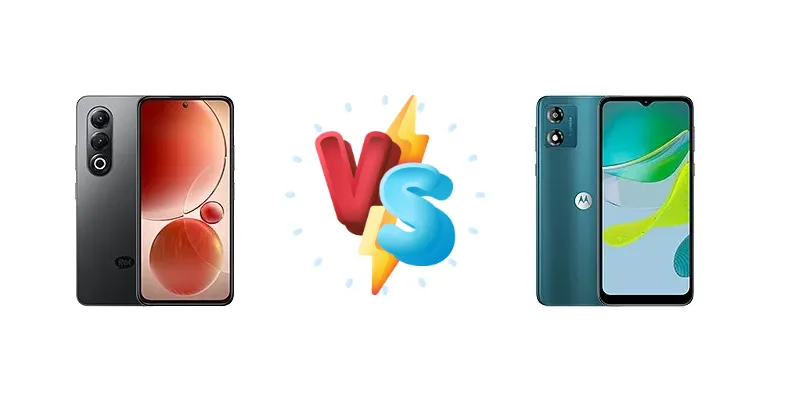
The itel S25 and Motorola Moto E13 represent the fiercely competitive sub-$150 smartphone market. Both devices leverage Unisoc chipsets to deliver an Android experience at an accessible price point, but key differences in processing power and charging capabilities separate them. This comparison dissects these nuances to determine which phone offers the best value for your money.
🏆 Quick Verdict
For users prioritizing responsiveness and faster charging, the itel S25 emerges as the stronger choice. Its Unisoc T620 chipset, with higher clocked Cortex-A75 cores, provides a noticeable performance edge. While the Moto E13 offers a reliable experience, its slower charging and less powerful processor hold it back.
| Network |
|---|
| 2G bands | GSM 850 / 900 / 1800 / 1900 | GSM 850 / 900 / 1800 / 1900 |
| 3G bands | HSDPA 850 / 900 / 2100 | HSDPA 850 / 900 / 2100 |
| 4G bands | LTE | 1, 3, 5, 7, 8, 28, 38, 40, 41 |
| Speed | HSPA, LTE | HSPA, LTE |
| Technology | GSM / HSPA / LTE | GSM / HSPA / LTE |
| | - | 1, 3, 5, 7, 8, 20, 28, 38, 40, 41 |
| Launch |
|---|
| Announced | 2024, November 09 | 2023, January 24 |
| Status | Available. Released 2024, November | Available. Released 2023, February 13 |
| Body |
|---|
| Build | - | Glass front, plastic frame, plastic back |
| Dimensions | 7.3 mm thickness | 164.2 x 75 x 8.5 mm (6.46 x 2.95 x 0.33 in) |
| SIM | Nano-SIM + Nano-SIM | Nano-SIM + Nano-SIM |
| Weight | 185 g (6.53 oz) | 179.5 g (6.35 oz) |
| | - | Water-resistant design |
| Display |
|---|
| Resolution | 1080 x 2436 pixels (~393 ppi density) | 720 x 1600 pixels, 20:9 ratio (~270 ppi density) |
| Size | 6.78 inches, 109.9 cm2 | 6.5 inches, 102.0 cm2 (~82.8% screen-to-body ratio) |
| Type | AMOLED, 1B colors, 120Hz, 1200 nits (HBM), 1800 nits (peak) | IPS LCD |
| Platform |
|---|
| CPU | Octa-core (2x2.2 GHz Cortex-A75 & 6xX.X GHz Cortex-A55) | Octa-core (2x1.6 GHz Cortex-A75 & 6x1.6 GHz Cortex-A55) |
| Chipset | Unisoc T620 (12 nm) | Unisoc T606 (12 nm) |
| GPU | - | Mali-G57 MP1 |
| OS | Android 14, up to 2 major Android upgrades, itel OS 14.5 | Android 13 (Go edition) |
| Memory |
|---|
| Card slot | Unspecified | microSDXC (dedicated slot) |
| Internal | 128GB 6GB RAM, 128GB 8GB RAM | 32GB 2GB RAM, 64GB 2GB RAM, 64GB 4GB RAM, 128GB 8GB RAM |
| | - | eMMC 5.1 |
| Main Camera |
|---|
| Features | Ring-LED flash, panorama, HDR | LED flash, HDR, panorama |
| Single | 50 MP, f/1.6, (wide), 0.64µm, AF
Auxiliary lens | 13 MP, f/2.2, (wide), 1.12µm, PDAF |
| Video | 1440p@30fps, 1080p@30fps | 1080p@30fps |
| Selfie camera |
|---|
| Single | 32 MP, f/2.2, 22mm (wide) | 5 MP, f/2.4, (wide), 1/5.0", 1.12µm |
| Video | 1440p@30fps, 1080p@30fps | 1080p@30fps |
| Sound |
|---|
| 3.5mm jack | - | Yes |
| 35mm jack | Yes | Yes |
| Loudspeaker | Yes | Yes |
| Comms |
|---|
| Bluetooth | Yes | 5.0, A2DP, LE |
| Infrared port | Yes | - |
| NFC | Yes (market/region dependent) | No |
| Positioning | GPS | GPS, GLONASS, GALILEO |
| Radio | Unspecified | FM radio, recording |
| USB | USB Type-C 2.0 | USB Type-C 2.0, OTG |
| WLAN | Yes | Wi-Fi 802.11 a/b/g/n/ac, dual-band |
| Features |
|---|
| Sensors | Fingerprint (under display, optical), unspecified sensors | Accelerometer, proximity |
| Battery |
|---|
| Charging | 18W wired, bypass charging | 10W wired |
| Type | 5000 mAh | Li-Po 5000 mAh |
| Misc |
|---|
| Colors | Bromo Black, Mambo Mint, Sahara Gleam | Cosmic Black, Creamy White, Aurora Green |
| Models | S685LN | - |
| Price | About 100 EUR | $ 119.99 / € 104.99 |
itel S25
- Faster processor (Unisoc T620)
- 18W fast charging
- Bypass charging support
- Potential for slightly higher power consumption
- Software experience may not be as clean as Motorola
Motorola Moto E13
- Clean Motorola software experience
- Potentially longer battery life due to lower power draw
- Generally reliable build quality
- Slower processor (Unisoc T606)
- Slower 10W charging
- Less responsive user experience
Display Comparison
Neither itel nor Motorola provide display specifications beyond the basic panel type. Given the price point, both likely utilize LCD panels. The absence of details like peak brightness or color gamut makes a direct comparison impossible. However, the focus should be on usability rather than visual fidelity in this segment. Expect similar viewing experiences in typical indoor lighting conditions.
Camera Comparison
Without detailed camera sensor information, a precise comparison is difficult. Both phones likely feature a primary camera and potentially a depth or macro sensor. However, the image signal processor (ISP) within the Unisoc T620 *may* offer slightly better image processing capabilities, potentially resulting in more detailed photos in good lighting conditions. The absence of Optical Image Stabilization (OIS) on either device means low-light performance will be heavily reliant on software processing. Focusing on the primary sensor resolution (if available) will be more informative than considering the typically low-resolution auxiliary lenses.
Performance
The core difference lies in the chipsets. The itel S25’s Unisoc T620 features two Cortex-A75 cores clocked at 2.2 GHz, while the Moto E13’s Unisoc T606 has the same core count but clocked lower at 1.6 GHz. This 600 MHz difference in peak frequency translates to a tangible performance advantage for the itel S25 in CPU-intensive tasks. The T620 will handle multitasking and app loading more efficiently. Both chips share the same Cortex-A55 efficiency cores, but the higher clock speed of the A75 cores on the S25 is the key differentiator. The 12nm process node is shared, so thermal differences are likely minimal, but the S25 will complete tasks faster.
Battery Life
While battery capacity isn't specified, the itel S25’s 18W wired charging is a significant advantage over the Moto E13’s 10W charging. This means the S25 can replenish its battery much faster, reducing downtime. While a larger battery capacity on the Moto E13 *could* offset the slower charging, the more efficient Unisoc T620 in the S25 may negate that advantage. The S25 also supports bypass charging, allowing it to be used while charging, a feature absent on the Moto E13.
Buying Guide
Buy the itel S25 if you need a phone that feels snappier for everyday tasks like social media, browsing, and light gaming, and if you value the convenience of 18W fast charging. Buy the Motorola Moto E13 if you prioritize a clean software experience and are willing to trade performance and charging speed for a potentially longer-lasting battery due to the lower power draw of the T606.
Frequently Asked Questions
❓ Will the Unisoc T620 in the itel S25 handle demanding games like PUBG Mobile?
While the Unisoc T620 can run PUBG Mobile, expect to play at lower graphics settings and frame rates for a smooth experience. It's not a gaming-focused chipset, but it's capable of handling less demanding titles without issue. The Moto E13's T606 will struggle more with demanding games.
❓ How much faster is the 18W charging on the itel S25 compared to the 10W charging on the Moto E13?
The 18W charging on the itel S25 will significantly reduce charging times. While exact 0-100% times depend on battery capacity, expect the S25 to charge roughly 40-60% faster than the Moto E13. This is a substantial difference for users who frequently need to top up their battery.
❓ Does the Motorola Moto E13 receive regular software updates?
Motorola generally provides at least one major Android update and a few security patches for its budget phones. However, the update schedule can be slower compared to brands like Samsung or Google. Expect a relatively clean Android experience, but don't anticipate the same level of long-term software support as higher-end devices.
❓ Is the difference in CPU clock speed between the T620 and T606 noticeable in everyday use?
Yes, the 600 MHz difference in peak CPU clock speed is noticeable in everyday tasks. The itel S25 will feel snappier when launching apps, multitasking, and browsing the web. The Moto E13 may exhibit slight lag or stuttering in these scenarios.