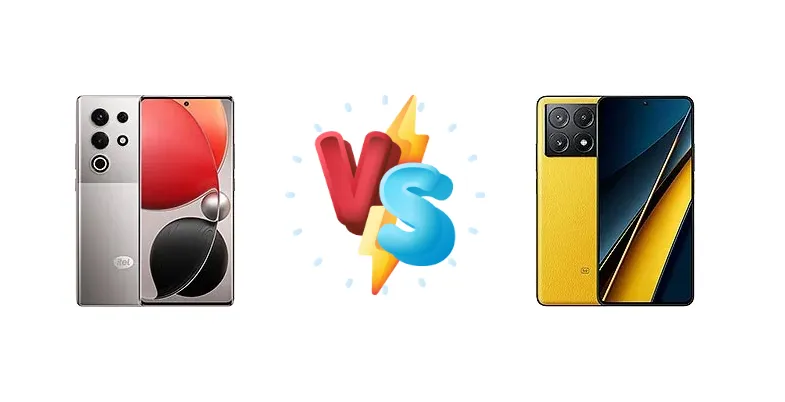
The smartphone market is segmented, and these two devices exemplify that. The itel S25 Ultra aims to deliver essential smartphone functionality at an incredibly accessible price point, while the Xiaomi Poco X6 Pro aggressively targets the mid-range with near-flagship performance. This comparison dissects their key differences to help you determine which aligns best with your priorities.
🏆 Quick Verdict
For users prioritizing performance and a premium experience, the Xiaomi Poco X6 Pro is the clear winner. Its Dimensity 8300 Ultra chipset and 67W charging significantly outperform the itel S25 Ultra. However, the itel S25 Ultra remains a viable option for budget-conscious users needing basic smartphone features.
| Network |
|---|
| 2G bands | GSM 850 / 900 / 1800 / 1900 | GSM 850 / 900 / 1800 / 1900 |
| 3G bands | HSDPA 850 / 900 / 2100 | HSDPA 850 / 900 / 1700(AWS) / 1900 / 2100 |
| 4G bands | LTE | 1, 2, 3, 4, 5, 7, 8, 18, 19, 20, 28, 38, 40, 41, 48, 66 |
| 5G bands | - | 1, 2, 3, 5, 7, 8, 20, 28, 38, 40, 41, 48, 77, 78 SA/NSA/Sub6 |
| Speed | HSPA, LTE | HSPA, LTE, 5G |
| Technology | GSM / HSPA / LTE | GSM / HSPA / LTE / 5G |
| Launch |
|---|
| Announced | 2024, November 09 | 2024, January 11 |
| Status | Available. Released 2024, November | Available. Released 2024, January 12 |
| Body |
|---|
| Build | - | Glass front (Gorilla Glass 5), plastic frame, plastic back or silicone polymer back (eco leather) |
| Dimensions | 6.9 mm thickness | 160.5 x 74.3 x 8.3 mm (6.32 x 2.93 x 0.33 in) |
| SIM | Nano-SIM + Nano-SIM | Nano-SIM + Nano-SIM |
| Weight | 163 g (5.75 oz) | 186 g or 190 g (6.56 oz) |
| Display |
|---|
| Protection | Corning Gorilla Glass 7i | Corning Gorilla Glass 5 |
| Resolution | 1080 x 2436 pixels (~393 ppi density) | 1220 x 2712 pixels, 20:9 ratio (~446 ppi density) |
| Size | 6.78 inches, 109.9 cm2 | 6.67 inches, 107.4 cm2 (~90.1% screen-to-body ratio) |
| Type | AMOLED, 1B colors, 120Hz, 2160Hz PWM, 1000 nits (HBM), 1400 nits (peak) | AMOLED, 68B colors, 120Hz, 1920Hz PWM, HDR10+, Dolby Vision, 500 nits (typ), 1200 nits (HBM), 1800 nits (peak) |
| Platform |
|---|
| CPU | Octa-core (2x2.2 GHz Cortex-A75 & 6xX.X GHz Cortex-A55) | Octa-core (1x3.35 GHz Cortex-A715 & 3x3.20 GHz Cortex-A715 & 4x2.20 GHz Cortex-A510) |
| Chipset | Unisoc T620 (12 nm) | Mediatek Dimensity 8300 Ultra (4 nm) |
| GPU | - | Mali G615-MC6 |
| OS | Android 14, up to 2 major Android upgrades, itel OS 14.5 | Android 14, up to 3 major Android upgrades, HyperOS |
| Memory |
|---|
| Card slot | Unspecified | No |
| Internal | 128GB 8GB RAM, 256GB 8GB RAM, 512GB 8GB RAM | 256GB 8GB RAM, 256GB 12GB RAM, 512GB 12GB RAM |
| Main Camera |
|---|
| Dual | 50 MP, f/1.6, (wide), AF
XX MP (macro)
Auxiliary lens | - |
| Features | LED flash, HDR, panorama | LED flash, HDR, panorama |
| Triple | - | 64 MP, f/1.7, 25mm (wide), 1/2.0", 0.7µm, PDAF, OIS
8 MP, f/2.2, 120˚ (ultrawide), 1/4.0", 1.12µm
2 MP (macro) |
| Video | 1440p@30fps, 1080p@30fps | 4K@24/30fps, 1080p@30/60fps, gyro-EIS |
| Selfie camera |
|---|
| Features | - | HDR, panorama |
| Single | 32 MP, f/2.2, 22mm (wide) | 16 MP, f/2.4, (wide), 1/3.06", 1.0µm |
| Video | 1440p@30fps, 1080p@30fps | 1080p@30/60fps |
| Sound |
|---|
| 35mm jack | No | No |
| Loudspeaker | Yes | Yes, with dual speakers |
| Comms |
|---|
| Bluetooth | Yes | 5.4, A2DP, LE, aptX HD |
| Infrared port | Yes | Yes |
| NFC | Yes (market/region dependent) | Yes (market/region dependent) |
| Positioning | GPS | GPS, GALILEO, GLONASS, QZSS, BDS (B1I+B1c) |
| Radio | Unspecified | No |
| USB | USB Type-C 2.0 | USB Type-C 2.0, OTG |
| WLAN | Yes | Wi-Fi 802.11 a/b/g/n/ac/6, dual-band, Wi-Fi Direct |
| Features |
|---|
| Sensors | Fingerprint (under display, optical), unspecified sensors | Fingerprint (under display, optical), accelerometer, gyro, compass |
| Battery |
|---|
| Charging | 18W wired, bypass charging | 67W wired, QC2.0, PD3.0, 100% in 45 min |
| Type | 5000 mAh | 5000 mAh |
| Misc |
|---|
| Colors | Bromo Black, Meteor Titanium, Komodo Ocean | Black, Yellow, Gray |
| Models | S686LN | 2311DRK48G, 2311DRK48I |
| Price | $ 195.00 | € 195.30 / $ 209.79 / £ 274.99 / ₹ 21,999 |
| SAR EU | - | 0.99 W/kg (head) 1.00 W/kg (body) |
itel S25 Ultra
- Extremely affordable price point
- Decent for basic smartphone tasks
- Bypass charging support
- Underpowered chipset for demanding tasks
- Likely low-quality camera system
- Slow charging speed
Xiaomi Poco X6 Pro
- Powerful Dimensity 8300 Ultra processor
- Fast 67W charging
- Bright and vibrant display
- Higher price compared to itel S25 Ultra
- Camera details are not provided
- May be overkill for basic users
Display Comparison
The Poco X6 Pro boasts a significantly brighter display, reaching a measured 1148 nits, making it easily viewable outdoors. While the itel S25 Ultra’s display specifications are not provided, it’s likely to be considerably dimmer. This brightness difference directly impacts usability in sunlight. The Poco X6 Pro’s panel likely utilizes a higher refresh rate (though not specified) contributing to smoother scrolling and animations, a feature likely absent on the itel S25 Ultra. The absence of details on the itel S25 Ultra’s panel technology suggests a focus on cost reduction over display quality.
Camera Comparison
The context data only mentions 'Photo / Video' capabilities for the Poco X6 Pro, lacking specific sensor details. However, given its price point and Xiaomi’s camera reputation, it likely features a more sophisticated camera system with a larger sensor and potentially Optical Image Stabilization (OIS). The itel S25 Ultra’s camera specifications are entirely absent, suggesting a basic camera setup focused on affordability. Image processing capabilities will also heavily favor the Poco X6 Pro, delivering better dynamic range and low-light performance. Users prioritizing photography should strongly consider the Poco X6 Pro.
Performance
The performance gap between these devices is substantial. The Xiaomi Poco X6 Pro’s Mediatek Dimensity 8300 Ultra, built on a 4nm process, is a powerhouse. Its octa-core configuration – 1x3.35 GHz Cortex-A715, 3x3.20 GHz Cortex-A715, and 4x2.20 GHz Cortex-A510 – delivers significantly faster processing speeds and improved efficiency compared to the itel S25 Ultra’s Unisoc T620 (12nm). The Unisoc T620, with its 2x2.2 GHz Cortex-A75 and 6xX.X GHz Cortex-A55 cores, is geared towards basic tasks. The 4nm fabrication of the Dimensity 8300 Ultra also translates to better thermal management, reducing throttling during sustained workloads like gaming. The Poco X6 Pro will handle demanding games and multitasking with ease, while the itel S25 Ultra will struggle with graphically intensive applications.
Battery Life
The Poco X6 Pro demonstrates impressive battery life, achieving 11:46h of active use. While the itel S25 Ultra’s battery capacity is not specified, its less power-hungry chipset suggests reasonable endurance for basic usage. However, the Poco X6 Pro’s 67W wired charging with QC2.0 and PD3.0 support, capable of a full charge in 45 minutes, is a significant advantage. The itel S25 Ultra’s 18W charging is considerably slower, requiring more time to replenish the battery. The faster charging of the Poco X6 Pro is a convenience factor that will appeal to users who need to quickly top up their device.
Buying Guide
Buy the itel S25 Ultra if you need a reliable, affordable smartphone for everyday tasks like calling, texting, and light social media use, and are willing to compromise on performance and camera quality. Buy the Xiaomi Poco X6 Pro if you prioritize gaming, demanding applications, fast charging, and a brighter, more vibrant display, and are willing to spend more for a significantly enhanced user experience.
Frequently Asked Questions
❓ Is the Unisoc T620 in the itel S25 Ultra capable of running popular games like PUBG or Call of Duty?
While the Unisoc T620 can technically run these games, expect significantly reduced graphics settings and potential frame rate drops. It's not optimized for demanding gaming experiences and is better suited for casual games.
❓ Does the Poco X6 Pro support high refresh rate gaming, and if so, what frame rates can it achieve in popular titles?
The Poco X6 Pro, with its powerful Dimensity 8300 Ultra, is expected to support high refresh rate gaming. While specific frame rates depend on the game and settings, it should comfortably achieve 60fps or higher in most titles, and potentially support 120fps in some games with optimized settings.
❓ How does the 67W charging on the Poco X6 Pro compare to standard charging speeds?
67W charging is significantly faster than standard charging. It can take a phone from 0% to 100% in around 45 minutes, whereas standard charging can take over two hours. This is a major convenience factor for users who need to quickly recharge their device.
❓ What type of storage does the Poco X6 Pro use, and does it support expansion via microSD card?
While the context data doesn't specify, Xiaomi typically uses UFS 3.1 or UFS 4.0 storage in their mid-range devices, offering fast read and write speeds. MicroSD card support is becoming less common, and it's likely the Poco X6 Pro does *not* offer expandable storage.