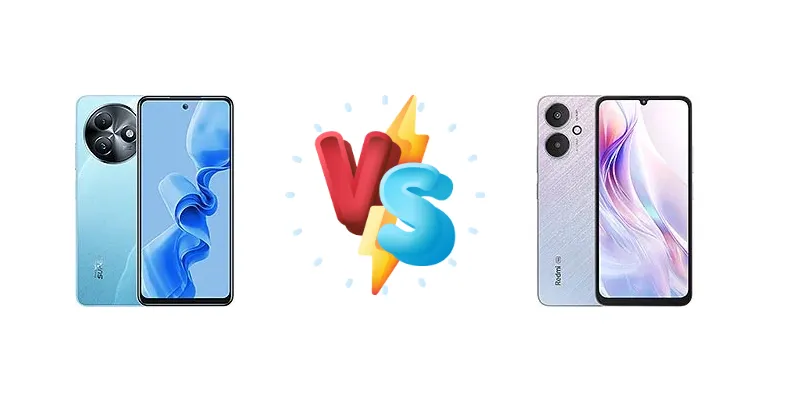
The sub-$200 5G smartphone market is heating up, with the itel S24 and Xiaomi Redmi 13C 5G vying for dominance. Both aim to deliver 5G connectivity and a modern smartphone experience without breaking the bank, but they take different approaches to achieving this. This comparison dissects their core components to determine which device offers the best blend of performance, features, and value.
🏆 Quick Verdict
For the average user prioritizing consistent performance and future-proofing, the Xiaomi Redmi 13C 5G emerges as the better choice. Its Dimensity 6100+ chipset, built on a more efficient 6nm process, provides a noticeable performance edge over the itel S24’s Helio G91 Ultra, translating to smoother multitasking and gaming.
| Network |
|---|
| 2G bands | GSM 850 / 900 / 1800 / 1900 | GSM 850 / 900 / 1800 / 1900 |
| 3G bands | HSDPA 850 / 900 / 2100 | HSDPA 800 / 850 / 900 / 1700(AWS) / 1900 / 2100 - International |
| 4G bands | 1, 3, 5, 8, 28, 38, 40, 41 | 1, 2, 3, 4, 5, 7, 8, 12, 13, 17, 18, 19, 20, 26, 28, 32, 38, 40, 41, 66 - International |
| 5G bands | - | 1, 3, 5, 7, 8, 20, 28, 38, 40, 41, 66, 77, 78 SA/NSA - International |
| Speed | HSPA, LTE | HSPA, LTE, 5G |
| Technology | GSM / HSPA / LTE | GSM / HSPA / LTE / 5G |
| Launch |
|---|
| Announced | 2024, March 29 | 2023, December 06 |
| Status | Available. Released 2024, April | Available. Released 2023, December 16 |
| Body |
|---|
| Build | - | Glass front (Gorilla Glass 3), plastic frame, plastic back |
| Dimensions | 163.5 x 75.5 x 8.3 mm (6.44 x 2.97 x 0.33 in) | 168.1 x 77.9 x 8.2 mm (6.62 x 3.07 x 0.32 in) |
| SIM | Nano-SIM + Nano-SIM | Nano-SIM + Nano-SIM |
| Weight | 192 g (6.77 oz) | 192 g or 195 g (6.77 oz) |
| Display |
|---|
| Protection | - | Corning Gorilla Glass 3 |
| Resolution | 720 x 1612 pixels, 20:9 ratio (~267 ppi density) | 720 x 1600 pixels, 20:9 ratio (~260 ppi density) |
| Size | 6.6 inches, 104.6 cm2 (~84.8% screen-to-body ratio) | 6.74 inches, 109.7 cm2 (~83.8% screen-to-body ratio) |
| Type | IPS LCD, 90Hz, 480 nits (peak) | IPS LCD, 90Hz, 450 nits (typ), 600 nits (HBM) |
| Platform |
|---|
| CPU | Octa-core (2x2.0 GHz Cortex-A75 & 6x1.8 GHz Cortex-A55) | Octa-core (2x2.2 GHz Cortex-A76 & 6x2.0 GHz Cortex-A55) |
| Chipset | Mediatek Helio G91 Ultra | Mediatek Dimensity 6100+ (6 nm) |
| GPU | Mali-G52 MC2 | Mali-G57 MC2 |
| OS | Android 13 | Android 13, MIUI 14 |
| Memory |
|---|
| Card slot | microSDXC (dedicated slot) | microSDXC (dedicated slot) |
| Internal | 128GB 4GB RAM, 128GB 8GB RAM, 256GB 8GB RAM | 64GB 4GB RAM, 128GB 4GB RAM, 128GB 6GB RAM, 256GB 8GB RAM |
| Main Camera |
|---|
| Features | LED flash | LED flash, HDR |
| Single | 108 MP, f/1.6, (wide), 1/1.67", 0.64µm, AF
Auxiliary lens | 50 MP, f/1.8, 28mm (wide), 1/2.76", 1.12µm, PDAF
Auxiliary lens |
| Video | 1440p@30fps, 1080p@30fps | 1080p@30fps |
| Selfie camera |
|---|
| Features | - | HDR |
| Single | 8 MP | 5 MP, f/2.2, (wide) |
| Video | 1440p@30fps, 1080p@30fps | 1080p@30fps |
| Sound |
|---|
| 35mm jack | Yes | Yes |
| Loudspeaker | Yes | Yes |
| Comms |
|---|
| Bluetooth | 5.2, A2DP, LE | 5.3, A2DP, LE |
| NFC | Yes (market/region dependent) | Yes (market/region dependent) |
| Positioning | GPS | GPS, GLONASS, GALILEO, BDS |
| Radio | FM radio, recording | FM radio |
| USB | USB Type-C 2.0, OTG | USB Type-C 2.0, OTG |
| WLAN | Wi-Fi 802.11 a/b/g/n/ac, dual-band | Wi-Fi 802.11 a/b/g/n/ac, dual-band |
| Features |
|---|
| Sensors | Fingerprint (side-mounted), accelerometer, compass | Fingerprint (side-mounted), accelerometer, compass |
| Battery |
|---|
| Charging | 18W wired, bypass charging, 50% in 40 min | 18W wired, PD |
| Type | Li-Po 5000 mAh | 5000 mAh |
| Misc |
|---|
| Colors | Dawn White, Coastline Blue, Starry Black | Starry Black, Twilight Blue, Starry Silver, Starlight Black, Startrail Green, Startrail Silver |
| Models | S667LN | 23124RN87G, 23124RN87I, 23124RN87C |
| Price | About 120 EUR | $ 198.99 / £ 119.00 / € 116.99 / ₹ 10,895 |
| SAR | - | 1.09 W/kg (head) 1.09 W/kg (body) |
| SAR EU | - | 0.98 W/kg (head) 0.98 W/kg (body) |
itel S24
- Bypass charging allows usage while charging.
- Potentially more refined software experience (based on brand history).
- Competitive pricing within the budget segment.
- Older Helio G91 Ultra chipset.
- Less efficient 12nm manufacturing process.
- Likely lower sustained performance compared to the Redmi 13C 5G.
Xiaomi Redmi 13C 5G
- More powerful and efficient Dimensity 6100+ chipset.
- 6nm manufacturing process for better battery life.
- Power Delivery (PD) support for charging compatibility.
- Software experience may be more generic (MIUI).
- Potential for bloatware (common with Xiaomi devices).
- May be slightly more expensive than the itel S24.
Display Comparison
Neither device boasts a standout display. Both are likely to feature LCD panels, common in this price bracket. However, detailed specs like resolution and peak brightness are missing. The focus here is on processing power, not visual fidelity. Bezels are expected to be moderate on both, prioritizing affordability over an immersive edge-to-edge experience. Color accuracy will likely be standard for the segment, leaning towards vibrant but not necessarily color-accurate profiles.
Camera Comparison
Camera performance is difficult to assess without detailed sensor information. Both phones likely feature a primary camera accompanied by auxiliary lenses (potentially a depth or macro sensor). The Redmi 13C 5G’s image processing pipeline, leveraging Mediatek’s ISP, may offer slightly better dynamic range and noise reduction. The itel S24’s camera performance will likely be adequate for social media sharing in good lighting conditions, but will struggle in low-light scenarios. The presence of a 2MP macro camera on either device is largely a marketing gimmick and shouldn’t heavily influence purchasing decisions.
Performance
The core difference lies in the chipsets. The Xiaomi Redmi 13C 5G’s Mediatek Dimensity 6100+ (6nm) is a clear upgrade over the itel S24’s Helio G91 Ultra. The Dimensity 6100+ features newer Cortex-A76 cores clocked at 2.2 GHz, compared to the G91 Ultra’s Cortex-A75 cores at 2.0 GHz. This architectural advantage, coupled with the more efficient 6nm manufacturing process, translates to better sustained performance and improved power efficiency. While both have 6x Cortex-A55 efficiency cores, the Redmi 13C 5G will handle demanding tasks and multitasking with greater ease. The Redmi 13C 5G is likely to benefit from better GPU performance as well, offering a smoother gaming experience.
Battery Life
Both devices feature 18W wired charging, with the Redmi 13C 5G adding Power Delivery (PD) support for potentially wider charger compatibility. While the battery capacity isn't specified, the Dimensity 6100+'s 6nm efficiency should translate to longer battery life on the Redmi 13C 5G, even with a similar capacity battery. The itel S24’s bypass charging feature allows the phone to be used while charging, a useful convenience, but doesn’t offset the potential battery life advantage of the Redmi 13C 5G.
Buying Guide
Buy the itel S24 if you prioritize a slightly more refined software experience (based on itel’s historical UI choices) and are comfortable with a chipset that, while capable, is a generation behind. Buy the Xiaomi Redmi 13C 5G if you prefer a more powerful processor for demanding apps and games, and value the benefits of a newer, more efficient chipset like the Dimensity 6100+.
Frequently Asked Questions
❓ Will the Dimensity 6100+ in the Redmi 13C 5G overheat during prolonged gaming sessions?
The Dimensity 6100+’s 6nm process and efficient core design significantly reduce the risk of overheating compared to older chipsets. While some throttling is inevitable during extended gaming, the Redmi 13C 5G is expected to maintain stable performance for longer periods than the itel S24.
❓ Is the 18W charging on either phone truly 'fast charging'?
18W charging is considered relatively slow by modern standards. While it's adequate for topping up the battery overnight, don't expect a rapid charge. The Redmi 13C 5G’s PD support offers wider charger compatibility, but the charging speed itself remains similar to the itel S24.
❓ How does the software experience differ between itel and Xiaomi?
itel typically employs a customized Android skin that aims for simplicity, though it can sometimes lack the polish of more established brands. Xiaomi’s MIUI is feature-rich but often criticized for bloatware and aggressive battery management. User preference will heavily influence which software experience is preferred.