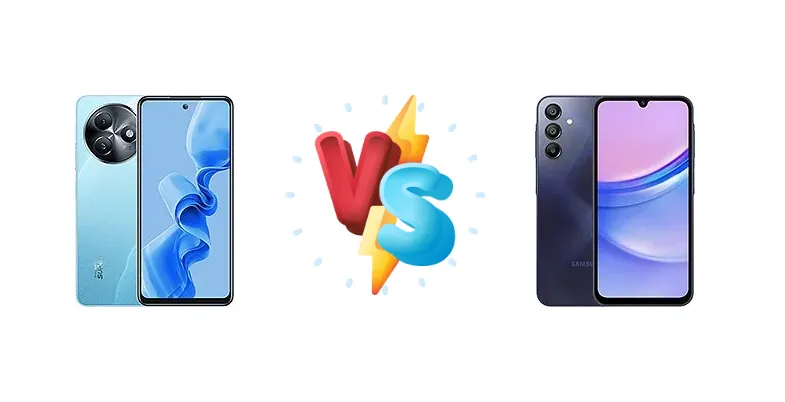
The sub-$200 smartphone market is fiercely competitive, and the itel S24 and Samsung Galaxy A15 are two contenders vying for your attention. While both aim to deliver essential smartphone functionality, they take different approaches to performance and battery life. This comparison dissects their key specifications to determine which device offers the best overall experience.
🏆 Quick Verdict
For the average user prioritizing all-day battery life and a brighter display, the Samsung Galaxy A15 emerges as the stronger choice. Its Helio G99 chipset, coupled with a measured 808 nits of brightness and impressive 15:28h active use battery score, provides a more consistently smooth and usable experience than the itel S24.
| Network |
|---|
| 2G bands | GSM 850 / 900 / 1800 / 1900 | GSM 850 / 900 / 1800 / 1900 |
| 3G bands | HSDPA 850 / 900 / 2100 | HSDPA 850 / 900 / 2100 |
| 4G bands | 1, 3, 5, 8, 28, 38, 40, 41 | 1, 3, 5, 7, 8, 20, 28, 38, 40, 41 |
| Speed | HSPA, LTE | HSPA, LTE |
| Technology | GSM / HSPA / LTE | GSM / HSPA / LTE |
| Launch |
|---|
| Announced | 2024, March 29 | 2023, December 11 |
| Status | Available. Released 2024, April | Available. Released 2023, December 16 |
| Body |
|---|
| Build | - | Glass front, plastic back, plastic frame |
| Dimensions | 163.5 x 75.5 x 8.3 mm (6.44 x 2.97 x 0.33 in) | 160.1 x 76.8 x 8.4 mm (6.30 x 3.02 x 0.33 in) |
| SIM | Nano-SIM + Nano-SIM | · Nano-SIM· Nano-SIM + Nano-SIM |
| Weight | 192 g (6.77 oz) | 200 g (7.05 oz) |
| Display |
|---|
| Resolution | 720 x 1612 pixels, 20:9 ratio (~267 ppi density) | 1080 x 2340 pixels, 19.5:9 ratio (~396 ppi density) |
| Size | 6.6 inches, 104.6 cm2 (~84.8% screen-to-body ratio) | 6.5 inches, 103.7 cm2 (~84.3% screen-to-body ratio) |
| Type | IPS LCD, 90Hz, 480 nits (peak) | Super AMOLED, 90Hz, 800 nits (HBM) |
| Platform |
|---|
| CPU | Octa-core (2x2.0 GHz Cortex-A75 & 6x1.8 GHz Cortex-A55) | Octa-core (2x2.2 GHz Cortex-A76 & 6x2.0 GHz Cortex-A55) |
| Chipset | Mediatek Helio G91 Ultra | Mediatek Helio G99 (6 nm) |
| GPU | Mali-G52 MC2 | Mali-G57 MC2 |
| OS | Android 13 | Android 14, up to 4 major Android upgrades, One UI 7 |
| Memory |
|---|
| Card slot | microSDXC (dedicated slot) | microSDXC (uses shared SIM slot) |
| Internal | 128GB 4GB RAM, 128GB 8GB RAM, 256GB 8GB RAM | 128GB 4GB RAM, 128GB 6GB RAM, 128GB 8GB RAM, 256GB 6GB RAM, 256GB 8GB RAM |
| Main Camera |
|---|
| Features | LED flash | LED flash, panorama, HDR |
| Single | 108 MP, f/1.6, (wide), 1/1.67", 0.64µm, AF
Auxiliary lens | - |
| Triple | - | 50 MP, f/1.8, 26mm (wide), 1/2.8", 0.64µm, PDAF
5 MP, f/2.2, 17mm (ultrawide), 1/5.0", 1.12µm
2 MP (macro) |
| Video | 1440p@30fps, 1080p@30fps | 1080p@30fps |
| Selfie camera |
|---|
| Single | 8 MP | 13 MP, f/2.0, 26mm (wide), 1/3.06", 1.12µm |
| Video | 1440p@30fps, 1080p@30fps | 1080p@30fps |
| Sound |
|---|
| 35mm jack | Yes | Yes |
| Loudspeaker | Yes | Yes |
| Comms |
|---|
| Bluetooth | 5.2, A2DP, LE | 5.3, A2DP, LE |
| NFC | Yes (market/region dependent) | Yes (market/region dependent) |
| Positioning | GPS | GPS, GALILEO, GLONASS, BDS, QZSS |
| Radio | FM radio, recording | FM radio (market/region dependent) |
| USB | USB Type-C 2.0, OTG | USB Type-C 2.0 |
| WLAN | Wi-Fi 802.11 a/b/g/n/ac, dual-band | Wi-Fi 802.11 a/b/g/n/ac, dual-band, Wi-Fi Direct |
| Features |
|---|
| Sensors | Fingerprint (side-mounted), accelerometer, compass | Fingerprint (side-mounted), accelerometer, compass |
| Battery |
|---|
| Charging | 18W wired, bypass charging, 50% in 40 min | 25W wired |
| Type | Li-Po 5000 mAh | 5000 mAh |
| Misc |
|---|
| Colors | Dawn White, Coastline Blue, Starry Black | Brave Black, Optimistic Blue, Magical Blue, Personality Yellow |
| Models | S667LN | SM-A155F, SM-A155F/DSN, SM-A155M, SM-A155M/DS, SM-A155P, SM-A155R |
| Price | About 120 EUR | € 168.99 / $ 125.00 / £ 113.00 |
| SAR EU | - | 0.42 W/kg (head) 1.29 W/kg (body) |
itel S24
- Potentially faster CPU core speeds for burst tasks.
- 18W charging with bypass charging for simultaneous use.
- Likely more affordable price point.
- Less efficient chipset (Helio G91 Ultra).
- Likely lower display brightness.
- Unknown battery capacity and potentially shorter battery life.
Samsung Galaxy A15
- Superior battery life (15:28h active use).
- Brighter display (808 nits).
- More efficient chipset (Helio G99, 6nm).
- Slower CPU core speeds compared to itel S24.
- Charging speed is good, but not class-leading.
- Samsung’s One UI can be resource intensive.
Display Comparison
The Samsung Galaxy A15 boasts a significant advantage in display quality with a measured peak brightness of 808 nits. This translates to superior visibility outdoors and in brightly lit environments, a common pain point for budget phones. While the itel S24’s display specifications are not provided, it’s reasonable to assume it falls short of this brightness level. The A15’s panel likely offers a more comfortable viewing experience overall, especially for media consumption. We lack information on panel type (IPS vs AMOLED) for either device, but the brightness difference is a clear win for Samsung.
Camera Comparison
Without detailed camera specifications beyond the presence of sensors, a direct comparison is difficult. However, it's safe to assume both phones will rely heavily on software processing to enhance image quality. The absence of information regarding sensor size or aperture on the itel S24 suggests it may struggle in low-light conditions compared to a potential larger sensor on the A15. The prevalence of 2MP macro lenses on both devices suggests limited utility; these are often included for marketing purposes rather than genuine photographic benefit. Image processing style will likely differ, with Samsung typically favoring more saturated and vibrant colors.
Performance
Both devices utilize MediaTek Helio chipsets, but the Samsung Galaxy A15’s Helio G99 (6nm) holds a performance edge over the itel S24’s Helio G91 Ultra. The G99’s more efficient 6nm process allows for sustained performance without significant thermal throttling. While the itel S24 features a CPU with two Cortex-A75 cores clocked at 2.0 GHz, the A15 counters with two Cortex-A76 cores at 2.2 GHz – a newer architecture offering improved IPC (Instructions Per Clock). This translates to snappier app launches and smoother multitasking on the A15. The A15’s GPU is also likely more capable, providing a better gaming experience, though neither phone is a dedicated gaming device.
Battery Life
The Samsung Galaxy A15 shines in battery performance, achieving an impressive 15 hours and 28 minutes of active use. While the itel S24’s battery capacity is unknown, its 18W charging, while offering bypass charging, is slower than the A15’s 25W charging. The A15 can replenish its battery more quickly, minimizing downtime. The G99’s 6nm efficiency also contributes to the A15’s superior battery life, allowing it to last a full day even with moderate to heavy usage. The itel S24 claims 50% charge in 40 minutes, but the A15’s faster charging and larger battery likely provide a more convenient overall experience.
Buying Guide
Buy the itel S24 if you prioritize a slightly more powerful CPU core configuration for occasional demanding tasks and faster charging speeds, and are willing to trade off some battery endurance and display brightness. Buy the Samsung Galaxy A15 if you value long-lasting battery life, a brighter and more visible display in outdoor conditions, and the established brand reputation of Samsung.
Frequently Asked Questions
❓ Does the MediaTek Helio G99 in the Samsung Galaxy A15 get noticeably warmer during extended gaming sessions?
While the Helio G99 is more efficient than the G91 Ultra, prolonged gaming will inevitably generate heat. However, the 6nm process and Samsung’s thermal management should prevent significant throttling, maintaining a playable frame rate for most mobile games. Expect some warmth, but not to the point of discomfort.
❓ Is the 18W charging on the itel S24 fast enough for a quick top-up during a short break?
The itel S24’s 18W charging with bypass charging is adequate for a quick boost, reaching 50% in approximately 40 minutes. However, it’s slower than the A15’s 25W charging, meaning you’ll need to dedicate more time to fully replenish the battery. The bypass charging feature is a plus, allowing you to use the phone while charging.
❓ How does Samsung's One UI affect the performance of the Galaxy A15, given its Helio G99 chipset?
Samsung's One UI is a feature-rich interface, but it can be more resource-intensive than some other Android skins. While the Helio G99 is capable, users might notice slight slowdowns when multitasking with numerous apps open. Optimizing background app usage and utilizing One UI’s built-in performance settings can mitigate these effects.