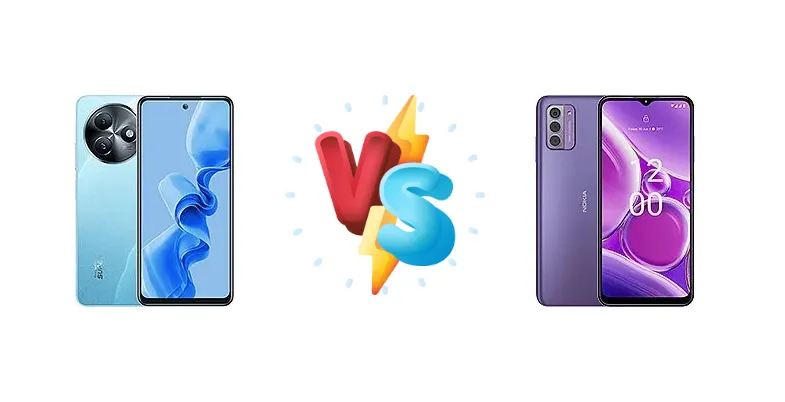
The sub-$200 smartphone market is fiercely competitive, and the itel S24 and Nokia G42 represent compelling options for users prioritizing 5G connectivity without breaking the bank. This comparison dissects their core components – the Mediatek Helio G91 Ultra and Qualcomm Snapdragon 480+ – to determine which device offers the best balance of performance, features, and value.
🏆 Quick Verdict
For the average user prioritizing consistent performance and slightly faster charging, the Nokia G42 emerges as the better choice. Its Snapdragon 480+ chipset, built on a more efficient 8nm process, provides a smoother experience, especially in sustained tasks, despite the itel S24's higher CPU clock speeds.
| Network |
|---|
| 2G bands | GSM 850 / 900 / 1800 / 1900 | GSM 850 / 900 / 1800 / 1900 |
| 3G bands | HSDPA 850 / 900 / 2100 | HSDPA 850 / 900 / 1700(AWS) / 1900 / 2100 |
| 4G bands | 1, 3, 5, 8, 28, 38, 40, 41 | 1, 2, 3, 4, 5, 7, 8, 12, 17, 13, 20, 28, 38, 39, 40, 41, 66 |
| 5G bands | - | 1, 2, 3, 5, 7, 8, 28, 40, 41, 66, 77, 78 SA/NSA |
| Speed | HSPA, LTE | HSPA, LTE, 5G |
| Technology | GSM / HSPA / LTE | GSM / HSPA / LTE / 5G |
| Launch |
|---|
| Announced | 2024, March 29 | 2023, June 28 |
| Status | Available. Released 2024, April | Available. Released 2023, June 28 |
| Body |
|---|
| Build | - | Glass front, plastic back, plastic frame |
| Dimensions | 163.5 x 75.5 x 8.3 mm (6.44 x 2.97 x 0.33 in) | 165 x 75.8 x 8.6 mm (6.50 x 2.98 x 0.34 in) |
| SIM | Nano-SIM + Nano-SIM | · Nano-SIM· Nano-SIM + Nano-SIM |
| Weight | 192 g (6.77 oz) | 193.8 g (6.84 oz) |
| Display |
|---|
| Protection | - | Corning Gorilla Glass 3 |
| Resolution | 720 x 1612 pixels, 20:9 ratio (~267 ppi density) | 720 x 1612 pixels, 20:9 ratio (~269 ppi density) |
| Size | 6.6 inches, 104.6 cm2 (~84.8% screen-to-body ratio) | 6.56 inches, 103.4 cm2 (~82.7% screen-to-body ratio) |
| Type | IPS LCD, 90Hz, 480 nits (peak) | IPS LCD, 90Hz, 450 nits (typ), 560 nits (peak) |
| Platform |
|---|
| CPU | Octa-core (2x2.0 GHz Cortex-A75 & 6x1.8 GHz Cortex-A55) | Octa-core (2x2.2 GHz Kryo 460 & 6x1.8 GHz Kryo 460) |
| Chipset | Mediatek Helio G91 Ultra | Qualcomm SM4350-AC Snapdragon 480+ 5G (8 nm) |
| GPU | Mali-G52 MC2 | Adreno 619 |
| OS | Android 13 | Android 13, upgradable to Android 14 |
| Memory |
|---|
| Card slot | microSDXC (dedicated slot) | microSDXC |
| Internal | 128GB 4GB RAM, 128GB 8GB RAM, 256GB 8GB RAM | 128GB 4GB RAM, 128GB 6GB RAM, 256GB 8GB RAM |
| Main Camera |
|---|
| Features | LED flash | LED flash, HDR, panorama |
| Single | 108 MP, f/1.6, (wide), 1/1.67", 0.64µm, AF
Auxiliary lens | - |
| Triple | - | 50 MP, f/1.8, (wide), AF
2 MP (macro)
Auxiliary lens |
| Video | 1440p@30fps, 1080p@30fps | 1080p@30fps |
| Selfie camera |
|---|
| Single | 8 MP | 8 MP |
| Video | 1440p@30fps, 1080p@30fps | Yes |
| Sound |
|---|
| 35mm jack | Yes | Yes |
| Loudspeaker | Yes | Yes |
| Comms |
|---|
| Bluetooth | 5.2, A2DP, LE | 5.1, A2DP, LE |
| NFC | Yes (market/region dependent) | Yes (market/region dependent) |
| Positioning | GPS | GPS, GLONASS, GALILEO, BDS |
| Radio | FM radio, recording | FM radio |
| USB | USB Type-C 2.0, OTG | USB Type-C 2.0, OTG |
| WLAN | Wi-Fi 802.11 a/b/g/n/ac, dual-band | Wi-Fi 802.11 a/b/g/n/ac/6, dual-band |
| Features |
|---|
| Sensors | Fingerprint (side-mounted), accelerometer, compass | Fingerprint (side-mounted), accelerometer, proximity, compass |
| Battery |
|---|
| Charging | 18W wired, bypass charging, 50% in 40 min | 20W wired, PD3.0, QC3 |
| Type | Li-Po 5000 mAh | Li-Po 5000 mAh |
| Misc |
|---|
| Colors | Dawn White, Coastline Blue, Starry Black | Gray, Purple, Red |
| Models | S667LN | - |
| Price | About 120 EUR | $ 545.00 / £ 124.99 |
itel S24
- Potentially higher peak CPU performance for short tasks.
- Bypass charging allows phone use while charging.
- Competitive price point.
- Less efficient chipset may lead to throttling.
- Limited fast charging protocol support.
- Likely less refined software experience.
Nokia G42
- More efficient Snapdragon 480+ chipset for sustained performance.
- PD3.0 and QC3 fast charging compatibility.
- Qualcomm ISP for potentially better image processing.
- Slightly lower CPU clock speeds.
- May be marginally more expensive.
- Charging speed only slightly faster.
Display Comparison
Neither itel nor Nokia provide display specifications beyond the basic resolution. However, the focus here is on performance, so display analysis is limited. We can assume both utilize LCD panels typical of this price bracket. The absence of high refresh rates or advanced features like LTPO is standard for these devices.
Camera Comparison
Without detailed camera specs, a direct comparison is difficult. Both phones likely feature a multi-camera setup with a primary sensor, but image quality will heavily depend on sensor size, aperture, and software processing. Given the price point, expecting flagship-level camera performance is unrealistic. The Nokia G42 benefits from Qualcomm’s image signal processor (ISP), which generally delivers good color accuracy and dynamic range. The itel S24 relies on Mediatek’s ISP, which is adequate but may not match the Qualcomm’s refinement.
Performance
The core difference lies in the chipsets. The itel S24’s Mediatek Helio G91 Ultra features an octa-core configuration with 2x2.0 GHz Cortex-A75 cores and 6x1.8 GHz Cortex-A55 cores. The Nokia G42 counters with the Qualcomm Snapdragon 480+ 5G, also octa-core, but utilizing 2x2.2 GHz Kryo 460 cores and 6x1.8 GHz Kryo 460 cores. While the G91 Ultra boasts higher clock speeds on its prime cores, the Snapdragon 480+ is fabricated on a more efficient 8nm process compared to the G91 Ultra’s likely larger node. This translates to better thermal management and sustained performance under load for the Nokia G42. The Snapdragon’s Kryo cores are also architecturally more advanced, offering improved IPC (Instructions Per Clock) compared to the Cortex-A75. This means the Nokia G42 will likely handle multitasking and demanding apps more gracefully.
Battery Life
The itel S24 supports 18W wired charging with bypass charging, claiming 50% charge in 40 minutes. The Nokia G42 steps up with 20W wired charging, and crucially, supports PD3.0 and QC3 standards. This broader compatibility means you’re more likely to be able to use existing chargers. While the slightly higher wattage of the Nokia G42 is beneficial, the support for fast charging protocols is a significant advantage, allowing for quicker and more efficient charging with compatible adapters. Battery capacity is not specified for either device, but we can assume similar sizes (around 5000mAh) given the market segment.
Buying Guide
Buy the itel S24 if you need a phone primarily for casual use, social media, and light gaming, and value a potentially higher peak CPU performance in short bursts. Buy the Nokia G42 if you prefer a more consistently smooth experience, benefit from Qualcomm’s optimized software, and appreciate the inclusion of Power Delivery (PD) and Quick Charge (QC) support for broader charger compatibility.
Frequently Asked Questions
❓ Will the Snapdragon 480+ in the Nokia G42 struggle with demanding games like PUBG Mobile?
While not a gaming powerhouse, the Snapdragon 480+ is capable of running PUBG Mobile at medium settings with reasonable frame rates. The 8nm process and Qualcomm’s optimizations help maintain stability during gaming sessions, unlike the itel S24 which may experience more noticeable throttling.
❓ Does the itel S24’s bypass charging feature significantly impact battery health over time?
Bypass charging allows you to use the phone while it's charging, which can generate heat. Prolonged use while charging *can* contribute to faster battery degradation over the long term, though the impact is often minimal for typical usage patterns. The Nokia G42 doesn't offer this feature, prioritizing charging efficiency.
❓ Is the difference in CPU clock speeds between the Helio G91 Ultra and Snapdragon 480+ noticeable in everyday tasks?
In short, not significantly. While the Helio G91 Ultra has higher peak clock speeds, the Snapdragon 480+'s more efficient architecture and better thermal management result in a smoother, more consistent experience in daily use. The Snapdragon's ability to maintain higher sustained performance outweighs the G91 Ultra's short-burst speed advantage.