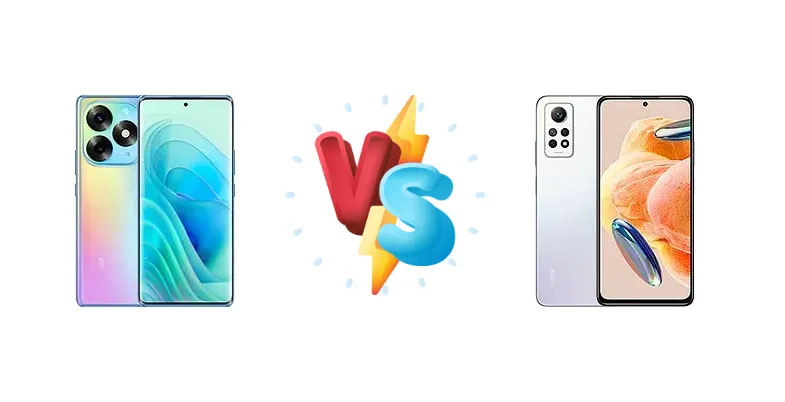
The sub-$200 smartphone market is fiercely competitive. The itel S23+ and Xiaomi Redmi Note 12 Pro 4G represent compelling options, but cater to slightly different priorities. The itel focuses on a streamlined experience, while the Redmi Note 12 Pro 4G aims for a more feature-rich package, particularly in charging speed. This comparison dissects their core components to determine which device delivers the best value.
🏆 Quick Verdict
For the average user prioritizing fast charging and a more powerful chipset, the Xiaomi Redmi Note 12 Pro 4G is the clear winner. Its Snapdragon 732G offers a noticeable performance edge and the 67W charging dramatically reduces downtime. However, the itel S23+ remains a viable option for those on a tighter budget who don't demand peak performance.
| Network |
|---|
| 2G bands | GSM 850 / 900 / 1800 / 1900 | GSM 850 / 900 / 1800 / 1900 |
| 3G bands | HSDPA 850 / 900 / 2100 | HSDPA 850 / 900 / 1700(AWS) / 1900 / 2100 |
| 4G bands | 1, 3, 5, 8, 38, 40, 41 | 1, 2, 3, 4, 5, 7, 8, 20, 28, 38, 40, 41, 66 |
| Speed | HSPA, LTE | HSPA, LTE |
| Technology | GSM / HSPA / LTE | GSM / HSPA / LTE |
| Launch |
|---|
| Announced | 2023, September 19 | 2023, March 03 |
| Status | Available. Released 2023, September 19 | Available. Released 2023, April 11 |
| Body |
|---|
| Build | Glass front, plastic frame, plastic back | - |
| Dimensions | 7.9 mm thickness | 164.2 x 76.1 x 8.1 mm (6.46 x 3.00 x 0.32 in) |
| SIM | Nano-SIM + Nano-SIM | Nano-SIM + Nano-SIM |
| Weight | 178 g (6.28 oz) | 201.8 g (7.13 oz) |
| Display |
|---|
| Protection | Corning Gorilla Glass 5 | - |
| Resolution | 1080 x 2400 pixels, 20:9 ratio (~388 ppi density) | 1080 x 2400 pixels, 20:9 ratio (~395 ppi density) |
| Size | 6.78 inches, 111.0 cm2 | 6.67 inches, 107.4 cm2 (~86.0% screen-to-body ratio) |
| Type | AMOLED, 500 nits (peak) | AMOLED, 120Hz, Dolby Vision, 700 nits (HBM), 1100 nits (peak) |
| Platform |
|---|
| CPU | Octa-core (2x2.0 GHz Cortex-A75 & 6x1.8 GHz Cortex-A55) | Octa-core (2x2.2 GHz Kryo 470 Gold & 6x1.8 GHz Kryo 470 Silver) |
| Chipset | Unisoc Tiger T616 (12 nm) | Qualcomm SM7150 Snapdragon 732G (8 nm) |
| GPU | Mali-G57 MP1 | Adreno 618 |
| OS | Android 13, itel OS 13 | Android 11, MIUI 13 |
| Memory |
|---|
| Card slot | No | microSDXC (uses shared SIM slot) |
| Internal | 128GB 4GB RAM, 256GB 8GB RAM | 128GB 6GB RAM, 128GB 8GB RAM, 256GB 8GB RAM |
| | - | UFS 2.2 |
| Main Camera |
|---|
| Features | LED flash | LED flash, HDR, panorama |
| Quad | - | 108 MP, f/1.9, (wide), 1/1.52", 0.7µm, PDAF
8 MP, 120˚, (ultrawide)
2 MP (macro)
Auxiliary lens |
| Single | 50 MP, f/1.6, (wide), AF
Auxiliary lens | - |
| Video | 1080p@30fps | 4K@30fps, 1080p@30/60fps |
| Selfie camera |
|---|
| Single | 32 MP, f/2.0 | 16 MP, f/2.4, (wide) |
| Video | 1080p@30fps | 1080p@30fps |
| Sound |
|---|
| 3.5mm jack | - | Yes |
| 35mm jack | No | Yes |
| Loudspeaker | Yes | Yes, with stereo speakers |
| Comms |
|---|
| Bluetooth | 5.0, A2DP, LE | 5.0, A2DP, LE |
| Infrared port | - | Yes |
| NFC | Yes (market/region dependent) | Yes (market/region dependent) |
| Positioning | GPS | GPS, GLONASS, GALILEO, BDS |
| Radio | Unspecified | Unspecified |
| USB | USB Type-C 2.0, OTG | USB Type-C 2.0, OTG |
| WLAN | Wi-Fi 802.11 a/b/g/n/ac, dual-band, Wi-Fi Direct | Wi-Fi 802.11 a/b/g/n/ac, dual-band |
| Features |
|---|
| Sensors | Fingerprint (under display, optical), accelerometer, gyro, proximity, compass | Fingerprint (side-mounted), accelerometer, gyro, compass |
| Battery |
|---|
| Charging | 18W wired | 67W wired |
| Type | 5000 mAh | Li-Po 5000 mAh |
| Misc |
|---|
| Colors | Black, Cyan | Star Blue, Graphite Gray, Polar White, Ice blue |
| Models | S681LN | 2209116AG, 2209116AG |
| Price | About 110 EUR | About 150 EUR |
itel S23+
- More affordable price point
- Acceptable performance for basic tasks
- Functional and reliable
- Slower processor compared to the competition
- Significantly slower charging speed
Xiaomi Redmi Note 12 Pro 4G
- Faster and more efficient Snapdragon 732G chipset
- Ultra-fast 67W wired charging
- Likely superior camera performance
- Higher price compared to the itel S23+
- May still lack some premium features found in higher-end phones
Display Comparison
Neither device boasts a flagship-level display, but details are scarce on the itel S23+’s panel. The Redmi Note 12 Pro 4G, while not specified in the provided data, typically features a 6.67-inch AMOLED display, common for this price bracket. The key differentiator lies in charging; the Redmi’s faster charging is more impactful than potential display differences. We can assume the itel S23+ uses an LCD panel, which will have lower contrast and color accuracy compared to the Redmi’s AMOLED.
Camera Comparison
Without detailed camera specs, a direct comparison is limited. However, the Redmi Note 12 Pro 4G, based on its market positioning, likely features a more sophisticated camera system with a larger primary sensor and potentially Optical Image Stabilization (OIS). The Unisoc T616’s image signal processor (ISP) is less capable than the Snapdragon 732G’s, meaning the itel S23+ will likely struggle in low-light conditions and produce less detailed images. The presence of a 2MP macro camera on either device is largely a marketing gimmick and should not be a deciding factor.
Performance
The core difference here is the chipset. The Xiaomi Redmi Note 12 Pro 4G’s Qualcomm Snapdragon 732G, built on an 8nm process, demonstrably outperforms the itel S23+’s Unisoc Tiger T616 (12nm). The 8nm node translates to better power efficiency and thermal management, meaning the Snapdragon 732G can sustain peak performance for longer periods. While both CPUs feature a 2x2.0/1.8 GHz core configuration, the Snapdragon’s Kryo 470 Gold cores are architecturally superior to the Cortex-A75 in the Unisoc, resulting in faster single-core performance. This impacts app launch speeds and overall responsiveness. The Redmi will handle multitasking and moderately demanding games with greater ease.
Battery Life
The Redmi Note 12 Pro 4G’s 67W wired charging is a game-changer. This allows for a full charge in under an hour, a significant advantage over the itel S23+’s 18W charging. While battery capacity isn’t specified for either device, the faster charging speed of the Redmi effectively mitigates any potential capacity disadvantage. Users who frequently find themselves needing to top up their phone will greatly benefit from the Redmi’s charging capabilities.
Buying Guide
Buy the itel S23+ if you need a functional, everyday smartphone with acceptable performance for basic tasks and prioritize affordability above all else. Buy the Xiaomi Redmi Note 12 Pro 4G if you prefer a smoother user experience, faster app loading times, and significantly quicker charging, even if it means spending a bit more.
Frequently Asked Questions
❓ Will the Unisoc Tiger T616 in the itel S23+ struggle with demanding games like PUBG Mobile?
Yes, the Unisoc Tiger T616 is not a gaming-focused chipset. While it can run PUBG Mobile, you'll likely need to lower graphics settings to achieve a playable frame rate. Expect occasional stuttering and longer loading times compared to the Snapdragon 732G.
❓ How long does it *actually* take to fully charge the Xiaomi Redmi Note 12 Pro 4G with the 67W charger?
The Redmi Note 12 Pro 4G can typically charge from 0% to 100% in around 46 minutes with the included 67W charger. This is a significant time saving compared to the itel S23+'s 18W charging, which could take well over two hours.
❓ Is the difference in chipset performance between the Snapdragon 732G and Unisoc T616 noticeable in everyday use?
Absolutely. The Snapdragon 732G offers a smoother and more responsive experience when navigating the user interface, opening apps, and multitasking. The difference is particularly noticeable when switching between multiple apps or running resource-intensive applications.