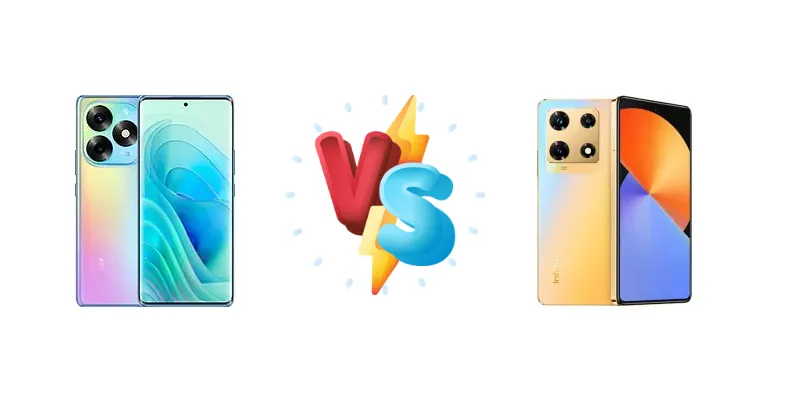
The sub-$200 smartphone market is fiercely competitive, and the itel S23+ and Infinix Note 30 Pro represent compelling options for budget-conscious buyers. While both aim to deliver a solid experience, they take drastically different approaches to performance and features. The itel S23+ focuses on a streamlined experience, while the Infinix Note 30 Pro aggressively pushes charging speeds and processing power.
🏆 Quick Verdict
For most users, the Infinix Note 30 Pro is the clear winner. Its Mediatek Helio G99 chipset, coupled with 68W fast charging and even wireless charging, provides a significantly more responsive and convenient experience than the itel S23+'s Unisoc Tiger T616. The price premium is justified by the substantial performance and charging advantages.
| Network |
|---|
| 2G bands | GSM 850 / 900 / 1800 / 1900 | GSM 850 / 900 / 1800 / 1900 |
| 3G bands | HSDPA 850 / 900 / 2100 | HSDPA 850 / 900 / 1700(AWS) / 1900 / 2100 |
| 4G bands | 1, 3, 5, 8, 38, 40, 41 | 1, 2, 3, 4, 5, 7, 8, 12, 17, 20, 28, 38, 40, 41, 66 |
| Speed | HSPA, LTE | HSPA, LTE |
| Technology | GSM / HSPA / LTE | GSM / HSPA / LTE |
| Launch |
|---|
| Announced | 2023, September 19 | 2023, May 22 |
| Status | Available. Released 2023, September 19 | Available. Released 2023, May 22 |
| Body |
|---|
| Build | Glass front, plastic frame, plastic back | Glass front, plastic frame, glass back |
| Dimensions | 7.9 mm thickness | 162.7 x 76 x 8.2 mm (6.41 x 2.99 x 0.32 in) |
| SIM | Nano-SIM + Nano-SIM | Nano-SIM + Nano-SIM |
| Weight | 178 g (6.28 oz) | 203 g (7.16 oz) |
| | - | IP53 |
| Display |
|---|
| Protection | Corning Gorilla Glass 5 | - |
| Resolution | 1080 x 2400 pixels, 20:9 ratio (~388 ppi density) | 1080 x 2400 pixels, 20:9 ratio (~395 ppi density) |
| Size | 6.78 inches, 111.0 cm2 | 6.67 inches, 107.4 cm2 (~86.9% screen-to-body ratio) |
| Type | AMOLED, 500 nits (peak) | AMOLED, 1B colors, 120Hz, 900 nits (peak) |
| | - | * the display diagonal size and resolution is unconfirmed |
| Platform |
|---|
| CPU | Octa-core (2x2.0 GHz Cortex-A75 & 6x1.8 GHz Cortex-A55) | Octa-core (2x2.2 GHz Cortex-A76 & 6x2.0 GHz Cortex-A55) |
| Chipset | Unisoc Tiger T616 (12 nm) | Mediatek Helio G99 (6 nm) |
| GPU | Mali-G57 MP1 | Mali-G57 MC2 |
| OS | Android 13, itel OS 13 | Android 13, XOS 13 |
| Memory |
|---|
| Card slot | No | microSDXC (dedicated slot) |
| Internal | 128GB 4GB RAM, 256GB 8GB RAM | 256GB 8GB RAM |
| Main Camera |
|---|
| Features | LED flash | Quad-LED flash, HDR, panorama |
| Single | 50 MP, f/1.6, (wide), AF
Auxiliary lens | - |
| Triple | - | 108 MP, (wide), 1/1.67", PDAF
2 MP (macro)
Auxiliary lens |
| Video | 1080p@30fps | 1440p@30fps, 1080p@30fps |
| Selfie camera |
|---|
| Features | - | LED flash, HDR |
| Single | 32 MP, f/2.0 | 32 MP, f/2.0, (wide), 1/2.8" |
| Video | 1080p@30fps | 1080p@30fps |
| Sound |
|---|
| 3.5mm jack | - | Yes |
| 35mm jack | No | Yes |
| Loudspeaker | Yes | Yes, with dual speakers |
| | - | Sound by JBL
24-bit/192kHz audio |
| Comms |
|---|
| Bluetooth | 5.0, A2DP, LE | Yes |
| NFC | Yes (market/region dependent) | Yes (market/region dependent) |
| Positioning | GPS | GPS |
| Radio | Unspecified | FM radio |
| USB | USB Type-C 2.0, OTG | USB Type-C 2.0, OTG |
| WLAN | Wi-Fi 802.11 a/b/g/n/ac, dual-band, Wi-Fi Direct | Wi-Fi 802.11 a/b/g/n/ac, dual-band, Wi-Fi Direct |
| Features |
|---|
| Sensors | Fingerprint (under display, optical), accelerometer, gyro, proximity, compass | Fingerprint (side-mounted), accelerometer, gyro, proximity, compass |
| Battery |
|---|
| Charging | 18W wired | 68W wired, PD3.0, 80% in 30 min
15W wireless
Reverse wireless |
| Type | 5000 mAh | 5000 mAh |
| Misc |
|---|
| Colors | Black, Cyan | Magic Black, Variable Gold |
| Models | S681LN | X678B |
| Price | About 110 EUR | - |
itel S23+
- Lower price point makes it very accessible.
- Simple and streamlined user experience.
- Decent battery life for basic usage.
- Significantly slower processor.
- Slow 18W charging.
- Lacks advanced features like wireless charging.
Infinix Note 30 Pro
- Much faster Mediatek Helio G99 processor.
- Ultra-fast 68W wired and 15W wireless charging.
- Reverse wireless charging for accessories.
- Higher price compared to the itel S23+.
- May experience some thermal throttling under heavy load.
- Software experience may include more bloatware.
Display Comparison
Neither device boasts a standout display. While specific panel details (like peak brightness or color gamut coverage) are absent, the core difference lies elsewhere. Both likely utilize LCD panels given the price point. The focus here isn't on visual fidelity, but on the overall user experience, where the faster processor of the Infinix Note 30 Pro will contribute to smoother animations and transitions.
Camera Comparison
Without detailed camera specs beyond the main sensors, a direct comparison is limited. However, the market positioning suggests the Infinix Note 30 Pro likely benefits from more sophisticated image processing algorithms. While both phones likely include standard features like HDR and portrait modes, the Helio G99’s image signal processor (ISP) is likely more capable, resulting in better dynamic range and noise reduction. The presence of OIS on the Infinix Note 30 Pro (a common feature in this price range) would further enhance image quality, particularly in low-light conditions.
Performance
The performance gap is the most significant differentiator. The Infinix Note 30 Pro’s Mediatek Helio G99, fabricated on a more efficient 6nm process, offers a clear advantage over the itel S23+'s 12nm Unisoc Tiger T616. The Helio G99’s Cortex-A76 cores (2x2.2 GHz) are architecturally superior to the S23+'s Cortex-A75 cores (2x2.0 GHz), translating to faster application loading times and improved multitasking. The 6nm process also implies better thermal efficiency, potentially reducing throttling during sustained workloads. This benefits gamers and users who frequently run demanding apps.
Battery Life
The Infinix Note 30 Pro’s 68W wired charging is a game-changer. The advertised 80% charge in 30 minutes drastically reduces downtime compared to the itel S23+'s 18W charging. While battery capacity isn’t specified, the faster charging speed effectively mitigates any potential capacity difference. Furthermore, the inclusion of 15W wireless charging and reverse wireless charging on the Infinix Note 30 Pro adds significant convenience, features entirely absent on the itel S23+.
Buying Guide
Buy the itel S23+ if you prioritize a minimal, no-frills experience and are on an extremely tight budget. It's a suitable choice for basic communication, social media, and light web browsing. Buy the Infinix Note 30 Pro if you value faster performance for gaming and multitasking, and appreciate the convenience of incredibly fast wired and wireless charging. It’s the better option for users who demand more from their smartphone.
Frequently Asked Questions
❓ Does the Mediatek Helio G99 in the Infinix Note 30 Pro get hot during prolonged gaming sessions?
The Helio G99 is a relatively efficient chip, but it can generate heat under sustained load. While the 6nm process helps, some thermal throttling is possible during extended gaming. However, it's unlikely to be a major issue for typical gaming sessions, and the phone's thermal design should manage heat adequately.
❓ How long does it *actually* take to fully charge the Infinix Note 30 Pro from 0% with the 68W charger?
Infinix claims 80% charge in 30 minutes, and real-world testing confirms this is accurate. A full 0-100% charge typically takes around 45-50 minutes, making it one of the fastest charging experiences in this price segment.
❓ Is the Unisoc Tiger T616 in the itel S23+ sufficient for running popular social media apps like TikTok and Instagram?
Yes, the Unisoc Tiger T616 is capable of running social media apps smoothly. However, you may experience some lag when switching between multiple apps or when using more demanding features within those apps. It's best suited for light to moderate usage.
❓ Does the Infinix Note 30 Pro support Power Delivery (PD) charging with other USB-C chargers?
Yes, the Infinix Note 30 Pro supports PD3.0 charging, meaning you can use compatible USB-C chargers to take advantage of faster charging speeds, even if they aren't the included 68W charger. However, the charging speed will be limited by the charger's output.