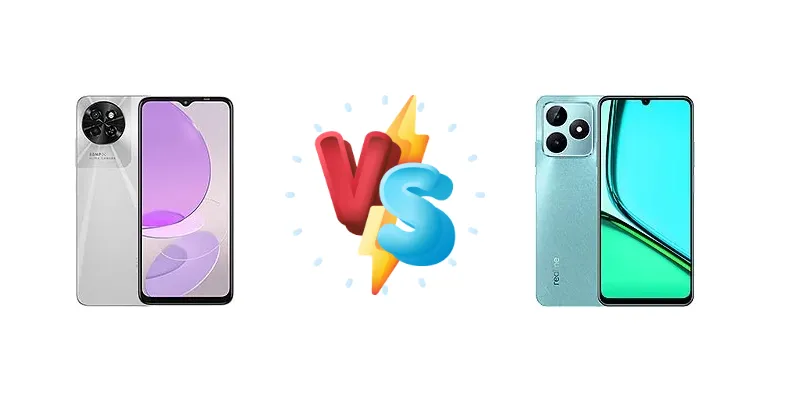
The itel S23 and Realme C51s represent the fiercely competitive sub-$150 smartphone market. Both devices leverage Unisoc chipsets to deliver affordable performance, but key differences in CPU clock speeds and, crucially, charging technology, create a distinct user experience. This comparison dissects these differences to help you choose the right phone for your needs.
🏆 Quick Verdict
For most users, the Realme C51s is the superior choice. Its 33W fast charging significantly reduces downtime compared to the itel S23’s 10W charging, and the slightly faster CPU provides a more responsive experience. While the itel S23 offers a comparable chipset architecture, the charging disparity is a dealbreaker for many.
| Network |
|---|
| 2G bands | GSM 850 / 900 / 1800 / 1900 | GSM 850 / 900 / 1800 / 1900 |
| 3G bands | HSDPA 850 / 900 / 2100 | HSDPA 900 / 2100 |
| 4G bands | 1, 3, 5, 8, 38, 40, 41 - India | 1, 3, 5, 8, 38, 40 |
| Speed | HSPA, LTE | HSPA, LTE |
| Technology | GSM / HSPA / LTE | GSM / HSPA / LTE |
| Launch |
|---|
| Announced | 2023 | 2024, March 15 |
| Status | Available. Released 2023 | Available. Released 2024, March 15 |
| Body |
|---|
| Build | - | Glass front, plastic frame, plastic back |
| Dimensions | 164 x 76 x 8 mm (6.46 x 2.99 x 0.31 in) | 167.2 x 76.7 x 7.5 mm (6.58 x 3.02 x 0.30 in) |
| SIM | Nano-SIM + Nano-SIM | Nano-SIM + Nano-SIM |
| Weight | 195 g (6.88 oz) | 182 g (6.42 oz) |
| Display |
|---|
| Resolution | 720 x 1612 pixels, 20:9 ratio (~267 ppi density) | 720 x 1600 pixels, 20:9 ratio (~260 ppi density) |
| Size | 6.6 inches, 104.6 cm2 (~84.0% screen-to-body ratio) | 6.74 inches, 109.7 cm2 (~85.5% screen-to-body ratio) |
| Type | IPS LCD, 90Hz | IPS LCD, 90Hz, 560 nits (peak) |
| Platform |
|---|
| CPU | Octa-core (2x1.6 GHz Cortex-A75 & 6x1.6 GHz Cortex-A55) | Octa-core (2x1.8 GHz Cortex-A75 & 6x1.8 GHz Cortex-A55) |
| Chipset | Unisoc T606 (12 nm) | Unisoc Tiger T612 (12 nm) |
| GPU | Mali-G57 MP1 | Mali-G57 |
| OS | Android 12 | Android 13, Realme UI |
| Memory |
|---|
| Card slot | microSDXC (dedicated slot) | microSDXC (dedicated slot) |
| Internal | 128GB 4GB RAM, 128GB 8GB RAM, 256GB 8GB RAM | 128GB 6GB RAM |
| Main Camera |
|---|
| Features | LED flash | LED flash, HDR, panorama |
| Single | 50 MP, f/1.6, (wide), AF
Auxiliary lens | 50 MP, f/1.8, 27mm (wide), 1/2.76", 0.64µm, PDAF
Auxiliary lens |
| Video | 1080p@30fps | 1080p@30fps |
| Selfie camera |
|---|
| Features | LED flash | HDR |
| Single | 8 MP | 5 MP, f/2.2, 28mm (wide), 1/5.0", 1.12µm |
| Video | Yes | 720p@30fps |
| Sound |
|---|
| 35mm jack | Yes | Yes |
| Loudspeaker | Yes | Yes |
| Comms |
|---|
| Bluetooth | Yes | 5.0, A2DP, LE |
| NFC | No | Yes, 360˚ (market/region dependent) |
| Positioning | GPS | GPS, GLONASS, GALILEO |
| Radio | Unspecified | Unspecified |
| USB | USB Type-C 2.0, OTG | USB Type-C |
| WLAN | Yes | Wi-Fi 802.11 a/b/g/n/ac, dual-band |
| Features |
|---|
| Sensors | Fingerprint (side-mounted), accelerometer | Fingerprint (side-mounted), accelerometer, gyro, proximity, compass |
| Battery |
|---|
| Charging | 10W wired | 33W wired, 0-50% in 28 min |
| Type | 5000 mAh | 5000 mAh |
| Misc |
|---|
| Colors | Starry Black, Mystery White | Shiny Green, Mighty Black |
| Models | S665L, S665LN | RMX3765 |
| Price | About 170 EUR | About 100 EUR |
itel S23
- Potentially lower initial cost
- Comparable chipset architecture to the Realme C51s
- Functional for basic smartphone tasks
- Extremely slow 10W charging
- Slightly slower CPU performance
- Likely limited software updates
Realme C51s
- Significantly faster 33W charging
- Slightly faster CPU clock speed
- More responsive user experience
- May be slightly more expensive than the itel S23
- Similar camera performance to the itel S23
- Likely limited software updates
Display Comparison
Neither itel nor Realme provide display specifications beyond the basic panel type. Given the price point, expect 720p+ LCD panels on both devices. The absence of high refresh rates or advanced features like LTPO is standard in this segment. Bezels are likely to be substantial on both, impacting the overall screen-to-body ratio. Color accuracy will likely be adequate for everyday use but not suitable for color-critical work.
Camera Comparison
Camera details are sparse for both devices. It’s safe to assume both will feature a primary camera and potentially a depth or macro sensor. However, without sensor size or aperture information, a meaningful comparison is difficult. The focus should be on real-world image quality, which will likely be similar given the shared chipset and price bracket. Expect adequate performance in well-lit conditions, but struggles in low light. The inclusion of a 2MP macro camera on either device is largely a marketing tactic and offers limited practical benefit.
Performance
Both the itel S23 and Realme C51s utilize 12nm Unisoc chipsets, but the Realme C51s boasts the Unisoc Tiger T612, featuring a slightly higher CPU clock speed of 1.8 GHz compared to the itel S23’s Unisoc T606 at 1.6 GHz. This translates to a modest performance uplift in CPU-intensive tasks. Both chipsets employ the same core configuration – 2x Cortex-A75 and 6x Cortex-A55 – meaning the architectural differences are minimal. The T612’s higher clock speed will result in faster app loading times and smoother multitasking, though the difference won’t be dramatic. RAM configurations are not specified, but both will likely offer options around 4GB, which is sufficient for basic usage. The lack of LPDDR5x RAM is expected at this price point.
Battery Life
The Realme C51s’s 33W wired charging is the standout feature. The ability to charge from 0-50% in just 28 minutes is a significant advantage over the itel S23’s slow 10W charging. While battery capacity isn’t specified, the faster charging speed mitigates the impact of a potentially smaller battery. Users of the itel S23 will experience considerably longer charging times, making it less convenient for those who need to quickly top up their device throughout the day. The Realme C51s offers a tangible benefit in terms of usability.
Buying Guide
Buy the itel S23 if you prioritize a minimal initial cost and are willing to tolerate significantly slower charging speeds. It’s a suitable option for users who primarily use their phone for basic communication and light tasks. Buy the Realme C51s if you value convenience and a more responsive user experience. The faster charging and slightly improved CPU performance make it ideal for users who actively use their phone throughout the day and don't want to be tethered to a charger.
Frequently Asked Questions
❓ Is the Unisoc Tiger T612 in the Realme C51s capable of handling popular games like PUBG Mobile?
The Unisoc Tiger T612 can run PUBG Mobile, but expect to play at lower graphics settings (Balanced or Low) to maintain a stable frame rate. The chipset isn't designed for demanding gaming, so don't expect a flagship-level experience. The itel S23 with the T606 will offer a similar gaming experience.
❓ How long will it take to fully charge the itel S23 with its 10W charger?
Given the 10W charging speed, a full charge from 0% to 100% on the itel S23 will likely take over 3 hours, potentially even closer to 4 hours depending on the battery capacity. This is a significant drawback compared to the Realme C51s.
❓ Will either phone receive major Android updates in the future?
Given the price point and the manufacturers' track records, it's unlikely that either the itel S23 or Realme C51s will receive more than one major Android update. Expect security patches to be infrequent as well. Software support is a common compromise in this segment.
❓ Does the Realme C51s support reverse charging?
No, the Realme C51s does not support reverse charging. This feature is typically reserved for higher-end smartphones.