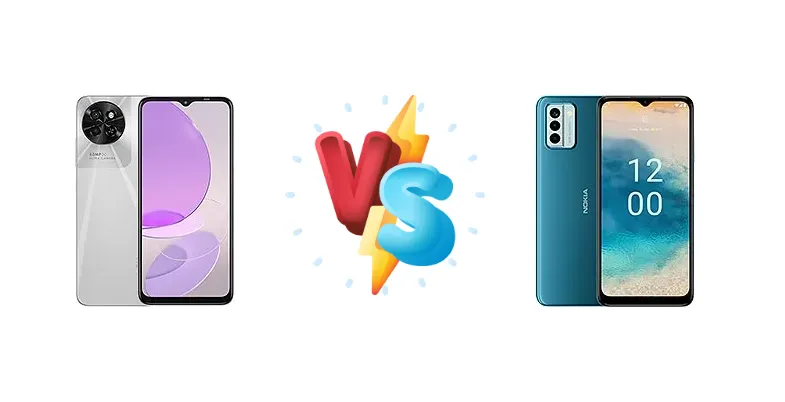
The itel S23 and Nokia G22 represent compelling options in the ultra-budget smartphone segment. Both devices utilize the Unisoc T606 chipset, creating a surprisingly close contest. However, key differences in charging capabilities and potentially build quality separate these two, making the choice less straightforward than it appears.
🏆 Quick Verdict
For the average user prioritizing convenience and faster power-ups, the Nokia G22 is the better choice. Its 20W charging with PD3.0 support significantly reduces charging times compared to the itel S23’s 10W standard. While performance is identical, the G22’s charging advantage is a practical benefit.
| Network |
|---|
| 2G bands | GSM 850 / 900 / 1800 / 1900 | GSM 850 / 900 / 1800 / 1900 |
| 3G bands | HSDPA 850 / 900 / 2100 | HSDPA 850 / 900 / 2100 |
| 4G bands | 1, 3, 5, 8, 38, 40, 41 - India | 1, 3, 5, 7, 8, 20, 28, 38, 39, 40, 41 |
| Speed | HSPA, LTE | HSPA, LTE |
| Technology | GSM / HSPA / LTE | GSM / HSPA / LTE |
| Launch |
|---|
| Announced | 2023 | 2023, February 25 |
| Status | Available. Released 2023 | Available. Released 2023, February 25 |
| Body |
|---|
| Build | - | Glass front (Gorilla Glass 3), plastic frame, plastic back |
| Dimensions | 164 x 76 x 8 mm (6.46 x 2.99 x 0.31 in) | 165 x 76.2 x 8.5 mm (6.50 x 3.00 x 0.33 in) |
| SIM | Nano-SIM + Nano-SIM | Nano-SIM + Nano-SIM |
| Weight | 195 g (6.88 oz) | 196.2 g (6.91 oz) |
| | - | Dust and splash resistant
QuickFix user-reparable design |
| Display |
|---|
| Protection | - | Corning Gorilla Glass 3 |
| Resolution | 720 x 1612 pixels, 20:9 ratio (~267 ppi density) | 720 x 1600 pixels, 20:9 ratio (~270 ppi density) |
| Size | 6.6 inches, 104.6 cm2 (~84.0% screen-to-body ratio) | 6.5 inches, 102.0 cm2 (~81.1% screen-to-body ratio) |
| Type | IPS LCD, 90Hz | IPS LCD, 90Hz, 500 nits (typ) |
| Platform |
|---|
| CPU | Octa-core (2x1.6 GHz Cortex-A75 & 6x1.6 GHz Cortex-A55) | Octa-core (2x1.6 GHz Cortex-A75 & 6x1.6 GHz Cortex-A55) |
| Chipset | Unisoc T606 (12 nm) | Unisoc T606 (12 nm) |
| GPU | Mali-G57 MP1 | Mali-G57 MP1 |
| OS | Android 12 | Android 12 |
| Memory |
|---|
| Card slot | microSDXC (dedicated slot) | microSDXC (uses shared SIM slot) |
| Internal | 128GB 4GB RAM, 128GB 8GB RAM, 256GB 8GB RAM | 64GB 4GB RAM, 128GB 4GB RAM, 256GB 6GB RAM |
| | - | UFS 2.2 |
| Main Camera |
|---|
| Features | LED flash | LED flash, HDR, panorama |
| Single | 50 MP, f/1.6, (wide), AF
Auxiliary lens | - |
| Triple | - | 50 MP, f/1.8, (wide), 1/2.76", 0.64µm, PDAF
2 MP (macro)
Auxiliary lens |
| Video | 1080p@30fps | 1080p@30fps |
| Selfie camera |
|---|
| Features | LED flash | - |
| Single | 8 MP | 8 MP, f/2.0, (wide) |
| Video | Yes | 1080p@30fps |
| Sound |
|---|
| 3.5mm jack | - | Yes |
| 35mm jack | Yes | Yes |
| Loudspeaker | Yes | Yes |
| Comms |
|---|
| Bluetooth | Yes | 5.0, A2DP, LE |
| NFC | No | Yes (market/region dependent) |
| Positioning | GPS | GPS, GLONASS, GALILEO |
| Radio | Unspecified | FM radio, RDS |
| USB | USB Type-C 2.0, OTG | USB Type-C 2.0, OTG |
| WLAN | Yes | Wi-Fi 802.11 a/b/g/n/ac, dual-band |
| Features |
|---|
| Sensors | Fingerprint (side-mounted), accelerometer | Fingerprint (side-mounted), accelerometer, proximity |
| Battery |
|---|
| Charging | 10W wired | 20W wired, PD3.0 |
| Type | 5000 mAh | Li-Po 5050 mAh |
| Misc |
|---|
| Colors | Starry Black, Mystery White | Lagoon Blue, Meteor Gray, So Peach |
| Models | S665L, S665LN | - |
| Price | About 170 EUR | About 120 EUR |
itel S23
- Likely the lowest price point of the two.
- Functional for basic smartphone tasks.
- Unisoc T606 provides adequate performance for everyday use.
- Significantly slower 10W charging.
- Potentially less durable build quality.
- Limited software support compared to Nokia.
Nokia G22
- 20W charging with PD3.0 for faster power-ups.
- Nokia’s brand reputation for software updates and support.
- Potentially more durable build quality.
- Slightly higher price compared to the itel S23.
- Performance is identical to the itel S23.
- May still lack advanced features found in higher-end phones.
Display Comparison
Both the itel S23 and Nokia G22 likely feature LCD panels, typical for this price bracket. Specifics like resolution and peak brightness are not provided, but we can assume they are similar, aiming for a functional viewing experience rather than a premium one. Bezels are likely to be noticeable on both devices, and color accuracy will be standard for budget displays. The lack of high refresh rates or advanced panel technologies like LTPO is expected.
Camera Comparison
Camera details are sparse, but it's safe to assume both phones feature multiple rear cameras, likely including a main sensor and potentially depth or macro lenses. Given the price point, image quality will be heavily reliant on software processing. The absence of Optical Image Stabilization (OIS) is expected. While megapixel counts may differ, the underlying image sensor size and quality will likely be similar, limiting the overall photographic capabilities. Focusing on the main sensor's performance is key, as auxiliary lenses are often of limited utility.
Performance
The core of both devices is the Unisoc T606 (12 nm) chipset, featuring an octa-core CPU configuration with 2x1.6 GHz Cortex-A75 and 6x1.6 GHz Cortex-A55 cores. This means CPU performance will be virtually identical between the two. RAM configurations are not specified, but performance will be constrained by the chipset and likely limited RAM. Thermal management will be adequate for basic tasks, but sustained heavy workloads will likely result in throttling. The GPU performance will also be the same, suitable for light gaming.
Battery Life
Battery capacity is not specified for either device. However, the Nokia G22’s 20W wired charging with Power Delivery 3.0 (PD3.0) is a significant advantage. This allows for faster charging times and compatibility with a wider range of chargers. The itel S23’s 10W charging is considerably slower. While a larger battery capacity on the itel S23 could partially offset this, the convenience of faster charging on the Nokia G22 is a substantial benefit for users who frequently need to top up their devices.
Buying Guide
Buy the itel S23 if you prioritize absolute lowest cost and are willing to accept slower charging speeds. It's a functional device for basic tasks. Buy the Nokia G22 if you value faster charging, potentially better long-term support (given Nokia’s brand reputation), and the convenience of Power Delivery charging, even if it means a slightly higher upfront cost.
Frequently Asked Questions
❓ Does the Unisoc T606 chipset struggle with multitasking on either the itel S23 or Nokia G22?
The Unisoc T606 is a capable chipset for basic multitasking, such as switching between messaging apps and web browsing. However, with limited RAM (specifications not provided), running numerous apps simultaneously or demanding applications may lead to slowdowns and app reloading. Neither device is designed for heavy multitasking.
❓ Is the 20W charging on the Nokia G22 a substantial improvement over the itel S23’s 10W charging in real-world use?
Yes, the 20W charging on the Nokia G22 offers a noticeable improvement. While exact 0-100% times are unavailable, 20W charging will significantly reduce the time required to replenish the battery compared to the slower 10W charging on the itel S23. This is particularly beneficial for users who need a quick power boost throughout the day.
❓ Given the similar hardware, will software updates differentiate the user experience between the itel S23 and Nokia G22?
Potentially. Nokia generally provides more consistent and longer-term software support than itel. This could translate to security updates and potentially even minor feature enhancements over the lifespan of the Nokia G22, offering a more secure and refined user experience compared to the itel S23.