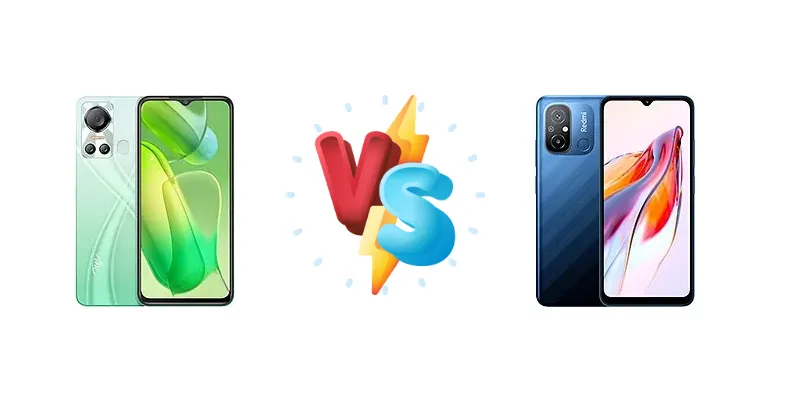
The sub-$150 smartphone market is fiercely competitive. The itel S18 and Xiaomi Redmi 12C represent two popular choices, but cater to slightly different priorities. The itel S18 aims for a balance of features, while the Redmi 12C focuses on delivering a larger display and a more recognizable brand experience. This comparison dissects their core components to determine which device offers the best value.
🏆 Quick Verdict
For most users, the Xiaomi Redmi 12C emerges as the better choice. Its Helio G85 chipset, built on a more efficient 12nm process, provides a noticeable performance advantage over the itel S18’s Unisoc SC9863A. While the itel S18 isn't a bad phone, the Redmi 12C’s superior processing power translates to a smoother user experience, especially with demanding apps.
| Network |
|---|
| 2G bands | GSM 850 / 900 / 1800 / 1900 | GSM 850 / 900 / 1800 / 1900 |
| 3G bands | HSDPA 850 / 900 / 2100 | HSDPA 850 / 900 / 2100 |
| 4G bands | LTE | 1, 3, 5, 7, 8, 20, 28, 38, 40, 41 - International |
| Speed | HSPA, LTE | HSPA, LTE |
| Technology | GSM / HSPA / LTE | GSM / CDMA / HSPA / EVDO / LTE |
| | - | CDMA2000 1xEV-DO |
| Launch |
|---|
| Announced | 2022 | 2022, December 31 |
| Status | Available. Released 2022 | Available. Released 2023, January 01 |
| Body |
|---|
| Dimensions | - | 168.8 x 76.4 x 8.8 mm (6.65 x 3.01 x 0.35 in) |
| SIM | Dual SIM | Nano-SIM + Nano-SIM |
| Weight | - | 192 g (6.77 oz) |
| Display |
|---|
| Resolution | 720 x 1612 pixels, 20:9 ratio (~267 ppi density) | 720 x 1650 pixels (~268 ppi density) |
| Size | 6.6 inches, 104.6 cm2 | 6.71 inches, 106.5 cm2 (~82.6% screen-to-body ratio) |
| Type | IPS LCD | IPS LCD, 500 nits (typ) |
| Platform |
|---|
| CPU | Octa-core (4x1.6 GHz Cortex-A55 & 4x1.2 GHz Cortex-A55) | Octa-core (2x2.0 GHz Cortex-A75 & 6x1.8 GHz Cortex-A55) |
| Chipset | Unisoc SC9863A (28 nm) | Mediatek MT6769Z Helio G85 (12 nm) |
| GPU | IMG8322 | Mali-G52 MC2 |
| OS | Android 11 (Go edition) | Android 12, MIUI 13 |
| Memory |
|---|
| Card slot | microSDXC | microSDXC (dedicated slot) |
| Internal | 64GB 2GB RAM | 32GB 2GB RAM, 32GB 3GB RAM, 32GB 4GB RAM, 64GB 3GB RAM, 64GB 4GB RAM, 128GB 3GB RAM, 128GB 4GB RAM, 128GB 6GB RAM |
| | - | eMMC 5.1 |
| Main Camera |
|---|
| Dual | 8 MP (wide)
0.08 MP (macro)
Auxiliary lens | 50 MP, (wide), PDAF
0.08 MP (depth) |
| Features | Dual-LED flash | LED flash, HDR |
| Single | - | 50 MP, f/1.8, (wide), 1/2.76", PDAF
Auxiliary lens |
| Video | Yes | 1080p@30fps |
| Selfie camera |
|---|
| Single | 8 MP | 5 MP, f/2.2, (wide) |
| Video | Yes | 1080p@30fps |
| Sound |
|---|
| 3.5mm jack | - | Yes |
| 35mm jack | Yes | Yes |
| Loudspeaker | Yes | Yes |
| Comms |
|---|
| Bluetooth | Yes | 5.1, A2DP, LE |
| NFC | No | Yes (market/region dependent) |
| Positioning | GPS | GPS, GLONASS, BDS, GALILEO |
| Radio | Unspecified | FM radio |
| USB | microUSB | microUSB 2.0 |
| WLAN | Yes | Wi-Fi 802.11 a/b/g/n/ac, dual-band, Wi-Fi Direct |
| Features |
|---|
| Sensors | Fingerprint (rear-mounted), accelerometer | Fingerprint (rear-mounted), accelerometer |
| | - | Virtual proximity sensing |
| Battery |
|---|
| Charging | - | 10W wired |
| Type | 5000 mAh | Li-Po 5000 mAh |
| Misc |
|---|
| Colors | Mint Green, Digital Sliver, Midnight Black | Graphite Gray, Ocean Blue, Mint Green, Lavender Purple |
| Models | - | 22120RN86G, 22120RN86I, 22126RN91Y, 2212ARNC4L |
| Price | - | £ 132.99 / € 107.41 |
| SAR | - | 1.08 W/kg (head) 0.64 W/kg (body) |
| SAR EU | - | 0.98 W/kg (head) 0.99 W/kg (body) |
itel S18
- Potentially lower price point
- May offer unique software features
- Slightly more compact size
- Significantly weaker processor
- Less efficient chipset
- Likely slower app loading times
Xiaomi Redmi 12C
- More powerful Helio G85 chipset
- Larger display for immersive viewing
- 5000mAh battery for all-day use
- Slow 10W charging
- Larger size may be less comfortable for some
- Software experience may include bloatware
Display Comparison
Neither device boasts a standout display. Both likely utilize LCD panels, a common trait in this price bracket. However, details like peak brightness and color accuracy are unavailable. The Redmi 12C’s larger screen size (6.71 inches vs. the itel S18’s 6.6 inches) offers a more immersive viewing experience, though this comes at the cost of potentially lower pixel density. Bezels are expected to be substantial on both devices, reflecting their budget nature.
Camera Comparison
Camera performance is likely to be similar, with both devices relying on basic sensors. Details on sensor sizes and apertures are missing, but it’s safe to assume both will feature a primary camera and potentially a depth or macro sensor. Given the price point, image quality will be acceptable in good lighting conditions but will suffer in low light. The Redmi 12C may benefit from slightly better image processing capabilities due to the more powerful chipset, but the difference is unlikely to be dramatic. Focusing on the main sensor is key, as auxiliary sensors (like 2MP macros) offer limited practical value.
Performance
The core difference lies in the chipsets. The Xiaomi Redmi 12C’s MediaTek Helio G85 (12nm) is significantly more powerful than the itel S18’s Unisoc SC9863A (28nm). The Helio G85 features two Cortex-A75 cores clocked at 2.0 GHz, providing a substantial boost in single-core performance compared to the itel’s four Cortex-A55 cores at 1.6 GHz. This translates to faster app loading times, smoother multitasking, and a more enjoyable gaming experience on the Redmi 12C. The 12nm process also contributes to better power efficiency, potentially extending battery life. The itel S18’s chipset, while adequate for basic tasks, will struggle with more demanding applications.
Battery Life
Battery capacity is not specified for the itel S18, but the Redmi 12C packs a 5000mAh battery. The Redmi 12C’s 10W charging is slow by modern standards, requiring a significant amount of time to fully charge. However, the Helio G85’s improved power efficiency may offset the slower charging speed, providing comparable or even better real-world battery life compared to a device with a larger battery but a less efficient chipset. Without knowing the itel S18’s battery capacity, a direct comparison is difficult, but the Redmi 12C’s larger capacity provides a clear advantage.
Buying Guide
Buy the itel S18 if you prioritize a potentially lower price point and are primarily focused on basic smartphone tasks like calling, texting, and light social media use. Buy the Xiaomi Redmi 12C if you value a more responsive user experience, better performance in apps and games, and the backing of a well-established brand with wider software support.
Frequently Asked Questions
❓ Will the Redmi 12C’s Helio G85 handle popular games like PUBG Mobile?
The Helio G85 is capable of running PUBG Mobile, but you’ll likely need to lower the graphics settings to medium or low to achieve a smooth frame rate. The itel S18’s Unisoc SC9863A will struggle with PUBG Mobile, even on the lowest settings.
❓ Is the 10W charging on the Redmi 12C a significant drawback?
Yes, 10W charging is slow compared to modern standards. Expect a full charge to take over 3 hours. However, the Redmi 12C’s 5000mAh battery and the Helio G85’s efficiency mean you won’t need to charge it as frequently.
❓ Does the itel S18 offer any software features not found on the Redmi 12C?
itel often includes unique software customizations, but these can vary by region. It's difficult to say definitively without testing a specific unit. However, Xiaomi’s MIUI is a more mature and widely supported software experience.
❓ Which phone is better for streaming videos?
The Redmi 12C’s larger display and more powerful processor make it the better choice for streaming videos. It will handle video playback more smoothly and offer a more immersive viewing experience.