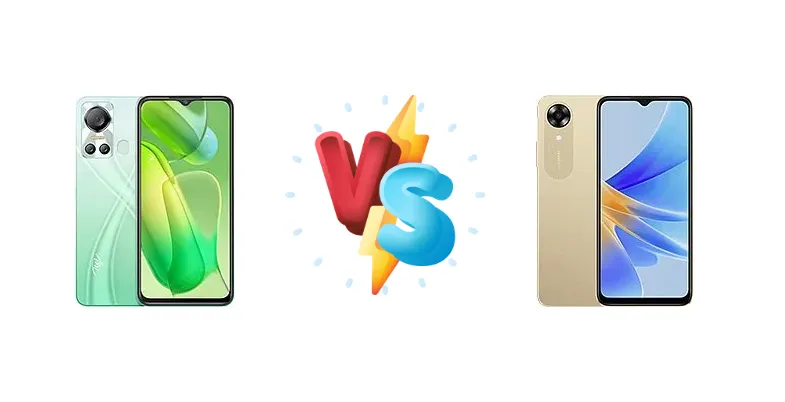
The itel S18 and Oppo A17k represent two contenders in the fiercely competitive sub-$150 smartphone market. Both aim to deliver essential smartphone functionality at an accessible price point, but they achieve this with significantly different hardware choices. This comparison dissects those choices, focusing on real-world performance implications for the average user.
🏆 Quick Verdict
For most users, the Oppo A17k offers a more responsive experience thanks to its Mediatek Helio G35 chipset fabricated on a smaller 12nm process. While the itel S18 is a viable option, the A17k’s CPU clock speeds and more modern architecture provide a noticeable edge in daily tasks and light gaming.
| Network |
|---|
| 2G bands | GSM 850 / 900 / 1800 / 1900 | GSM 850 / 900 / 1800 / 1900 |
| 3G bands | HSDPA 850 / 900 / 2100 | HSDPA 850 / 900 / 2100 |
| 4G bands | LTE | 1, 3, 5, 8, 38, 40, 41 |
| Speed | HSPA, LTE | HSPA, LTE |
| Technology | GSM / HSPA / LTE | GSM / HSPA / LTE |
| Launch |
|---|
| Announced | 2022 | 2022, October 13 |
| Status | Available. Released 2022 | Available. Released 2022, October 18 |
| Body |
|---|
| Dimensions | - | 164.2 x 75.6 x 8.3 mm (6.46 x 2.98 x 0.33 in) |
| SIM | Dual SIM | Nano-SIM + Nano-SIM |
| Weight | - | 189 g (6.67 oz) |
| | - | IPX4 water resistance |
| Display |
|---|
| Protection | - | Panda Glass |
| Resolution | 720 x 1612 pixels, 20:9 ratio (~267 ppi density) | 720 x 1612 pixels, 20:9 ratio (~269 ppi density) |
| Size | 6.6 inches, 104.6 cm2 | 6.56 inches, 103.4 cm2 (~83.3% screen-to-body ratio) |
| Type | IPS LCD | IPS LCD, 480 nits (typ), 600 nits (HBM) |
| Platform |
|---|
| CPU | Octa-core (4x1.6 GHz Cortex-A55 & 4x1.2 GHz Cortex-A55) | Octa-core (4x2.3 GHz Cortex-A53 & 4x1.8 GHz Cortex-A53) |
| Chipset | Unisoc SC9863A (28 nm) | Mediatek MT6765 Helio G35 (12 nm) |
| GPU | IMG8322 | PowerVR GE8320 |
| OS | Android 11 (Go edition) | Android 12, ColorOS 12.1 |
| Memory |
|---|
| Card slot | microSDXC | microSDXC |
| Internal | 64GB 2GB RAM | 64GB 3GB RAM |
| | - | eMMC 5.1 |
| Main Camera |
|---|
| Dual | 8 MP (wide)
0.08 MP (macro)
Auxiliary lens | - |
| Features | Dual-LED flash | LED flash, panorama |
| Single | - | 8 MP, f/2.0, (wide), AF |
| Video | Yes | 1080p@30fps |
| Selfie camera |
|---|
| Single | 8 MP | 5 MP, f/2.2, (wide) |
| Video | Yes | 1080p@30fps |
| Sound |
|---|
| 3.5mm jack | - | Yes |
| 35mm jack | Yes | Yes |
| Loudspeaker | Yes | Yes |
| Comms |
|---|
| Bluetooth | Yes | 5.3, A2DP, LE, aptX HD |
| NFC | No | No |
| Positioning | GPS | GPS, GLONASS, BDS, GALILEO |
| Radio | Unspecified | Unspecified |
| USB | microUSB | microUSB 2.0, OTG |
| WLAN | Yes | Wi-Fi 802.11 a/b/g/n/ac, dual-band |
| Features |
|---|
| Sensors | Fingerprint (rear-mounted), accelerometer | Fingerprint (side-mounted), accelerometer, proximity, compass |
| Battery |
|---|
| Type | 5000 mAh | Li-Po 5000 mAh |
| Misc |
|---|
| Colors | Mint Green, Digital Sliver, Midnight Black | Navy Blue, Gold |
| Models | - | CPH2471 |
| Price | - | About 130 EUR |
itel S18
- Potentially lower price point
- May offer slightly longer standby time (depending on battery capacity)
- Simple and straightforward user experience
- Significantly slower processor
- Less responsive user interface
- Likely to struggle with multitasking
Oppo A17k
- Faster and more efficient processor
- Smoother user experience
- Better performance for casual gaming
- May be slightly more expensive
- Potentially shorter battery life (depending on capacity)
- Basic camera performance
Display Comparison
Neither device boasts a standout display. Details regarding panel type (IPS vs TFT) and resolution are missing, but both likely feature basic LCD panels. The key difference lies under the hood: processing power impacts UI responsiveness, which affects perceived display smoothness. Without specific brightness data, it's difficult to assess outdoor visibility, but both are likely to struggle in direct sunlight. Bezels are expected to be substantial on both devices, typical for this price bracket.
Camera Comparison
Camera performance on both devices is expected to be basic. Details regarding sensor size and image processing are unavailable, but the market segment suggests reliance on software algorithms to enhance image quality. The presence of a 2MP macro camera on either device is largely a marketing tactic, offering limited practical benefit due to the small sensor size and low resolution. The primary camera sensor’s quality will be the determining factor, but without specific details, it’s difficult to declare a winner. Expect adequate results in well-lit conditions, but significant noise and lack of detail in low light.
Performance
The Oppo A17k’s Mediatek Helio G35, built on a 12nm process, represents a clear advantage over the itel S18’s Unisoc SC9863A (28nm). The 12nm process allows for greater transistor density and improved power efficiency, translating to less heat generation and potentially sustained performance. The Helio G35’s CPU configuration – 4x2.3 GHz Cortex-A53 cores and 4x1.8 GHz Cortex-A53 cores – is significantly faster than the itel S18’s 4x1.6 GHz Cortex-A55 and 4x1.2 GHz Cortex-A55 setup. While both use Cortex-A series cores, the A53 architecture is older but clocked higher, and the smaller process node gives the A17k an edge. This difference will be most noticeable when multitasking or launching apps. The Unisoc chip's larger process node suggests it will likely throttle more aggressively under sustained load.
Battery Life
Battery capacity details are missing for both devices. However, the more efficient Mediatek Helio G35 in the Oppo A17k will likely result in better battery life, even if the itel S18 has a slightly larger capacity. The 12nm process contributes to lower power consumption during both active use and standby. Charging wattage is also unknown, but faster charging on the A17k could offset a smaller battery capacity, providing quicker top-ups throughout the day.
Buying Guide
Buy the itel S18 if you prioritize a potentially lower price point and are primarily focused on very basic smartphone functions like calls, messaging, and light social media use. Buy the Oppo A17k if you prefer a smoother, more responsive user experience, even for slightly more demanding tasks like browsing with multiple tabs open or playing casual games. The A17k is the better choice for users who value performance over absolute rock-bottom pricing.
Frequently Asked Questions
❓ Will the Oppo A17k be able to run popular social media apps like TikTok and Instagram smoothly?
Yes, the Mediatek Helio G35 in the Oppo A17k is sufficiently powerful to run popular social media apps like TikTok and Instagram without significant lag. The higher clock speeds and more efficient architecture compared to the itel S18’s Unisoc chip will provide a smoother scrolling and video playback experience.
❓ Is the Unisoc SC9863A in the itel S18 suitable for playing mobile games?
The Unisoc SC9863A is not ideal for gaming. While it can handle very basic 2D games, it will struggle with more demanding 3D titles. Expect low frame rates, stuttering, and potential overheating. The Oppo A17k’s Helio G35 offers a noticeably better gaming experience, though still limited to casual games at lower settings.
❓ How much storage does each phone offer, and can it be expanded?
Storage details are not provided in the context data. However, budget smartphones typically offer 32GB or 64GB of internal storage. Both devices likely support microSD card expansion, allowing users to increase storage capacity for photos, videos, and apps. Check the product specifications for maximum supported microSD card size.
❓ What version of Android do these phones run?
The Android version is not specified. However, both devices likely run a customized version of Android Go Edition, designed for low-end hardware. Android Go Edition optimizes the operating system for devices with limited RAM and storage, providing a smoother experience on budget smartphones.