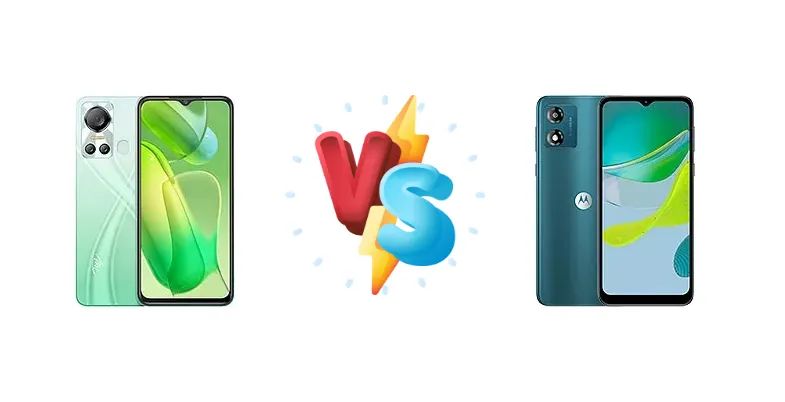
The itel S18 and Motorola Moto E13 represent the very bottom of the smartphone price spectrum, targeting first-time buyers or those needing a reliable secondary device. Both rely on Unisoc chipsets, but employ different architectures and manufacturing processes. This comparison dissects the key differences to determine which offers the best value for your money.
🏆 Quick Verdict
For most users, the Motorola Moto E13 emerges as the slightly better choice. Its newer 12nm Unisoc T606 chipset, featuring Cortex-A75 performance cores, delivers a noticeable performance uplift over the itel S18’s older 28nm SC9863A, making it more responsive for everyday tasks. While charging is slow at 10W, the overall user experience is smoother.
| Network |
|---|
| 2G bands | GSM 850 / 900 / 1800 / 1900 | GSM 850 / 900 / 1800 / 1900 |
| 3G bands | HSDPA 850 / 900 / 2100 | HSDPA 850 / 900 / 2100 |
| 4G bands | LTE | 1, 3, 5, 7, 8, 28, 38, 40, 41 |
| Speed | HSPA, LTE | HSPA, LTE |
| Technology | GSM / HSPA / LTE | GSM / HSPA / LTE |
| | - | 1, 3, 5, 7, 8, 20, 28, 38, 40, 41 |
| Launch |
|---|
| Announced | 2022 | 2023, January 24 |
| Status | Available. Released 2022 | Available. Released 2023, February 13 |
| Body |
|---|
| Build | - | Glass front, plastic frame, plastic back |
| Dimensions | - | 164.2 x 75 x 8.5 mm (6.46 x 2.95 x 0.33 in) |
| SIM | Dual SIM | Nano-SIM + Nano-SIM |
| Weight | - | 179.5 g (6.35 oz) |
| | - | Water-resistant design |
| Display |
|---|
| Resolution | 720 x 1612 pixels, 20:9 ratio (~267 ppi density) | 720 x 1600 pixels, 20:9 ratio (~270 ppi density) |
| Size | 6.6 inches, 104.6 cm2 | 6.5 inches, 102.0 cm2 (~82.8% screen-to-body ratio) |
| Type | IPS LCD | IPS LCD |
| Platform |
|---|
| CPU | Octa-core (4x1.6 GHz Cortex-A55 & 4x1.2 GHz Cortex-A55) | Octa-core (2x1.6 GHz Cortex-A75 & 6x1.6 GHz Cortex-A55) |
| Chipset | Unisoc SC9863A (28 nm) | Unisoc T606 (12 nm) |
| GPU | IMG8322 | Mali-G57 MP1 |
| OS | Android 11 (Go edition) | Android 13 (Go edition) |
| Memory |
|---|
| Card slot | microSDXC | microSDXC (dedicated slot) |
| Internal | 64GB 2GB RAM | 32GB 2GB RAM, 64GB 2GB RAM, 64GB 4GB RAM, 128GB 8GB RAM |
| | - | eMMC 5.1 |
| Main Camera |
|---|
| Dual | 8 MP (wide)
0.08 MP (macro)
Auxiliary lens | - |
| Features | Dual-LED flash | LED flash, HDR, panorama |
| Single | - | 13 MP, f/2.2, (wide), 1.12µm, PDAF |
| Video | Yes | 1080p@30fps |
| Selfie camera |
|---|
| Single | 8 MP | 5 MP, f/2.4, (wide), 1/5.0", 1.12µm |
| Video | Yes | 1080p@30fps |
| Sound |
|---|
| 3.5mm jack | - | Yes |
| 35mm jack | Yes | Yes |
| Loudspeaker | Yes | Yes |
| Comms |
|---|
| Bluetooth | Yes | 5.0, A2DP, LE |
| NFC | No | No |
| Positioning | GPS | GPS, GLONASS, GALILEO |
| Radio | Unspecified | FM radio, recording |
| USB | microUSB | USB Type-C 2.0, OTG |
| WLAN | Yes | Wi-Fi 802.11 a/b/g/n/ac, dual-band |
| Features |
|---|
| Sensors | Fingerprint (rear-mounted), accelerometer | Accelerometer, proximity |
| Battery |
|---|
| Charging | - | 10W wired |
| Type | 5000 mAh | Li-Po 5000 mAh |
| Misc |
|---|
| Colors | Mint Green, Digital Sliver, Midnight Black | Cosmic Black, Creamy White, Aurora Green |
| Price | - | $ 119.99 / € 104.99 |
itel S18
- Potentially longer battery life due to less powerful processor.
- May be available at a slightly lower price point.
- Simple and straightforward user experience.
- Significantly slower performance compared to the Moto E13.
- Older, less efficient chipset.
- Likely limited software support.
Motorola Moto E13
- Faster and more responsive performance thanks to the Unisoc T606.
- More efficient 12nm chipset.
- Defined 10W charging speed.
- Slower charging speed compared to some competitors.
- May be slightly more expensive than the itel S18.
- Basic camera system.
Display Comparison
Neither device boasts a standout display. Both are likely to feature LCD panels, typical for this price point. However, details like resolution and peak brightness are missing. The itel S18’s older chipset may translate to less efficient display driving, potentially impacting battery life. Without specific display specs, it's difficult to declare a clear winner; however, the Moto E13’s newer chipset *could* offer slightly better image processing for display output.
Camera Comparison
Camera performance on both devices is expected to be basic. Details regarding sensor size and image processing are unavailable. Given the price bracket, both likely feature a primary camera paired with a low-resolution depth or macro sensor. The absence of Optical Image Stabilization (OIS) on either device suggests image quality will be heavily reliant on software processing. Without further information, it’s impossible to definitively say which camera performs better; however, the Moto E13’s more capable chipset *could* allow for slightly more sophisticated image processing algorithms.
Performance
This is where the most significant difference lies. The Motorola Moto E13’s Unisoc T606, built on a 12nm process, is a clear upgrade over the itel S18’s 28nm Unisoc SC9863A. The T606’s inclusion of 2x 1.6 GHz Cortex-A75 cores alongside 6x Cortex-A55 cores provides a substantial boost in single-core and multi-core performance compared to the S18’s all Cortex-A55 configuration. This translates to faster app launch times, smoother multitasking, and a more enjoyable overall user experience. The 12nm process also contributes to improved power efficiency, despite the higher performance cores. The itel S18’s older chipset will likely struggle with more demanding applications.
Battery Life
The itel S18 and Motorola Moto E13 likely feature similar battery capacities, typical for entry-level smartphones. However, the Moto E13’s 10W wired charging is a notable specification. While slow by modern standards, it provides a defined charging speed. The itel S18’s charging speed is unknown, but may be even slower. The Unisoc T606’s improved power efficiency in the Moto E13 could offset any capacity differences, potentially leading to comparable real-world battery life despite the more powerful processor.
Buying Guide
Buy the itel S18 if your primary need is a phone for extremely basic tasks – calls, texts, and light social media – and you prioritize potentially longer battery life due to the less powerful processor. Buy the Motorola Moto E13 if you want a more responsive experience for app switching, browsing, and occasional gaming, and are willing to accept slower charging speeds for the performance gain.
Frequently Asked Questions
❓ Will the Motorola Moto E13 struggle with popular apps like WhatsApp and Facebook?
While not a powerhouse, the Unisoc T606 in the Moto E13 is sufficiently capable to run apps like WhatsApp and Facebook smoothly. The Cortex-A75 cores provide a noticeable performance boost over the itel S18, ensuring a more responsive experience even with multiple apps open.
❓ Is the 10W charging on the Moto E13 painfully slow?
Yes, 10W charging is relatively slow compared to modern smartphones. Expect a full charge to take around 2-3 hours. However, given the likely smaller battery capacity and the phone's intended use case (basic tasks), this shouldn't be a major inconvenience for most users.
❓ Can the itel S18 handle basic mobile gaming?
The itel S18 can handle very basic 2D games, but will likely struggle with more demanding 3D titles. The Unisoc SC9863A’s limited processing power and older architecture will result in low frame rates and potential lag.
❓ How long will software support last on these devices?
Software support is likely to be limited on both devices. Expect only one major Android update, if any, and security patches for a relatively short period. Motorola generally offers slightly better software support than itel, but neither is known for long-term updates in this price segment.