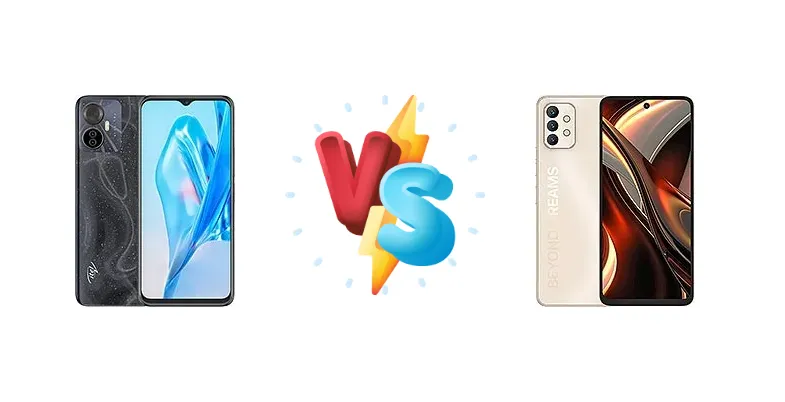
The sub-$200 smartphone market is fiercely competitive, and the itel S18 Pro and Umidigi A13 Pro Max represent compelling options for budget-conscious buyers. However, they approach this segment with vastly different strategies: the itel S18 Pro prioritizes affordability, while the Umidigi A13 Pro Max aims for a more balanced experience with a significantly more powerful chipset. This comparison dissects their key differences to help you choose the right device.
🏆 Quick Verdict
For most users, the Umidigi A13 Pro Max is the clear winner. Its Mediatek Dimensity 900 chipset delivers a substantially smoother and more responsive experience than the itel S18 Pro’s Unisoc SC9863A, making it better suited for multitasking, gaming, and future-proofing. While the itel S18 Pro is cheaper, the performance gap is too significant to ignore for all but the most basic users.
| Network |
|---|
| 2G bands | GSM 850 / 900 / 1800 / 1900 | GSM 850 / 900 / 1800 / 1900 |
| 3G bands | HSDPA 850 / 900 / 2100 | HSDPA 800 / 850 / 900 / 1700(AWS) / 1900 / 2100 |
| 4G bands | LTE | 1, 2, 3, 4, 5, 7, 8, 12, 13, 17, 18, 19, 20, 25, 26, 28, 34, 38, 39, 40, 41, 66 |
| 5G bands | - | 1, 2, 3, 5, 7, 8, 12, 20, 25, 28, 38, 40, 41, 66, 77, 78 SA/NSA |
| Speed | HSPA, LTE | HSPA, LTE, 5G |
| Technology | GSM / HSPA / LTE | GSM / CDMA / HSPA / LTE / 5G |
| Launch |
|---|
| Announced | 2023 | 2022 |
| Status | Available. Released 2023 | Available. Released 2022 |
| Body |
|---|
| Dimensions | - | 168.5 x 76.3 x 8.8 mm (6.63 x 3.00 x 0.35 in) |
| SIM | Dual SIM | Nano-SIM + Nano-SIM |
| Weight | - | 200 g (7.05 oz) |
| Display |
|---|
| Resolution | 1080 x 2408 pixels, 20:9 ratio (~400 ppi density) | 1080 x 2460 pixels (~395 ppi density) |
| Size | 6.6 inches, 104.9 cm2 | 6.8 inches, 109.8 cm2 (~85.4% screen-to-body ratio) |
| Type | IPS LCD | IPS LCD, 90Hz |
| Platform |
|---|
| CPU | Octa-core (4x1.6 GHz Cortex-A55 & 4x1.2 GHz Cortex-A55) | Octa-core (2x2.4 GHz Cortex-A78 & 6x2.0 GHz Cortex-A55) |
| Chipset | Unisoc SC9863A (28 nm) | Mediatek Dimensity 900 (6 nm) |
| GPU | IMG8322 | Mali-G68 MC4 |
| OS | Android, itel OS 8.6 | Android 12 |
| Memory |
|---|
| Card slot | microSDXC | microSDXC (uses shared SIM slot) |
| Internal | 64GB 4GB RAM | 256GB 12GB RAM |
| Main Camera |
|---|
| Dual | 13 MP (wide)
0.08 MP (macro)
Auxiliary lens | - |
| Features | LED flash | Dual-LED flash, HDR |
| Triple | - | 64 MP, f/1.8, (wide), AF
5 MP (macro)
Auxiliary lens |
| Video | 1080p@30fps | 4K@30fps, 1080p@30fps |
| Selfie camera |
|---|
| Features | LED flash | - |
| Single | 32 MP | 24 MP, f/2.4, (wide) |
| Video | 1080p@30fps | 1080p@30fps |
| Sound |
|---|
| 35mm jack | Yes | Yes |
| Loudspeaker | Yes | Yes |
| Comms |
|---|
| Bluetooth | Yes | 5.1, A2DP, LE |
| NFC | No | No |
| Positioning | GPS | GPS, GALILEO, GLONASS, BDS |
| Radio | Unspecified | No |
| USB | USB Type-C | USB Type-C |
| WLAN | Yes | Wi-Fi 802.11 b/g/n/ac/6, dual-band, Wi-Fi Direct |
| Features |
|---|
| Sensors | Fingerprint (side-mounted), accelerometer | Fingerprint (side-mounted), accelerometer, proximity, compass |
| Battery |
|---|
| Charging | 10W wired | 18W wired |
| Type | 5000 mAh | 5150 mAh |
| Misc |
|---|
| Colors | Liquid Silver, Starry Black | Starry Black, Sunglow Gold |
| Price | - | About 240 EUR |
itel S18 Pro
- Lowest possible price point
- Functional for basic smartphone tasks
- Acceptable for users with minimal needs
- Significantly underpowered chipset
- Slow charging speed
- Likely limited software support
Umidigi A13 Pro Max
- Much faster and more responsive performance
- Faster 18W charging
- More future-proof chipset
- Better thermal management
- Higher price than the itel S18 Pro
- May still lack some premium features
- Camera performance likely average
Display Comparison
Neither device boasts a standout display. Both likely utilize IPS LCD panels, common in this price bracket. However, the lack of detailed display specs (resolution, brightness) makes a direct comparison difficult. The focus here is on the chipset's ability to drive the display smoothly, where the Umidigi has a clear advantage. Expect both to offer adequate viewing angles and color reproduction for everyday use, but don't anticipate vibrant colors or high peak brightness.
Camera Comparison
Camera performance is likely to be similar in real-world usage, given the lack of detailed sensor information. Both phones will likely feature a primary camera accompanied by auxiliary sensors of limited utility. The Umidigi’s more powerful ISP (Image Signal Processor) within the Dimensity 900 chipset *could* offer slightly better image processing, particularly in low-light conditions, but this is speculative. Users shouldn't expect flagship-level image quality from either device. Focusing on the primary sensor megapixel count is misleading without knowing sensor size and pixel binning capabilities.
Performance
The performance disparity is the defining characteristic of this comparison. The Umidigi A13 Pro Max’s Mediatek Dimensity 900, fabricated on a 6nm process, is in a different league than the itel S18 Pro’s Unisoc SC9863A (28nm). The Dimensity 900 features a more modern CPU architecture – two Cortex-A78 cores clocked at 2.4GHz alongside six Cortex-A55 cores – compared to the itel’s four Cortex-A55 cores at 1.6GHz and four at 1.2GHz. This translates to significantly faster app loading times, smoother multitasking, and a far more enjoyable gaming experience on the Umidigi. The 6nm process also contributes to better thermal efficiency, reducing the likelihood of performance throttling under sustained load.
Battery Life
The Umidigi A13 Pro Max offers 18W wired charging, a step up from the itel S18 Pro’s 10W charging. While neither is particularly fast by modern standards, the faster charging will reduce the time spent tethered to a wall outlet. Battery capacity isn’t specified for either device, but the Dimensity 900’s superior power efficiency means the Umidigi will likely deliver comparable or better battery life despite potentially having a similar capacity. The 18W charging will allow for a quicker top-up when needed, providing a practical benefit for users on the go.
Buying Guide
Buy the itel S18 Pro if you need a functional smartphone for essential tasks like calls, texts, and light social media browsing, and your budget is extremely limited. You’re prioritizing absolute cost savings over performance. Buy the Umidigi A13 Pro Max if you prefer a more fluid user experience, enjoy mobile gaming, or anticipate using demanding apps. The extra investment unlocks a significantly more capable device that will remain usable for longer.
Frequently Asked Questions
❓ Will the Umidigi A13 Pro Max handle demanding games like PUBG Mobile?
The Mediatek Dimensity 900 is capable of running PUBG Mobile at medium settings with acceptable frame rates. While it won't deliver a flagship gaming experience, it's a significant improvement over the itel S18 Pro and will provide a playable experience for casual gamers. Expect some frame drops during intense firefights.
❓ Is the Unisoc SC9863A in the itel S18 Pro sufficient for everyday social media and messaging?
Yes, the Unisoc SC9863A is adequate for basic tasks like browsing social media, sending messages, and making calls. However, expect noticeable lag when switching between apps or loading heavier websites. It's best suited for users who prioritize affordability over performance.
❓ How long will it take to fully charge each phone?
With 10W charging, the itel S18 Pro will likely take over 3 hours to fully charge. The Umidigi A13 Pro Max, with its 18W charging, should charge in around 2-2.5 hours, offering a more convenient charging experience.
❓ Does the Umidigi A13 Pro Max support 5G connectivity?
The Mediatek Dimensity 900 chipset *is* capable of supporting 5G connectivity. However, whether the Umidigi A13 Pro Max actually utilizes 5G depends on the specific model and regional availability. Check the product specifications carefully before purchasing if 5G is a priority.