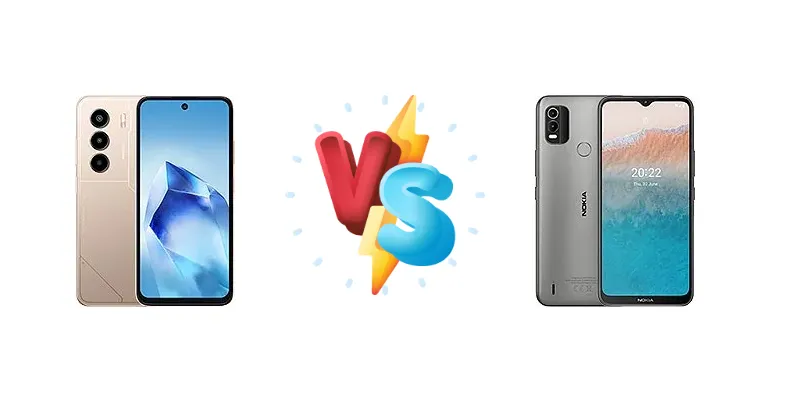
The itel Power 70 and Nokia C21 Plus represent two compelling options in the ultra-budget smartphone segment. While both aim to deliver essential smartphone functionality at a low price point, they take different approaches to achieving this. The itel prioritizes processing power with its Helio G50, while the Nokia focuses on a streamlined experience with its Unisoc chipset and Android Go edition. This comparison will dissect their key differences to determine which device offers the best value.
🏆 Quick Verdict
For the average user prioritizing responsiveness and occasional gaming, the itel Power 70 emerges as the stronger choice. Its Mediatek Helio G50 chipset, with its higher clock speeds, provides a noticeable performance advantage over the Nokia C21 Plus’s Unisoc SC9863A. However, the Nokia C21 Plus offers a cleaner software experience and potentially better efficiency.
| Network |
|---|
| 2G bands | GSM 850 / 900 / 1800 / 1900 | GSM 850 / 900 / 1800 / 1900 |
| 3G bands | HSDPA 850 / 900 / 2100 | HSDPA 850 / 900 / 2100 |
| 4G bands | LTE | LTE |
| Speed | HSPA, LTE | HSPA 42.2/5.76 Mbps, LTE Cat4 150/50 Mbps |
| Technology | GSM / HSPA / LTE | GSM / HSPA / LTE |
| | - | HSDPA 850 / 900 / 1700(AWS) / 1900 / 2100 |
| Launch |
|---|
| Announced | 2025, March 02 | 2022, February 28 |
| Status | Available. Released 2025, March | Available. Released 2022, April 29 |
| Body |
|---|
| Build | - | Glass front, aluminum frame, plastic back |
| Dimensions | 7.9 mm thickness | 164.8 x 75.9 x 8.6 mm (6.49 x 2.99 x 0.34 in) |
| SIM | Nano-SIM + Nano-SIM | · Nano-SIM· Nano-SIM + Nano-SIM |
| Weight | 192.4 g (6.81 oz) | 178 g or 191 g (6.28 oz) |
| | - | Splash protection |
| Display |
|---|
| Protection | - | Scratch-resistant glass |
| Resolution | 720 x 1600 pixels, 20:9 ratio (~263 ppi density) | 720 x 1600 pixels, 20:9 ratio (~269 ppi density) |
| Size | 6.67 inches, 107.4 cm2 (~83.8% screen-to-body ratio) | 6.52 inches, 102.6 cm2 (~82.1% screen-to-body ratio) |
| Type | IPS LCD, 120Hz, 700 nits | IPS LCD |
| Platform |
|---|
| CPU | Octa-core 2.2 GHz Cortex-A53 | Octa-core (4x1.6 GHz Cortex-A55 & 4x1.2 GHz Cortex-A55) |
| Chipset | Mediatek Helio G50 Ultimate | Unisoc SC9863A (28 nm) |
| GPU | PowerVR GE8320 | IMG8322 |
| OS | Android 14, itel OS 14 | Android 11 (Go edition) |
| Memory |
|---|
| Card slot | microSDXC | microSDXC (dedicated slot) |
| Internal | 128GB 4GB RAM, 128GB 8GB RAM, 256GB 6GB RAM, 256GB 8GB RAM | 32GB 2GB RAM, 32GB 3GB RAM, 64GB 2GB RAM, 64GB 3GB RAM, 64GB 4GB RAM |
| | - | eMMC 5.1 |
| Main Camera |
|---|
| Dual | - | 13 MP, (wide), AF
Auxiliary lens |
| Features | LED flash, HDR, panorama | LED flash, HDR, panorama |
| Single | 13 MP | 5 MP |
| Video | Yes | 1080p@30fps |
| Selfie camera |
|---|
| Features | - | LED flash |
| Single | 8 MP | 5 MP |
| Video | Yes | 720p |
| Sound |
|---|
| 3.5mm jack | - | Yes |
| 35mm jack | Yes | Yes |
| Loudspeaker | Yes | Yes |
| Comms |
|---|
| Bluetooth | Yes | 4.2, A2DP |
| NFC | No | No |
| Positioning | GPS | GPS |
| Radio | Unspecified | FM radio |
| USB | USB Type-C, OTG | microUSB 2.0 |
| WLAN | Yes | Wi-Fi 802.11 b/g/n |
| Features |
|---|
| Sensors | Fingerprint (side-mounted), accelerometer, proximity | Fingerprint (rear-mounted), accelerometer, proximity |
| Battery |
|---|
| Charging | 18W wired
Reverse wired | 10W wired |
| Type | 6000 mAh | Li-Ion 4000/5050 mAh |
| Misc |
|---|
| Colors | Black, Marine, Bronze, Silver | Dark Cyan, Warm Gray |
| Models | P673L | TA-1433, TA-1431, TA-1426, TA-1424 |
| Price | About 80 EUR | About 120 EUR |
| SAR | - | 0.57 W/kg (head) 0.65 W/kg (body) |
| SAR EU | - | 0.40 W/kg (head) 0.99 W/kg (body) |
itel Power 70
- Faster processor for smoother performance
- 18W fast charging for quicker top-ups
- Reverse wired charging for emergency power sharing
- Potentially more bloatware
- Less efficient chipset compared to Unisoc
Nokia C21 Plus
- Clean Android Go edition experience
- Potentially better battery efficiency
- More affordable price point
- Slower processor for demanding tasks
- Slow 10W charging
- Limited performance for gaming
Display Comparison
Neither device boasts a standout display. Both likely feature LCD panels, typical for this price bracket. However, detailed display specs (resolution, brightness) are missing. The Nokia C21 Plus’s smaller 6.5-inch display may offer a slightly higher pixel density than the itel Power 70’s, assuming similar resolutions. The absence of high refresh rates or advanced panel technologies like LTPO is expected, focusing instead on cost-effectiveness.
Camera Comparison
Camera performance is likely to be similar, with both phones targeting basic photography needs. Detailed sensor information is unavailable, but both will likely feature a primary camera and potentially a secondary depth or macro sensor. The absence of Optical Image Stabilization (OIS) is expected. Image processing will heavily influence the final results, and itel’s typically leans towards more saturated colors, while Nokia aims for a more natural look. Without specific sensor sizes or apertures, it’s difficult to definitively declare a winner.
Performance
The core difference lies in the chipsets. The itel Power 70’s Mediatek Helio G50 Ultimate features an octa-core CPU clocked at 2.2 GHz, utilizing Cortex-A53 cores. This is a significant step up in clock speed compared to the Nokia C21 Plus’s Unisoc SC9863A, which combines four Cortex-A55 cores at 1.6 GHz with another four at 1.2 GHz. While the Unisoc utilizes the more modern Cortex-A55 architecture, the lower clock speeds and the split core configuration suggest the Helio G50 will deliver superior performance in most tasks. The G50 also benefits from a more mature GPU, potentially offering a better gaming experience. The 28nm process node of the Unisoc SC9863A is less efficient than the likely larger node of the Helio G50, potentially leading to more heat generation under load.
Battery Life
The itel Power 70’s 18W wired charging is a clear advantage over the Nokia C21 Plus’s 10W charging. This translates to significantly faster charging times, reducing downtime. While battery capacity isn’t specified, the itel’s faster charging is more impactful than a potentially larger battery paired with slower charging. The Unisoc SC9863A’s efficiency might offer slightly better standby battery life, but the itel’s faster charging will likely offset this in real-world usage.
Buying Guide
Buy the itel Power 70 if you need a phone capable of handling more demanding apps and light gaming, and if faster charging is a priority. Its 18W charging support significantly reduces downtime. Buy the Nokia C21 Plus if you prefer a simpler, bloatware-free Android experience, and if battery efficiency is paramount, even at the cost of processing speed. The Nokia’s Android Go edition is optimized for lower-powered hardware.
Frequently Asked Questions
❓ Will the itel Power 70 struggle with popular social media apps like Facebook and Instagram?
The Helio G50 chipset should handle Facebook and Instagram without significant issues. However, multitasking with several apps open simultaneously might lead to some slowdown. The Nokia C21 Plus may exhibit more noticeable lag when running these apps due to its less powerful processor.
❓ Is the Android Go edition on the Nokia C21 Plus a significant benefit for performance?
Android Go is designed to run smoothly on low-powered hardware by using lightweight versions of Google apps. While it improves responsiveness compared to full Android on the same hardware, it still can't match the raw performance of a more powerful chipset like the Helio G50 in the itel Power 70.
❓ How long will it take to fully charge each phone from 0%?
With 18W charging, the itel Power 70 should fully charge in approximately 2-3 hours, depending on battery capacity. The Nokia C21 Plus, with its 10W charging, will likely take 4-5 hours to reach 100%.
❓ Can the itel Power 70 be used to charge other devices?
Yes, the itel Power 70 supports reverse wired charging, allowing you to use it as a power bank to charge other devices via USB cable. This is a useful feature for emergencies.