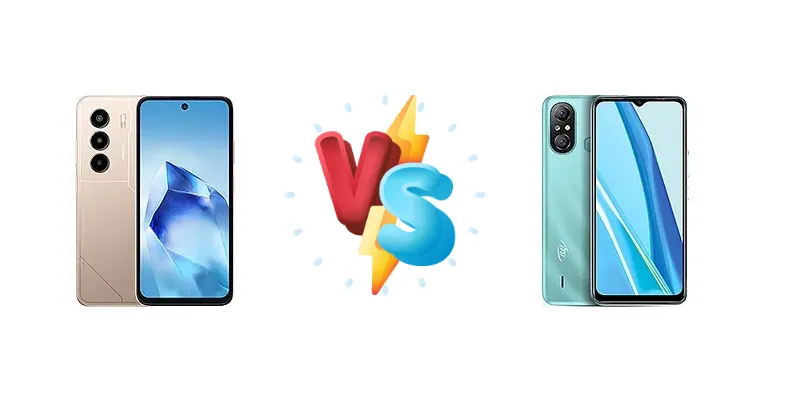
The itel Power 70 and itel A49 represent two distinct approaches to the ultra-budget smartphone market. The Power 70 prioritizes extended battery life and a more capable processor, while the A49 focuses on affordability and essential functionality. This comparison dissects their key differences to help you determine which device best suits your needs.
🏆 Quick Verdict
For most users, the itel Power 70 is the superior choice. Its Mediatek Helio G50 Ultimate chipset provides a significantly smoother experience for multitasking and app usage compared to the A49’s Unisoc SC9832E. The 18W charging is also a substantial advantage, offsetting the likely slightly smaller battery capacity.
| Network |
|---|
| 2G bands | GSM 850 / 900 / 1800 / 1900 | GSM 850 / 900 / 1800 / 1900 |
| 3G bands | HSDPA 850 / 900 / 2100 | HSDPA 850 / 900 / 2100 |
| 4G bands | LTE | LTE |
| Speed | HSPA, LTE | HSPA, LTE |
| Technology | GSM / HSPA / LTE | GSM / HSPA / LTE |
| Launch |
|---|
| Announced | 2025, March 02 | 2022 |
| Status | Available. Released 2025, March | Available. Released 2022 |
| Body |
|---|
| Dimensions | 7.9 mm thickness | - |
| SIM | Nano-SIM + Nano-SIM | Dual SIM |
| Weight | 192.4 g (6.81 oz) | - |
| Display |
|---|
| Resolution | 720 x 1600 pixels, 20:9 ratio (~263 ppi density) | 720 x 1600 pixels, 20:9 ratio (~266 ppi density) |
| Size | 6.67 inches, 107.4 cm2 (~83.8% screen-to-body ratio) | 6.6 inches, 105.2 cm2 |
| Type | IPS LCD, 120Hz, 700 nits | IPS LCD |
| Platform |
|---|
| CPU | Octa-core 2.2 GHz Cortex-A53 | Quad-core 1.4 GHz |
| Chipset | Mediatek Helio G50 Ultimate | Unisoc SC9832E (28 nm) |
| GPU | PowerVR GE8320 | Mali-T820 MP1 |
| OS | Android 14, itel OS 14 | Android 11 (Go edition) |
| Memory |
|---|
| Card slot | microSDXC | microSDXC |
| Internal | 128GB 4GB RAM, 128GB 8GB RAM, 256GB 6GB RAM, 256GB 8GB RAM | 32GB 2GB RAM |
| Main Camera |
|---|
| Features | LED flash, HDR, panorama | LED flash |
| Single | 13 MP | 5 MP |
| Video | Yes | Yes |
| Selfie camera |
|---|
| Single | 8 MP | 5 MP |
| Video | Yes | Yes |
| Sound |
|---|
| 35mm jack | Yes | Yes |
| Loudspeaker | Yes | Yes |
| Comms |
|---|
| Bluetooth | Yes | Yes |
| NFC | No | No |
| Positioning | GPS | GPS |
| Radio | Unspecified | Unspecified |
| USB | USB Type-C, OTG | microUSB |
| WLAN | Yes | Yes |
| Features |
|---|
| Sensors | Fingerprint (side-mounted), accelerometer, proximity | Fingerprint (rear-mounted), accelerometer |
| Battery |
|---|
| Charging | 18W wired
Reverse wired | - |
| Type | 6000 mAh | 4000 mAh |
| Misc |
|---|
| Colors | Black, Marine, Bronze, Silver | Blue |
| Models | P673L | - |
| Price | About 80 EUR | - |
itel Power 70
- Significantly faster processor for smoother performance
- 18W fast charging for quicker top-ups
- Reverse wired charging for added versatility
- Likely slightly higher price point
- May have a less visually striking design
itel A49
- Extremely affordable price
- Simple and easy-to-use interface
- Acceptable for basic communication tasks
- Slow processor struggles with multitasking
- Slow charging speeds
- Limited functionality for demanding users
Display Comparison
Both devices likely feature LCD panels, common in this price bracket. However, detailed display specs like resolution and brightness are unavailable. The A49, given its lower price point, likely has a lower resolution panel. The Power 70’s slightly higher price suggests a potentially more refined display experience, though neither is expected to compete with higher-end OLED or IPS displays. Bezels are likely substantial on both devices, maximizing screen real estate within their respective budgets.
Camera Comparison
Camera details are sparse, but it's safe to assume both phones feature basic camera setups. Without sensor size or aperture information, a direct comparison is difficult. However, the Power 70’s slightly higher price point *might* indicate a marginally better camera module. Expect image quality to be adequate for social media sharing in good lighting conditions on both devices, but poor in low light. Any 2MP macro or depth sensors on either phone should be considered marketing features rather than significant photographic tools.
Performance
The performance gap is the most significant differentiator. The itel Power 70’s Mediatek Helio G50 Ultimate, with its octa-core 2.2 GHz Cortex-A53 CPU, offers a substantial advantage over the itel A49’s quad-core 1.4 GHz Unisoc SC9832E. The Helio G50’s higher clock speed and core count translate to faster app loading times, smoother multitasking, and a more responsive user interface. The Unisoc SC9832E, built on a 28nm process, is geared towards basic functionality and will struggle with demanding applications. The Power 70 is the clear winner for anyone planning to do more than just make calls and send texts.
Battery Life
While specific battery capacities are not provided, the itel Power 70’s 18W wired charging is a major advantage. The A49 likely supports a slower charging rate, meaning significantly longer charge times. The Power 70’s faster charging allows for quicker top-ups, minimizing downtime. Even if the A49 has a slightly larger battery capacity, the Power 70’s charging speed will likely result in more usable battery life throughout the day due to more frequent, shorter charging cycles. The Power 70 also offers reverse wired charging, a feature absent on the A49, allowing it to act as a power bank for other devices.
Buying Guide
Buy the itel Power 70 if you need a phone capable of handling more than just basic tasks like calls and messaging. It’s ideal for users who enjoy occasional gaming, social media browsing, or running multiple apps simultaneously. Buy the itel A49 if you prioritize absolute affordability and only require a phone for essential communication – calls, texts, and light web browsing – and are willing to accept a slower overall experience.
Frequently Asked Questions
❓ Will the itel Power 70 handle popular social media apps like Facebook and WhatsApp smoothly?
Yes, the Mediatek Helio G50 Ultimate chipset in the Power 70 is capable of running social media apps like Facebook and WhatsApp without significant lag. The octa-core processor and higher clock speed provide sufficient processing power for these everyday tasks, unlike the A49 which may exhibit noticeable slowdowns.
❓ Is the Unisoc SC9832E in the itel A49 sufficient for video calls?
The Unisoc SC9832E can handle basic video calls, but expect a less fluid experience compared to the Power 70. The lower processing power may result in occasional stuttering or delays, especially during calls with poor network connectivity. The A49 is best suited for short, infrequent video calls.
❓ How long does it take to fully charge the itel Power 70 with the 18W charger?
While a precise 0-100% charge time isn't available, the 18W charging should fully charge the itel Power 70 in approximately 2-3 hours, depending on battery capacity. This is significantly faster than the A49, which likely takes 4+ hours with its slower charging rate.