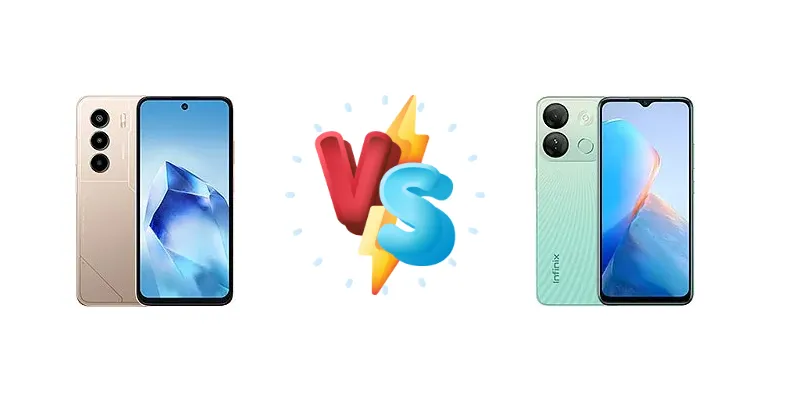
The sub-$150 smartphone market is fiercely competitive, and the itel Power 70 and Infinix Smart 7 HD are two contenders vying for your attention. While both aim to deliver essential smartphone functionality at an accessible price, they take different approaches to performance and power. This comparison dissects their key specifications to determine which device offers the best value for budget-conscious consumers.
🏆 Quick Verdict
For users prioritizing responsiveness and faster charging, the itel Power 70 is the clear winner. Its Mediatek Helio G50 Ultimate chipset, clocked at 2.2 GHz, provides a noticeable performance edge over the Infinix Smart 7 HD’s 1.6 GHz CPU. While the Infinix offers a slightly lower entry price, the itel’s 18W charging and superior processing power justify the small premium.
| Network |
|---|
| 2G bands | GSM 850 / 900 / 1800 / 1900 | GSM 850 / 900 / 1800 / 1900 |
| 3G bands | HSDPA 850 / 900 / 2100 | HSDPA 850 / 900 / 2100 |
| 4G bands | LTE | 1, 3, 5, 8, 38, 40, 41 |
| Speed | HSPA, LTE | HSPA, LTE |
| Technology | GSM / HSPA / LTE | GSM / HSPA / LTE |
| | - | 1, 2, 3, 4, 5, 7, 8, 20, 28, 38, 40, 41 |
| Launch |
|---|
| Announced | 2025, March 02 | 2023, April 14 |
| Status | Available. Released 2025, March | Available. Released 2023, April 14 |
| Body |
|---|
| Build | - | Glass front, plastic back, plastic frame |
| Dimensions | 7.9 mm thickness | 163.9 x 75.5 x 8.7 mm (6.45 x 2.97 x 0.34 in) |
| SIM | Nano-SIM + Nano-SIM | Nano-SIM + Nano-SIM |
| Weight | 192.4 g (6.81 oz) | 196.5 g (6.95 oz) |
| Display |
|---|
| Resolution | 720 x 1600 pixels, 20:9 ratio (~263 ppi density) | 720 x 1612 pixels, 20:9 ratio (~267 ppi density) |
| Size | 6.67 inches, 107.4 cm2 (~83.8% screen-to-body ratio) | 6.6 inches, 104.6 cm2 (~84.6% screen-to-body ratio) |
| Type | IPS LCD, 120Hz, 700 nits | IPS LCD, 500 nits |
| Platform |
|---|
| CPU | Octa-core 2.2 GHz Cortex-A53 | Octa-core 1.6 GHz |
| Chipset | Mediatek Helio G50 Ultimate | - |
| GPU | PowerVR GE8320 | - |
| OS | Android 14, itel OS 14 | Android 12 (Go edition) |
| Memory |
|---|
| Card slot | microSDXC | microSDXC (dedicated slot) |
| Internal | 128GB 4GB RAM, 128GB 8GB RAM, 256GB 6GB RAM, 256GB 8GB RAM | 64GB 2GB RAM |
| | - | UFS 2.1 |
| Main Camera |
|---|
| Dual | - | 8 MP, f/2.0
0.08 MP, (depth) |
| Features | LED flash, HDR, panorama | Dual-LED flash, HDR, panorama |
| Single | 13 MP | 8 MP, f/2.0
Auxiliary lens |
| Video | Yes | 1080p@30fps |
| Selfie camera |
|---|
| Features | - | LED flash |
| Single | 8 MP | 5 MP, f/2.0 |
| Video | Yes | 720p@30fps |
| Sound |
|---|
| 3.5mm jack | - | Yes |
| 35mm jack | Yes | Yes |
| Loudspeaker | Yes | Yes |
| Comms |
|---|
| Bluetooth | Yes | 5.0, A2DP, LE |
| NFC | No | No |
| Positioning | GPS | GPS |
| Radio | Unspecified | FM radio |
| USB | USB Type-C, OTG | microUSB 2.0, OTG |
| WLAN | Yes | Wi-Fi 802.11 b/g/n |
| Features |
|---|
| Sensors | Fingerprint (side-mounted), accelerometer, proximity | Fingerprint (rear-mounted), accelerometer, proximity |
| Battery |
|---|
| Charging | 18W wired
Reverse wired | 10W wired |
| Type | 6000 mAh | 5000 mAh |
| Misc |
|---|
| Colors | Black, Marine, Bronze, Silver | Ink Black, Silk Blue, Jade White, Green Apple |
| Models | P673L | X6516 |
| Price | About 80 EUR | About 110 EUR |
itel Power 70
- Faster Processor: The Helio G50 Ultimate provides a noticeable performance boost.
- Faster Charging: 18W charging significantly reduces charging times.
- Reverse Wired Charging: Offers the convenience of charging other devices.
- Potentially Higher Price: May cost slightly more than the Infinix.
- Limited Display Details: Lack of display specs suggests a basic panel.
Infinix Smart 7 HD
- Lower Price: Likely the more affordable option.
- Functional for Basic Tasks: Suitable for calls, texts, and light social media.
- Acceptable Battery Life: Should provide adequate battery life for minimal usage.
- Slower Processor: The 1.6 GHz CPU will struggle with demanding tasks.
- Slow Charging: 10W charging is significantly slower than the itel.
- Limited Performance: Not ideal for multitasking or gaming.
Display Comparison
Neither device boasts a standout display. Given the context data, we can assume both utilize LCD panels, common in this price bracket. The absence of specifications like resolution or refresh rate suggests a focus on cost reduction. However, the itel Power 70’s chipset may allow for slightly smoother UI animations due to its processing power, even on a similar panel. Bezels are likely comparable, and color accuracy will be standard for budget LCDs.
Camera Comparison
Without detailed camera specifications, a direct comparison is limited. It’s safe to assume both devices feature basic camera setups geared towards casual photography. The absence of information regarding sensor size or aperture suggests neither will excel in low-light conditions. Any megapixel count differences are likely offset by inferior image processing on the Infinix, given the itel’s more powerful chipset. Expect similar results in good lighting, but the itel will likely offer faster image processing and potentially better dynamic range.
Performance
The performance gap is the most significant differentiator. The itel Power 70’s Mediatek Helio G50 Ultimate, with its octa-core CPU clocked at 2.2 GHz, demonstrably outperforms the Infinix Smart 7 HD’s octa-core CPU running at 1.6 GHz. This 37.5% clock speed increase translates to faster app launches, smoother multitasking, and a more responsive user experience. While both likely utilize similar amounts of RAM (market expectation for this segment), the G50 Ultimate’s architecture will handle data processing more efficiently. The Infinix will struggle with demanding applications and heavier multitasking.
Battery Life
While the exact battery capacities are unknown, the itel Power 70’s 18W charging is a substantial advantage over the Infinix Smart 7 HD’s 10W charging. This means significantly faster 0-100% charge times, reducing downtime. Even if the Infinix has a slightly larger battery capacity, the itel’s faster charging will likely result in more usable uptime throughout the day for the average user. The faster charging also mitigates the impact of potential battery degradation over time.
Buying Guide
Buy the itel Power 70 if you need a phone that can handle multitasking, moderate gaming, and benefits from quicker app loading times. The 18W charging is a significant advantage for those who rely heavily on their phone throughout the day. Buy the Infinix Smart 7 HD if your primary needs are basic communication – calls, texts, and light social media – and you prioritize minimizing upfront cost above all else. It’s a functional device for first-time smartphone users or as a reliable backup.
Frequently Asked Questions
❓ Will the Infinix Smart 7 HD struggle with popular apps like WhatsApp and Facebook?
While the Infinix Smart 7 HD can run these apps, its 1.6 GHz processor may result in slower loading times and occasional lag, especially when multitasking. The itel Power 70’s Helio G50 Ultimate will provide a smoother experience with these and other commonly used applications.
❓ How long will it take to fully charge the itel Power 70 from 0%?
With 18W charging, the itel Power 70 should fully charge in approximately 2-3 hours, depending on battery capacity. This is significantly faster than the Infinix Smart 7 HD, which will likely take 4-5 hours with its 10W charging.
❓ Can the itel Power 70 be used as a power bank for other devices?
Yes, the itel Power 70 supports reverse wired charging, allowing you to use it to charge other devices via USB cable. This is a useful feature for emergencies or when traveling.
❓ Is the performance difference between the two phones noticeable for everyday use?
Yes, the 37.5% clock speed difference between the processors is noticeable. The itel Power 70 will feel more responsive when opening apps, switching between tasks, and browsing the web. The Infinix Smart 7 HD may exhibit lag or slowdowns during these activities.