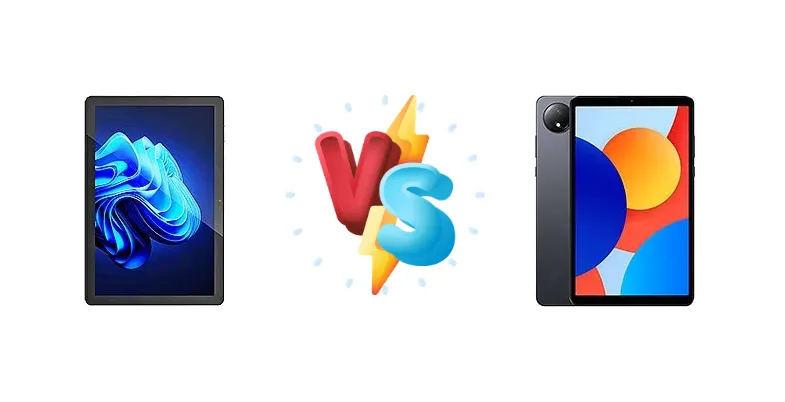
The sub-$150 tablet market is heating up, with the itel Pad One and Xiaomi Redmi Pad SE 8.7 vying for dominance. Both aim to deliver a functional Android experience without breaking the bank, but they take different approaches to achieving this. This comparison dissects their core components to reveal which tablet offers the best value for your money.
🏆 Quick Verdict
For most users, the Xiaomi Redmi Pad SE 8.7 is the superior choice. Its more modern Mediatek Helio G85 chipset provides a noticeable performance uplift over the itel Pad One’s Unisoc SC9863A1, and the faster 18W (International) charging significantly reduces downtime. While the itel Pad One is cheaper, the performance trade-off isn't worth it for all but the most basic users.
| Network |
|---|
| 2G bands | - | GSM 850 / 900 / 1800 / 1900 |
| 3G bands | HSDPA 2100 | HSDPA 800 / 850 / 900 / 1700(AWS) / 1900 / 2100 |
| 4G bands | 1, 3, 5, 7, 8, 20, 28, 38, 40, 41 | 1, 2, 3, 4, 5, 7, 8, 13, 18, 19, 20, 26, 28, 38, 40, 41, 66 |
| Speed | HSPA, LTE | HSPA, LTE - cellular model only |
| Technology | HSPA / LTE | GSM / HSPA / LTE |
| Launch |
|---|
| Announced | 2023 | 2024, July 29 |
| Status | Available. Released 2023 | Available. Released 2024, August 08 |
| Body |
|---|
| Build | Glass front, aluminum back, aluminum frame | Glass front (Gorilla Glass 3) |
| Dimensions | 241.4 x 160.2 x 8.2 mm (9.50 x 6.31 x 0.32 in) | 211.6 x 125.5 x 8.8 mm (8.33 x 4.94 x 0.35 in) |
| SIM | Nano-SIM | Nano-SIM + Nano-SIM (cellular model only) |
| Weight | - | 370 / 373 / 375 g (13.05 oz) |
| Display |
|---|
| Protection | - | Corning Gorilla Glass 3 |
| Resolution | 800 x 1280 pixels, 16:10 ratio (~149 ppi density) | 800 x 1340 pixels, 5:3 ratio (~179 ppi density) |
| Size | 10.1 inches, 295.8 cm2 (~76.5% screen-to-body ratio) | 8.7 inches, 214.9 cm2 (~80.9% screen-to-body ratio) |
| Type | IPS | IPS LCD, 1B colors, 90Hz, 600 nits (HBM) |
| Platform |
|---|
| CPU | Octa-core (4x1.6 GHz Cortex-A55 & 4x1.2 GHz Cortex-A55) | Octa-core (2x2.0 GHz Cortex-A75 & 6x1.8 GHz Cortex-A55) |
| Chipset | Unisoc SC9863A1 (22 nm) | Mediatek Helio G85 (12 nm) |
| GPU | IMG8322 | Mali-G52 MC2 |
| OS | Android 12 (Go edition) | Android 14, HyperOS |
| Memory |
|---|
| Card slot | microSDXC | microSDXC (dedicated slot) |
| Internal | 128GB 4GB RAM | 64GB 4GB RAM, 128GB 4GB RAM, 128GB 6GB RAM |
| Main Camera |
|---|
| Features | LED flash | LED flash |
| Single | 5 MP, (wide), AF | 8 MP, f/2.0, (wide), 1/4.0", 1.12µm |
| Video | 1080p@30fps | 1080p@30fps |
| Selfie camera |
|---|
| Single | 8 MP, (wide) | 5 MP, f/2.2, (wide), 1/5.0", 1.12µm |
| Video | 1080p@30fps | 1080p@30fps |
| Sound |
|---|
| 35mm jack | Yes | Yes |
| Loudspeaker | Yes, with dual speakers | Yes, with stereo speakers |
| Comms |
|---|
| Bluetooth | Yes | 5.3, A2DP, LE |
| Infrared port | - | Yes |
| NFC | No | No |
| Positioning | GPS | GPS, GALILEO, GLONASS, BDS - cellular model only |
| Radio | FM radio | FM radio |
| USB | USB Type-C 2.0, OTG | USB Type-C 2.0 |
| WLAN | Yes | Wi-Fi 802.11 a/b/g/n/ac, dual-band |
| Features |
|---|
| Sensors | Accelerometer | Accelerometer, proximity (accessories only), compass |
| Battery |
|---|
| Charging | 10W wired | 18W wired (Int'l)
10W wired (India) |
| Type | 6000 mAh | 6650 mAh |
| Misc |
|---|
| Colors | Light Blue, Deep Grey | Aurora Green (Forest Green), Sky Blue (Ocean Blue), Graphite Gray (Urban Grey) |
| Models | - | 220233L2G |
| Price | - | About 120 EUR |
| SAR | - | 0.90 W/kg (head) 0.65 W/kg (body) |
| SAR EU | - | 0.40 W/kg (head) 0.99 W/kg (body) |
itel Pad One
- Lowest possible price point
- Functional for basic tasks
- Acceptable for light use
- Significantly weaker performance
- Slow 10W charging
- Likely limited software support
Xiaomi Redmi Pad SE 8.7
- Faster and more responsive performance
- Faster 18W (International) charging
- More versatile for everyday tasks
- Slightly higher price
- Still a budget device with compromises
- 10W charging in India
Display Comparison
Neither tablet boasts a particularly impressive display. Both are likely to utilize IPS LCD panels, common in this price bracket. However, details like peak brightness and color gamut coverage are missing. The Redmi Pad SE 8.7’s 8.7-inch size offers a slightly larger viewing area than the itel Pad One’s unspecified size, potentially enhancing media consumption. Bezels are expected to be substantial on both, reflecting their budget positioning. Without specific display specs, it's difficult to declare a clear winner, but the larger screen size of the Redmi Pad SE 8.7 gives it a slight edge.
Camera Comparison
Camera quality is unlikely to be a priority for buyers in this segment, and details are scarce. Both tablets likely feature basic camera setups. Given the price point, expecting high-resolution sensors or advanced features like OIS would be unrealistic. Any camera differences will likely be minimal and won't significantly impact the user experience. Focusing on the primary sensor resolution would be misleading without image samples.
Performance
The performance gap is the most significant differentiator. The Xiaomi Redmi Pad SE 8.7’s Mediatek Helio G85, built on a 12nm process, is a substantial upgrade over the itel Pad One’s Unisoc SC9863A1 (22nm). The Helio G85 features two Cortex-A75 cores clocked at 2.0 GHz alongside six Cortex-A55 cores at 1.8 GHz, providing a much stronger burst performance for tasks like app loading and multitasking compared to the itel Pad One’s four Cortex-A55 cores at 1.6 GHz and four at 1.2 GHz. This translates to a smoother user experience and better responsiveness. The 12nm process also contributes to better thermal efficiency, potentially reducing throttling during sustained workloads. While RAM configurations are unknown, the chipset advantage heavily favors the Redmi Pad SE 8.7.
Battery Life
Battery capacity is not specified for either device. However, the charging speeds reveal a key difference. The Redmi Pad SE 8.7 supports 18W wired charging (International markets, 10W in India), while the itel Pad One is limited to 10W. This faster charging capability on the Redmi Pad SE 8.7 significantly reduces the time spent tethered to a power outlet, a crucial advantage for on-the-go users. Even with a similar battery capacity, the faster charging will provide a more convenient experience. The Indian market Redmi Pad SE 8.7 will have a slower charging experience, but still faster than the itel Pad One.
Buying Guide
Buy the itel Pad One if you need an extremely affordable tablet for very light tasks like reading ebooks, basic web browsing, and occasional video calls. It’s a good option for those on a strict budget who prioritize cost above all else. Buy the Xiaomi Redmi Pad SE 8.7 if you prefer a smoother, more responsive experience for everyday tasks, light gaming, and media consumption. The faster processor and charging make it a more versatile and enjoyable device.
Frequently Asked Questions
❓ Will the Redmi Pad SE 8.7 handle popular games like PUBG Mobile?
The Mediatek Helio G85 in the Redmi Pad SE 8.7 is capable of running PUBG Mobile, but expect to play at medium settings to maintain a stable frame rate. The Unisoc SC9863A1 in the itel Pad One will likely struggle with demanding games like PUBG Mobile, offering a less enjoyable experience.
❓ How does the software experience differ between the two tablets?
Both tablets run Android, but the user interface and software features will differ. Xiaomi’s MIUI is known for its customization options, while itel’s software is likely a more stock Android experience with fewer pre-installed apps. Software update support is also likely to be more consistent on the Redmi Pad SE 8.7 due to Xiaomi’s larger resources.
❓ Is the 10W charging on the itel Pad One noticeably slow?
Yes, 10W charging is significantly slower than the 18W charging offered on the international version of the Redmi Pad SE 8.7. Expect a much longer wait to fully charge the itel Pad One, potentially taking several hours from a low battery level.
❓ Which tablet is better for video streaming?
The Xiaomi Redmi Pad SE 8.7 is better suited for video streaming due to its more powerful processor, which will handle video decoding and playback more smoothly. The larger screen size also contributes to a more immersive viewing experience.