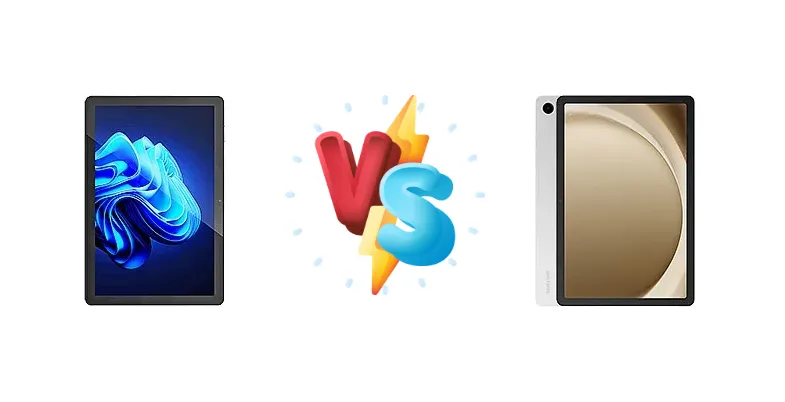
The tablet market has a new wave of ultra-affordable options, and the itel Pad One and Samsung Galaxy Tab A9+ represent two distinct approaches. The itel Pad One prioritizes rock-bottom pricing, while the Samsung Galaxy Tab A9+ attempts to balance affordability with a more modern feature set, including 5G connectivity. This comparison dissects the core differences to help you choose the best tablet for your needs.
🏆 Quick Verdict
For most users, the Samsung Galaxy Tab A9+ is the superior choice. Its Qualcomm Snapdragon 695 chipset, built on a 6nm process, delivers a significantly smoother and more responsive experience than the itel Pad One’s Unisoc SC9863A1. While the itel Pad One is cheaper, the performance gap justifies the price difference for all but the most basic use cases.
| Network |
|---|
| 2G bands | - | GSM 850 / 900 / 1800 / 1900 |
| 3G bands | HSDPA 2100 | HSDPA 850 / 900 / 1700(AWS) / 1900 / 2100 |
| 4G bands | 1, 3, 5, 7, 8, 20, 28, 38, 40, 41 | 1, 2, 3, 4, 5, 7, 8, 12, 13, 17, 20, 26, 28, 38, 40, 41, 66 |
| 5G bands | - | 1, 3, 5, 7, 8, 20, 28, 38, 40, 41, 66, 77, 78 SA/NSA/Sub6 |
| Speed | HSPA, LTE | HSPA, LTE, 5G - cellular model only |
| Technology | HSPA / LTE | GSM / HSPA / LTE / 5G |
| Launch |
|---|
| Announced | 2023 | 2023, October 05 |
| Status | Available. Released 2023 | Available. Released 2023, October 17 |
| Body |
|---|
| Build | Glass front, aluminum back, aluminum frame | - |
| Dimensions | 241.4 x 160.2 x 8.2 mm (9.50 x 6.31 x 0.32 in) | 257.1 x 168.7 x 6.9 mm (10.12 x 6.64 x 0.27 in) |
| SIM | Nano-SIM | Nano-SIM + eSIM (cellular model only) |
| Weight | - | 480 g or 492 g (1.06 lb) |
| Display |
|---|
| Resolution | 800 x 1280 pixels, 16:10 ratio (~149 ppi density) | 1200 x 1920 pixels, 16:10 ratio (~206 ppi density) |
| Size | 10.1 inches, 295.8 cm2 (~76.5% screen-to-body ratio) | 11.0 inches, 350.9 cm2 (~80.9% screen-to-body ratio) |
| Type | IPS | TFT LCD, 90Hz |
| Platform |
|---|
| CPU | Octa-core (4x1.6 GHz Cortex-A55 & 4x1.2 GHz Cortex-A55) | Octa-core (2x2.2 GHz Kryo 660 Gold & 6x1.8 GHz Kryo 660 Silver) |
| Chipset | Unisoc SC9863A1 (22 nm) | Qualcomm SM6375 Snapdragon 695 5G (6 nm) |
| GPU | IMG8322 | Adreno 619 |
| OS | Android 12 (Go edition) | Android 13, upgradable to Android 15, One UI 7 |
| Memory |
|---|
| Card slot | microSDXC | microSDXC (dedicated slot) |
| Internal | 128GB 4GB RAM | 64GB 4GB RAM, 128GB 4GB RAM, 128GB 8GB RAM, 256GB 8GB RAM |
| Main Camera |
|---|
| Features | LED flash | - |
| Single | 5 MP, (wide), AF | 8 MP, AF |
| Video | 1080p@30fps | 1080p@30fps |
| Selfie camera |
|---|
| Single | 8 MP, (wide) | 5 MP |
| Video | 1080p@30fps | 1080p@30fps |
| Sound |
|---|
| 35mm jack | Yes | Yes |
| Loudspeaker | Yes, with dual speakers | Yes, with stereo speakers (4 speakers) |
| Comms |
|---|
| Bluetooth | Yes | 5.1, A2DP, LE |
| NFC | No | No |
| Positioning | GPS | GPS, GLONASS, GALILEO, BDS, QZSS - cellular model only |
| Radio | FM radio | No |
| USB | USB Type-C 2.0, OTG | USB Type-C 2.0 |
| WLAN | Yes | Wi-Fi 802.11 a/b/g/n/ac, dual-band, Wi-Fi Direct |
| Features |
|---|
| Sensors | Accelerometer | Accelerometer, gyro, proximity (accessories only), compass |
| Battery |
|---|
| Charging | 10W wired | 15W wired |
| Type | 6000 mAh | Li-Po 7040 mAh |
| Misc |
|---|
| Colors | Light Blue, Deep Grey | Graphite, Silver, Navy |
| Models | - | SM-X210, SM-X215, SM-X216B |
| Price | - | $ 199.99 |
| SAR | - | 0.42 W/kg (body) |
| SAR EU | - | 1.19 W/kg (body) |
itel Pad One
- Significantly lower price point
- Functional for basic tasks
- Acceptable for simple video calls
- Poor performance with Unisoc SC9863A1
- Slow charging at 10W
- Likely limited software updates
Samsung Galaxy Tab A9+
- Much faster performance with Snapdragon 695
- 5G connectivity for on-the-go use
- Faster 15W charging
- Higher price than the itel Pad One
- Still uses an LCD panel
- May not compete with premium tablets
Display Comparison
Neither device boasts a premium display. While specific display specs (resolution, panel type) are missing for the itel Pad One, its price point suggests an LCD panel. The Samsung Galaxy Tab A9+ also utilizes an LCD, but the focus here is on the processing power driving the display. The difference in chipsets will impact UI smoothness and video decoding capabilities more than panel quality. Expect both to be adequate for media consumption, but not color-accurate for professional work.
Camera Comparison
Camera quality is unlikely to be a deciding factor for either tablet, given their target market. Both are likely to feature basic camera setups. Without specific sensor details for the itel Pad One, it’s safe to assume a lower-resolution main sensor. The Samsung Galaxy Tab A9+ likely has a more refined image processing pipeline, but don’t expect flagship-level photography. These cameras are primarily for video calls and quick snapshots.
Performance
The performance disparity is the most significant difference. The Samsung Galaxy Tab A9+’s Qualcomm Snapdragon 695 (6nm) is a substantial upgrade over the itel Pad One’s Unisoc SC9863A1 (22nm). The 6nm process node allows for greater transistor density and improved power efficiency, translating to better sustained performance and less thermal throttling. The Snapdragon 695’s Kryo 660 cores (2x2.2 GHz Gold & 6x1.8 GHz Silver) offer a more sophisticated architecture than the Cortex-A55 cores in the Unisoc chip (4x1.6 GHz & 4x1.2 GHz). This means faster app loading times, smoother multitasking, and a more enjoyable overall user experience on the A9+. The itel Pad One will struggle with demanding applications.
Battery Life
The Samsung Galaxy Tab A9+ supports 15W wired charging, while the itel Pad One is limited to 10W. While battery capacity isn’t specified for either, the more efficient Snapdragon 695 in the A9+ will likely result in comparable or better battery life despite potentially having a similar capacity. The faster charging speed on the A9+ also means less time tethered to a wall outlet.
Buying Guide
Buy the itel Pad One if you need a tablet solely for extremely light tasks like basic web browsing, reading ebooks, or video calls, and your budget is severely constrained. It’s a functional device for minimal demands. Buy the Samsung Galaxy Tab A9+ if you prefer a more versatile tablet capable of handling multitasking, streaming, light gaming, and benefiting from 5G connectivity for on-the-go use. It offers a better long-term experience and future-proofing.
Frequently Asked Questions
❓ Will the Unisoc SC9863A1 in the itel Pad One struggle with multiple apps open simultaneously?
Yes, the Unisoc SC9863A1 is a low-end chipset. Expect noticeable slowdowns and app reloading when multitasking with more than a few apps. It's best suited for running one app at a time.
❓ Does the Samsung Galaxy Tab A9+ support expandable storage via microSD card?
While not explicitly stated in the provided specs, Samsung tablets typically offer microSD card support. This is a significant advantage for users who need to store large files like videos or photos, as it allows for easy storage expansion.
❓ Is the 5G connectivity on the Samsung Galaxy Tab A9+ worth the extra cost if I primarily use Wi-Fi?
If you consistently have access to reliable Wi-Fi, the 5G connectivity may not be essential. However, it provides valuable flexibility for use on the go, allowing you to stay connected even without a Wi-Fi network. Consider your typical usage scenarios to determine if the added cost is justified.
❓ How will the 10W charging on the itel Pad One affect the user experience?
10W charging is relatively slow. Expect it to take several hours to fully charge the device from 0%. This can be inconvenient if you frequently use the tablet throughout the day and need to quickly top up the battery.