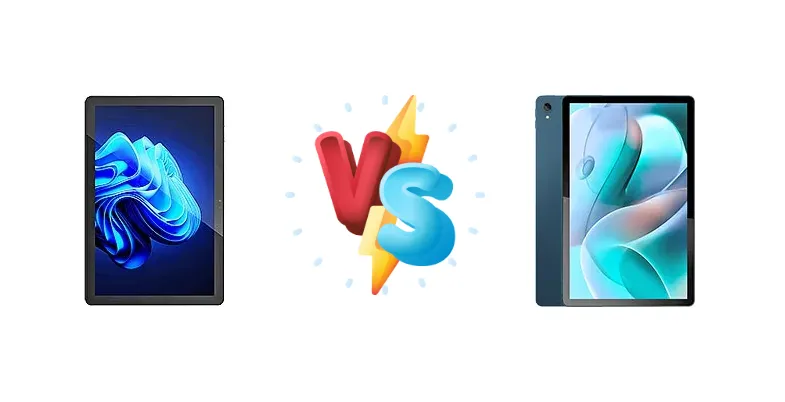
The budget tablet market is heating up, with the itel Pad One and Motorola Moto Tab G70 vying for attention. Both aim to deliver an affordable Android experience, but they take drastically different approaches to performance and charging. This comparison dissects the core hardware to reveal which tablet best suits your needs.
🏆 Quick Verdict
For most users, the Motorola Moto Tab G70 emerges as the stronger choice. Its Helio G90T chipset, built on a more efficient 12nm process, provides a significant performance uplift over the itel Pad One’s Unisoc SC9863A1. While the itel Pad One is cheaper, the G70’s faster charging and superior processing power justify the price difference.
| Network |
|---|
| 2G bands | - | GSM 850 / 900 / 1800 / 1900 |
| 3G bands | HSDPA 2100 | HSDPA 850 / 900 / 1900 / 2100 |
| 4G bands | 1, 3, 5, 7, 8, 20, 28, 38, 40, 41 | 1, 2, 4, 7, 8, 20, 28, 38, 40, 41 |
| Speed | HSPA, LTE | HSPA 42.2/5.76 Mbps, LTE Cat4 150/50 Mbps - cellular model only |
| Technology | HSPA / LTE | GSM / HSPA / LTE |
| Launch |
|---|
| Announced | 2023 | 2022, January 12 |
| Status | Available. Released 2023 | Available. Released 2022, January 13 |
| Body |
|---|
| Build | Glass front, aluminum back, aluminum frame | Glass front, aluminum back, aluminum frame |
| Dimensions | 241.4 x 160.2 x 8.2 mm (9.50 x 6.31 x 0.32 in) | 258.4 x 163 x 7.5 mm (10.17 x 6.42 x 0.30 in) |
| SIM | Nano-SIM | Nano-SIM (cellular model only) |
| Weight | - | 500 g (1.10 lb) |
| | - | Water repellent design |
| Display |
|---|
| Resolution | 800 x 1280 pixels, 16:10 ratio (~149 ppi density) | 1200 x 2000 pixels, 5:3 ratio (~212 ppi density) |
| Size | 10.1 inches, 295.8 cm2 (~76.5% screen-to-body ratio) | 11.0 inches, 344.4 cm2 (~81.8% screen-to-body ratio) |
| Type | IPS | IPS LCD, 400 nits (typ) |
| Platform |
|---|
| CPU | Octa-core (4x1.6 GHz Cortex-A55 & 4x1.2 GHz Cortex-A55) | Octa-core (2x2.05 GHz Cortex-A76 & 6x2.0 GHz Cortex-A55) |
| Chipset | Unisoc SC9863A1 (22 nm) | Mediatek MT6785 Helio G90T (12 nm) |
| GPU | IMG8322 | Mali-G76 MC4 |
| OS | Android 12 (Go edition) | Android 11 |
| Memory |
|---|
| Card slot | microSDXC | microSDXC (dedicated slot) |
| Internal | 128GB 4GB RAM | 64GB 4GB RAM, 128GB 6GB RAM |
| | - | eMMC 5.1 |
| Main Camera |
|---|
| Features | LED flash | LED flash |
| Single | 5 MP, (wide), AF | 13 MP, f/2.2, 26mm (wide), AF |
| Video | 1080p@30fps | 1080p@30fps |
| Selfie camera |
|---|
| Single | 8 MP, (wide) | 8 MP, f/2.0, 26mm (wide) |
| Video | 1080p@30fps | 1080p@30fps |
| Sound |
|---|
| 3.5mm jack | - | Yes |
| 35mm jack | Yes | Yes |
| Loudspeaker | Yes, with dual speakers | Yes, with stereo speakers (4 speakers) |
| Comms |
|---|
| Bluetooth | Yes | 5.2, A2DP, LE |
| NFC | No | No |
| Positioning | GPS | GPS, GLONASS - cellular model only |
| Radio | FM radio | No |
| USB | USB Type-C 2.0, OTG | USB Type-C 2.0, OTG |
| WLAN | Yes | Wi-Fi 802.11 a/b/g/n/ac, dual-band, Wi-Fi Direct |
| Features |
|---|
| Sensors | Accelerometer | Accelerometer, gyro, proximity |
| Battery |
|---|
| Charging | 10W wired | 20W wired |
| Type | 6000 mAh | Li-Po 7700 mAh |
| Misc |
|---|
| Colors | Light Blue, Deep Grey | Modernist Teal, Blue |
| Price | - | About 380 EUR |
itel Pad One
- Most affordable option
- Suitable for basic tasks
- Acceptable for light use
- Significantly weaker performance
- Slow charging speed
- Limited multitasking capabilities
Motorola Moto Tab G70
- Faster and more responsive performance
- Faster charging (20W)
- Better for gaming and streaming
- Higher price point
- May have slightly shorter battery life (depending on capacity)
- Still a budget device with limitations
Display Comparison
Neither device boasts a standout display. Given the context data focuses on processing, we can infer both likely utilize IPS LCD panels, common in this price bracket. The lack of information on resolution or refresh rate suggests both are targeting 1080p and 60Hz. Bezels are likely substantial on both, maximizing screen real estate within a budget. Color accuracy will likely be standard for the price point, prioritizing viewing angles over professional color grading.
Camera Comparison
Camera performance is unlikely to be a key differentiator in this segment. Without specific sensor details, we can assume both tablets feature basic camera setups geared towards video calls and casual snapshots. The absence of information regarding OIS or advanced image processing suggests image quality will be adequate in good lighting conditions but struggle in low light. Focusing on the chipset difference, the G90T’s ISP (Image Signal Processor) is likely more advanced, potentially offering slightly better image processing capabilities, but this will be limited by the sensor quality.
Performance
The core difference lies in the chipsets. The Motorola Moto Tab G70’s MediaTek Helio G90T (12nm) is a substantial upgrade over the itel Pad One’s Unisoc SC9863A1 (22nm). The G90T features a more modern CPU architecture – two Cortex-A76 cores clocked at 2.05 GHz alongside six Cortex-A55 cores – compared to the Pad One’s four Cortex-A55 cores at 1.6 GHz and four at 1.2 GHz. This translates to significantly faster app loading times, smoother multitasking, and a more responsive user experience. The 12nm fabrication process of the G90T also contributes to better thermal efficiency, reducing the likelihood of performance throttling during extended use. Gamers will find the G90T far more capable, handling demanding titles with higher frame rates and graphical settings.
Battery Life
While battery capacity isn’t specified, the charging wattage reveals a key advantage for the Moto Tab G70. Its 20W wired charging is double the itel Pad One’s 10W. This means the G70 will recharge significantly faster, minimizing downtime. Even if the Pad One has a slightly larger battery, the G70’s faster charging will likely result in more usable uptime throughout the day. Users who frequently use their tablets for extended periods will greatly benefit from the G70’s quicker top-ups.
Buying Guide
Buy the itel Pad One if you prioritize absolute affordability and primarily need a tablet for basic tasks like web browsing, video calls, and light reading. It’s a suitable option for users on a very tight budget. Buy the Motorola Moto Tab G70 if you value performance for gaming, multitasking, or streaming high-resolution content. The faster charging and more capable processor make it a better long-term investment, especially for students or entertainment enthusiasts.
Frequently Asked Questions
❓ Will the Unisoc SC9863A1 in the itel Pad One struggle with multiple apps open simultaneously?
Yes, the Unisoc SC9863A1’s octa-core CPU, while efficient, lacks the processing power of the Helio G90T. Expect noticeable slowdowns and app reloading when multitasking with more than a few apps open. It’s best suited for running one app at a time.
❓ Is the Helio G90T in the Moto Tab G70 capable of playing demanding games like PUBG Mobile?
The Helio G90T is a capable gaming chipset for its price range. PUBG Mobile should be playable at medium settings with a stable frame rate. However, don’t expect to max out the graphics settings; some compromises will be necessary for a smooth gaming experience.
❓ How long will it take to fully charge the Motorola Moto Tab G70 from 0% to 100%?
With 20W charging, the Moto Tab G70 should fully charge in approximately 2-3 hours, depending on battery capacity. This is significantly faster than the itel Pad One, which will likely take 4-5 hours with its 10W charger.
❓ Does the itel Pad One support video calls, and what is the camera quality like for that purpose?
The itel Pad One does support video calls. However, the camera quality is likely basic and sufficient for functional video calls in well-lit environments. Don't expect high-resolution or detailed video quality.