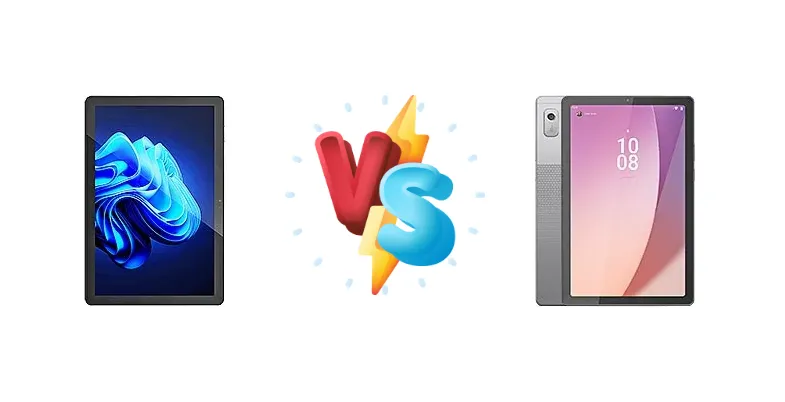
The sub-$150 tablet market is fiercely competitive, offering options for casual users, students, and families. The itel Pad One and Lenovo Tab M9 represent two compelling choices, but cater to slightly different priorities. The itel Pad One focuses on affordability, while the Lenovo Tab M9 aims for a balance of performance and features. This comparison will dissect their key specifications to determine which tablet delivers the best value.
🏆 Quick Verdict
For most users, the Lenovo Tab M9 is the superior choice. Its Mediatek Helio G80 chipset, built on a more efficient 12nm process, provides a noticeable performance boost over the itel Pad One’s Unisoc SC9863A1. While both offer 10W charging, the M9’s stronger processor justifies the slightly higher price for those needing more than basic functionality.
| Network |
|---|
| 2G bands | - | GSM 850 / 900 / 1800 / 1900 |
| 3G bands | HSDPA 2100 | HSDPA 850 / 900 / 1700(AWS) / 1900 / 2100 |
| 4G bands | 1, 3, 5, 7, 8, 20, 28, 38, 40, 41 | 1, 2, 3, 4, 5, 7, 8, 18, 19, 20, 26, 28, 38, 40, 41, 66 |
| Speed | HSPA, LTE | HSPA, LTE - cellular model only |
| Technology | HSPA / LTE | GSM / HSPA / LTE |
| Launch |
|---|
| Announced | 2023 | 2022, December 20 |
| Status | Available. Released 2023 | Available. Released 2023, March 14 |
| Body |
|---|
| Build | Glass front, aluminum back, aluminum frame | - |
| Dimensions | 241.4 x 160.2 x 8.2 mm (9.50 x 6.31 x 0.32 in) | 215.4 x 136.8 x 8 mm (8.48 x 5.39 x 0.31 in) |
| SIM | Nano-SIM | Nano-SIM (cellular model only) |
| Weight | - | 344 g (12.13 oz) |
| Display |
|---|
| Resolution | 800 x 1280 pixels, 16:10 ratio (~149 ppi density) | 800 x 1340 pixels, 5:3 ratio (~173 ppi density) |
| Size | 10.1 inches, 295.8 cm2 (~76.5% screen-to-body ratio) | 9.0 inches, 230.0 cm2 (~78.1% screen-to-body ratio) |
| Type | IPS | IPS LCD, 400 nits (typ) |
| Platform |
|---|
| CPU | Octa-core (4x1.6 GHz Cortex-A55 & 4x1.2 GHz Cortex-A55) | Octa-core (2x2.0 GHz Cortex-A75 & 6x1.8 GHz Cortex-A55) |
| Chipset | Unisoc SC9863A1 (22 nm) | Mediatek MT6769V/CU Helio G80 (12 nm) |
| GPU | IMG8322 | Mali-G52 MC2 |
| OS | Android 12 (Go edition) | Android 12 |
| Memory |
|---|
| Card slot | microSDXC | microSDXC (dedicated slot) |
| Internal | 128GB 4GB RAM | 32GB 3GB RAM, 64GB 4GB RAM, 128GB 4GB RAM |
| | - | eMMC 5.1 |
| Main Camera |
|---|
| Features | LED flash | - |
| Single | 5 MP, (wide), AF | 8 MP, AF |
| Video | 1080p@30fps | 1080p |
| Selfie camera |
|---|
| Single | 8 MP, (wide) | 2 MP |
| Video | 1080p@30fps | 720p |
| Sound |
|---|
| 3.5mm jack | - | Yes |
| 35mm jack | Yes | Yes |
| Loudspeaker | Yes, with dual speakers | Yes, with dual speakers |
| Comms |
|---|
| Bluetooth | Yes | 5.1, A2DP, LE |
| NFC | No | No |
| Positioning | GPS | GPS, GLONASS, GALILEO - cellular model only |
| Radio | FM radio | Unspecified |
| USB | USB Type-C 2.0, OTG | USB Type-C 2.0 |
| WLAN | Yes | Wi-Fi 802.11 a/b/g/n/ac, dual-band, Wi-Fi Direct |
| Features |
|---|
| Sensors | Accelerometer | Accelerometer, proximity |
| Battery |
|---|
| Charging | 10W wired | 10W wired |
| Type | 6000 mAh | Li-Po 5100 mAh |
| Misc |
|---|
| Colors | Light Blue, Deep Grey | Arctic Grey, Frost Blue |
| Models | - | TB310FU |
| Price | - | About 180 EUR |
itel Pad One
- Extremely affordable price point
- Suitable for basic tasks like web browsing and video calls
- Lightweight and portable
- Weak processor struggles with multitasking
- Limited gaming capabilities
- Potentially shorter battery life due to inefficient chipset
Lenovo Tab M9
- Significantly faster processor for smoother performance
- Better suited for multitasking and casual gaming
- More efficient chipset potentially offers longer battery life
- Slightly higher price than the itel Pad One
- Still limited in terms of high-end features
- 10W charging is relatively slow
Display Comparison
Neither itel nor Lenovo provide detailed display specifications beyond the basic panel size. However, the lack of information suggests both are utilizing standard IPS LCD panels. The absence of features like high refresh rates or HDR support is expected at this price point. The real difference lies in the processing power driving the display; a smoother UI on the M9 will translate to a more pleasant viewing experience, even if the panels themselves are similar. Bezels are likely comparable, given the market segment.
Camera Comparison
Given the price point, camera quality is not a primary focus for either tablet. Detailed camera specifications are scarce, but it’s safe to assume both feature basic sensors suitable for video calls and occasional snapshots. Focusing on megapixel counts would be misleading; image processing and sensor size are far more important, and neither manufacturer provides this information. Expect similar, unremarkable image quality from both devices in good lighting conditions.
Performance
The Lenovo Tab M9’s Mediatek Helio G80 chipset is the clear winner here. Built on a 12nm process, it offers significantly improved power efficiency and performance compared to the itel Pad One’s Unisoc SC9863A1 (22nm). The Helio G80’s CPU configuration – 2x2.0 GHz Cortex-A75 and 6x1.8 GHz Cortex-A55 – is a substantial upgrade over the itel’s 4x1.6 GHz Cortex-A55 & 4x1.2 GHz Cortex-A55. This translates to faster app loading times, smoother multitasking, and a more responsive user interface. The Helio G80 also features a more capable GPU, making the M9 a better choice for casual gaming. The Unisoc chip in the itel Pad One will struggle with demanding applications and may exhibit noticeable lag during everyday use.
Battery Life
Both tablets feature 10W wired charging, indicating a similar charging experience. While battery capacity isn’t specified, the more efficient Mediatek Helio G80 in the Lenovo Tab M9 will likely result in longer battery life despite potentially having a similar capacity to the itel Pad One. The 12nm process node contributes to reduced power consumption, allowing the M9 to operate for longer on a single charge, especially during demanding tasks.
Buying Guide
Buy the itel Pad One if you need an extremely affordable tablet for basic tasks like web browsing, video calls, and light media consumption. It’s ideal for users who prioritize cost above all else. Buy the Lenovo Tab M9 if you prefer a smoother, more responsive experience for multitasking, streaming, and casual gaming. The M9 is better suited for students or anyone who anticipates using their tablet for more demanding applications.
Frequently Asked Questions
❓ Will the Lenovo Tab M9 handle popular games like PUBG Mobile or Call of Duty Mobile?
The Helio G80 is capable of running PUBG Mobile and Call of Duty Mobile, but you’ll likely need to play at lower graphics settings to maintain a stable frame rate. Don't expect a flagship gaming experience, but it's significantly better than the itel Pad One, which would struggle with these titles.
❓ Is the Unisoc SC9863A1 in the itel Pad One sufficient for video conferencing and online classes?
Yes, the Unisoc SC9863A1 is adequate for basic video conferencing and online classes. However, expect some lag or stuttering if you have multiple apps open simultaneously. The Lenovo Tab M9 offers a much smoother experience for these tasks.
❓ How long does it take to fully charge both tablets with the 10W charger?
With the included 10W chargers, expect a full charge to take approximately 3-4 hours for both tablets. The charging speed is relatively slow compared to modern fast-charging standards.
❓ Does the Lenovo Tab M9 support expandable storage via microSD card?
While Lenovo doesn't explicitly state microSD support in their marketing materials, many models of the Tab M9 *do* include a microSD card slot. Check the specific retailer listing to confirm before purchasing.