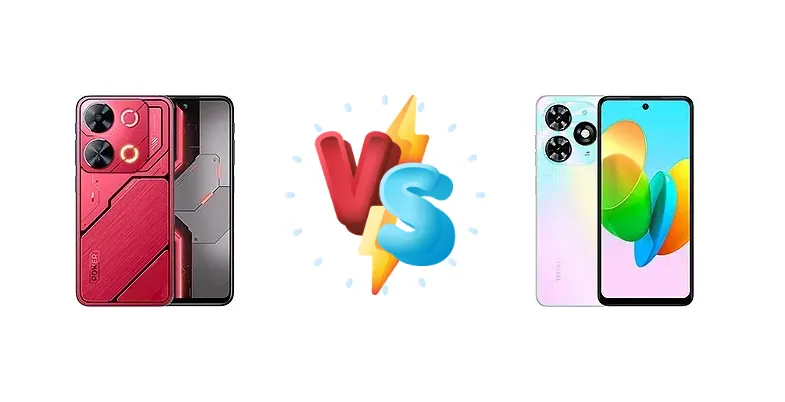
The itel P65 and Tecno Spark 20C represent the fiercely competitive sub-$150 smartphone market. Both aim to deliver essential features at an accessible price, but they take different approaches to achieving this. The itel P65 leverages the efficiency of Unisoc’s T615 chipset, while the Tecno Spark 20C opts for a Mediatek solution. This comparison will dissect their key differences to determine which device offers the best value.
🏆 Quick Verdict
For the average user prioritizing sustained performance and a more modern CPU architecture, the itel P65 emerges as the better choice. Its Unisoc T615, with its Cortex-A75 cores, provides a noticeable advantage in multitasking and app responsiveness compared to the Tecno Spark 20C’s older Cortex-A53 cores, despite the latter’s higher clock speed.
| Network |
|---|
| 2G bands | GSM 850 / 900 / 1800 / 1900 | GSM 850 / 900 / 1800 / 1900 |
| 3G bands | HSDPA 850 / 900 / 2100 | HSDPA 900 / 2100 |
| 4G bands | LTE | LTE |
| Speed | HSPA, LTE | HSPA, LTE |
| Technology | GSM / HSPA / LTE | GSM / HSPA / LTE |
| Launch |
|---|
| Announced | 2024, August 08 | 2023, November 27 |
| Status | Available. Released 2024, August 08 | Available. Released 2023, December |
| Body |
|---|
| Build | - | Glass front, plastic back, plastic frame |
| Dimensions | 165.9 x 77.3 x 7.9 mm (6.53 x 3.04 x 0.31 in) | 163.7 x 75.6 x 8.6 mm (6.44 x 2.98 x 0.34 in) |
| SIM | Nano-SIM + Nano-SIM | Nano-SIM + Nano-SIM |
| Weight | 192.4 g (6.81 oz) | - |
| Display |
|---|
| Resolution | 720 x 1600 pixels, 20:9 ratio (~262 ppi density) | 720 x 1612 pixels, 20:9 ratio (~267 ppi density) |
| Size | 6.7 inches, 108.4 cm2 (~84.5% screen-to-body ratio) | 6.6 inches, 104.6 cm2 (~84.6% screen-to-body ratio) |
| Type | IPS LCD, 120Hz | IPS LCD, 90Hz |
| Platform |
|---|
| CPU | Octa-core (2x1.8 GHz Cortex-A75 & 6x1.6 GHz Cortex-A55) | Octa-core 2.2 GHz Cortex-A53 |
| Chipset | Unisoc T615 (12 nm) | Mediatek |
| GPU | Mali-G57 MP1 | - |
| OS | Android 14, itel OS 14 | Android 13 |
| Memory |
|---|
| Card slot | microSDXC | microSDXC |
| Internal | 128GB 4GB RAM, 128GB 8GB RAM, 256GB 6GB RAM | 128GB 4GB RAM, 128GB 8GB RAM, 256GB 4GB RAM |
| Main Camera |
|---|
| Features | LED flash, HDR, panorama | Dual-LED flash, HDR |
| Single | 50 MP, f/1.6, (wide)
Auxiliary lens | 50 MP, (wide), 1/2.8", PDAF
Auxiliary lens |
| Video | 1080p@30fps | 1080p@30fps |
| Selfie camera |
|---|
| Features | - | Dual-LED flash |
| Single | 8 MP, f/2.0, 26mm (wide) | 8 MP |
| Video | 1080p@30fps | Yes |
| Sound |
|---|
| 35mm jack | Yes | Yes |
| Loudspeaker | Yes | Yes, with stereo speakers |
| Comms |
|---|
| Bluetooth | Yes | Yes |
| NFC | Yes (256/6GB model only) | No |
| Positioning | GPS | GPS |
| Radio | FM radio | FM radio |
| USB | USB Type-C, OTG | USB Type-C, OTG |
| WLAN | Yes | Yes |
| Features |
|---|
| Sensors | Fingerprint (side-mounted), accelerometer, proximity | Fingerprint (side-mounted), accelerometer, compass |
| Battery |
|---|
| Charging | 18W wired, 40% in 30 min | 18W wired |
| Type | 5000 mAh | 5000 mAh |
| Misc |
|---|
| Colors | Cyber Blaze, Cyber Black, Cyber Titanium | Mystery White, Alpenglow Gold, Magic Skin, Gravity Black |
| Models | P671L | BG7n, BG7 |
| Price | About 110 EUR | About 140 EUR |
itel P65
- More modern CPU architecture (Cortex-A75 cores)
- Potentially better power efficiency with Unisoc T615
- Faster charging claim (40% in 30 mins)
- Lack of detailed display specifications
- Camera performance likely limited by sensor quality
Tecno Spark 20C
- Potentially lower price point
- Higher CPU clock speed (though architecture is older)
- Simple and straightforward user experience
- Older CPU architecture (Cortex-A53 cores)
- Likely struggles with multitasking and demanding apps
- Limited performance headroom
Display Comparison
Neither device’s display specifications are provided, so a direct comparison is limited. However, given their price bracket, both likely utilize LCD panels with 720p+ resolution. The absence of details like peak brightness or color gamut suggests neither prioritizes display quality as a key selling point. Expect standard viewing experiences suitable for everyday use, but not ideal for outdoor visibility or media consumption.
Camera Comparison
Without specific camera sensor details, a meaningful comparison is difficult. Both phones likely feature a multi-camera setup with a primary sensor and auxiliary lenses (potentially including a 2MP macro). Given the price point, image quality will be adequate for social media sharing in good lighting conditions, but expect limitations in low-light performance and dynamic range. The absence of Optical Image Stabilization (OIS) on either device suggests reliance on software processing for stabilization.
Performance
The core difference lies in the chipsets. The itel P65’s Unisoc T615 (12nm) features an octa-core configuration with 2x 1.8 GHz Cortex-A75 cores and 6x 1.6 GHz Cortex-A55 cores. This architecture is significantly more modern than the Tecno Spark 20C’s Mediatek chipset, which utilizes an octa-core setup clocked at 2.2 GHz, but based on the older Cortex-A53 architecture. While the Tecno’s higher clock speed *appears* advantageous, the A75 cores in the itel P65 offer substantially better Instructions Per Clock (IPC), translating to faster real-world performance in most scenarios. The 12nm process node of the Unisoc T615 also suggests reasonable power efficiency. The Tecno Spark 20C will likely struggle more with demanding applications and multitasking.
Battery Life
Both the itel P65 and Tecno Spark 20C feature 18W wired charging, with the itel P65 claiming a 40% charge in 30 minutes. While battery capacity isn’t specified, the Unisoc T615’s efficiency could translate to slightly better battery life for the itel P65, even with a similar capacity battery. The 18W charging is standard for this price range and will provide a reasonable top-up time, but don’t expect exceptionally fast charging speeds.
Buying Guide
Buy the itel P65 if you need a phone that can handle moderate multitasking, streaming, and light gaming without significant slowdowns. Its CPU architecture is better suited for demanding tasks. Buy the Tecno Spark 20C if your primary needs are basic communication – calls, texts, and light social media – and you prioritize a potentially lower price point over raw processing power. It’s a solid option for first-time smartphone users.
Frequently Asked Questions
❓ Will the Tecno Spark 20C struggle with popular apps like Facebook and WhatsApp?
While the Tecno Spark 20C can run basic apps like Facebook and WhatsApp, its older Cortex-A53 processor may exhibit noticeable lag when multitasking or using these apps extensively. The itel P65, with its more modern chipset, will provide a smoother experience.
❓ Is the 18W charging on either phone considered fast charging?
18W charging is considered standard for smartphones in this price range, not particularly fast. Expect a full charge to take around 2-3 hours. The itel P65 claims 40% charge in 30 minutes, which is a reasonable expectation for this wattage.
❓ Can either of these phones handle basic mobile gaming?
Both phones can handle basic mobile games, but performance will be limited. The itel P65’s Unisoc T615 will offer a more playable experience in more demanding titles due to its superior CPU and GPU capabilities. Expect to lower graphics settings for smoother gameplay on both devices.