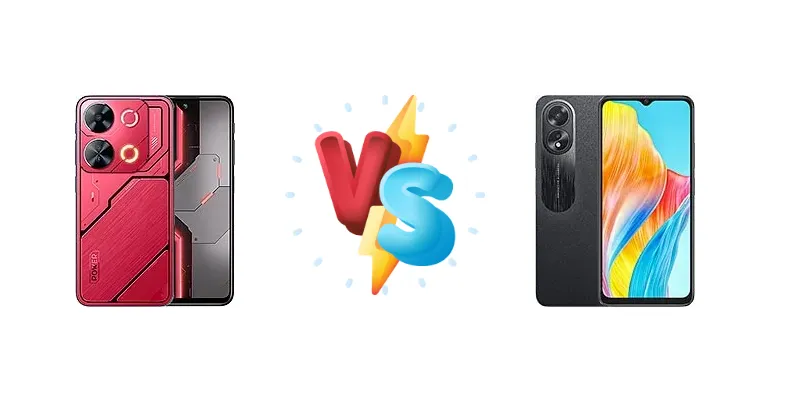
The itel P65 and Oppo A18 represent compelling options in the ultra-budget smartphone segment. Both aim to deliver essential functionality at a low price point, but they achieve this with different chipsets and slightly varying feature sets. This comparison dissects the key differences to help you determine which device best suits your needs.
🏆 Quick Verdict
For the average user prioritizing consistent performance and slightly faster charging, the Oppo A18 emerges as the better choice. Its Helio G85 chipset, with higher clocked Cortex-A75 cores, provides a noticeable edge in application loading and multitasking, despite the itel P65's potential battery life advantage.
| Network |
|---|
| 2G bands | GSM 850 / 900 / 1800 / 1900 | GSM 850 / 900 / 1800 / 1900 |
| 3G bands | HSDPA 850 / 900 / 2100 | HSDPA 850 / 900 / 2100 |
| 4G bands | LTE | 1, 3, 5, 7, 8, 20, 28, 38, 40, 41 |
| Speed | HSPA, LTE | HSPA, LTE |
| Technology | GSM / HSPA / LTE | GSM / HSPA / LTE |
| Launch |
|---|
| Announced | 2024, August 08 | 2023, September 27 |
| Status | Available. Released 2024, August 08 | Available. Released 2023, October 05 |
| Body |
|---|
| Dimensions | 165.9 x 77.3 x 7.9 mm (6.53 x 3.04 x 0.31 in) | 163.7 x 75 x 8.2 mm (6.44 x 2.95 x 0.32 in) |
| SIM | Nano-SIM + Nano-SIM | Nano-SIM + Nano-SIM |
| Weight | 192.4 g (6.81 oz) | 188 g (6.63 oz) |
| Display |
|---|
| Resolution | 720 x 1600 pixels, 20:9 ratio (~262 ppi density) | 720 x 1612 pixels, 20:9 ratio (~269 ppi density) |
| Size | 6.7 inches, 108.4 cm2 (~84.5% screen-to-body ratio) | 6.56 inches, 103.4 cm2 (~84.2% screen-to-body ratio) |
| Type | IPS LCD, 120Hz | IPS LCD, 90Hz, 720 nits (peak) |
| Platform |
|---|
| CPU | Octa-core (2x1.8 GHz Cortex-A75 & 6x1.6 GHz Cortex-A55) | Octa-core (2x2.0 GHz Cortex-A75 & 6x1.8 GHz Cortex-A55) |
| Chipset | Unisoc T615 (12 nm) | Mediatek MT6769 Helio G85 (12 nm) |
| GPU | Mali-G57 MP1 | Mali-G52 MC2 |
| OS | Android 14, itel OS 14 | Android 13, upgradable to Android 15, ColorOS 15 |
| Memory |
|---|
| Card slot | microSDXC | microSDXC |
| Internal | 128GB 4GB RAM, 128GB 8GB RAM, 256GB 6GB RAM | 64GB 4GB RAM, 128GB 4GB RAM |
| Main Camera |
|---|
| Dual | - | 8 MP, f/2.0, (wide), AF
Auxiliary lens |
| Features | LED flash, HDR, panorama | LED flash, panorama |
| Single | 50 MP, f/1.6, (wide)
Auxiliary lens | - |
| Video | 1080p@30fps | 1080p@30fps |
| Selfie camera |
|---|
| Features | - | Panorama |
| Single | 8 MP, f/2.0, 26mm (wide) | 5 MP, f/2.2, (wide) |
| Video | 1080p@30fps | 1080p@30fps |
| Sound |
|---|
| 35mm jack | Yes | Yes |
| Loudspeaker | Yes | Yes |
| Comms |
|---|
| Bluetooth | Yes | 5.3, A2DP, LE, aptX HD |
| NFC | Yes (256/6GB model only) | No |
| Positioning | GPS | GPS, GALILEO, GLONASS, BDS, QZSS |
| Radio | FM radio | No |
| USB | USB Type-C, OTG | USB Type-C 2.0, OTG |
| WLAN | Yes | Wi-Fi 802.11 a/b/g/n/ac, dual-band |
| Features |
|---|
| Sensors | Fingerprint (side-mounted), accelerometer, proximity | Fingerprint (side-mounted), accelerometer, proximity, compass |
| Battery |
|---|
| Charging | 18W wired, 40% in 30 min | - |
| Type | 5000 mAh | Li-Po 5000 mAh |
| Misc |
|---|
| Colors | Cyber Blaze, Cyber Black, Cyber Titanium | Glowing Black, Glowing Blue |
| Models | P671L | CPH2591 |
| Price | About 110 EUR | ₹ 10,290 |
itel P65
- Potentially longer battery life due to the efficient Unisoc T615 chipset.
- Competitive pricing within the ultra-budget segment.
- Adequate 18W charging with a quick 30-minute boost.
- Slower CPU clock speeds compared to the Oppo A18.
- Unisoc chipset may have limited software support compared to MediaTek.
Oppo A18
- Faster CPU performance thanks to the Helio G85’s higher clocked cores.
- MediaTek chipset offers broader compatibility and potentially better software support.
- Slightly better gaming performance due to the G85’s architecture.
- Potentially shorter battery life compared to the itel P65.
- Charging speed not explicitly stated, potentially similar to itel P65.
Display Comparison
Neither itel nor Oppo provide display specifications beyond resolution. Given the price bracket, both likely utilize LCD panels. The real differentiator will be color calibration and brightness, which are currently unknown. However, the focus here is on processing power, not display fidelity.
Camera Comparison
Without detailed camera specs, a direct comparison is difficult. Both phones likely feature a primary camera and depth sensor. The image processing capabilities of the MediaTek and Unisoc chipsets will play a significant role, but without knowing sensor sizes or apertures, it’s impossible to declare a clear winner. It's safe to assume image quality will be similar, adequate for social media sharing but not exceptional.
Performance
The core difference lies in the chipsets. The Oppo A18’s MediaTek Helio G85 features 2x2.0 GHz Cortex-A75 cores alongside 6x1.8 GHz Cortex-A55 cores, while the itel P65 uses the Unisoc T615 with 2x1.8 GHz Cortex-A75 cores and 6x1.6 GHz Cortex-A55 cores. The higher clock speed on the A75 cores of the Helio G85 translates to faster single-core performance, impacting app launch times and overall responsiveness. While both are 12nm chips, the G85’s architecture is optimized for gaming, offering a slight advantage in graphically intensive tasks. The itel P65’s Unisoc T615 prioritizes efficiency, potentially leading to longer battery life during sustained use.
Battery Life
Both devices target all-day battery life. The itel P65’s 18W charging supports 40% charge in 30 minutes, suggesting a full charge will take around 1.5-2 hours. The Oppo A18’s charging speed is not specified, but it’s likely similar. The Unisoc T615’s efficiency could give the itel P65 a slight edge in longevity, but the performance demands of the Helio G85 in the Oppo A18 might offset this advantage depending on usage patterns.
Buying Guide
Buy the itel P65 if you prioritize maximizing battery life and are primarily focused on basic tasks like calling, texting, and light social media use. Its Unisoc T615 is efficient, and the 18W charging is adequate for infrequent top-ups. Buy the Oppo A18 if you prefer a more responsive user experience, enjoy occasional gaming, or frequently switch between applications. The Helio G85 offers a tangible performance boost, making it a better fit for power users on a tight budget.
Frequently Asked Questions
❓ Will the Oppo A18 struggle with demanding games like PUBG Mobile?
While the Helio G85 isn't a high-end gaming chip, it's capable of running PUBG Mobile at medium settings with reasonable frame rates. Expect some frame drops during intense action, but it's a playable experience. The itel P65, with its slower processor, will likely require even lower settings.
❓ Is the difference in CPU clock speed between the Unisoc T615 and Helio G85 noticeable in everyday use?
Yes, the 200MHz difference in the Cortex-A75 core clock speed, combined with the architectural optimizations of the Helio G85, translates to a more responsive experience when opening apps, multitasking, and browsing the web. The Oppo A18 will feel snappier than the itel P65 in these scenarios.
❓ How does the software experience differ between itel and Oppo?
Oppo's ColorOS is generally considered more polished and feature-rich than itel's custom UI. Oppo also tends to provide more consistent software updates and security patches. This is a significant advantage for long-term usability.
❓ Which phone is better for someone who primarily uses WhatsApp and makes calls?
For basic communication, both phones are perfectly adequate. However, the Oppo A18’s slightly faster processor will ensure WhatsApp loads and responds more quickly, providing a smoother overall experience, even for simple tasks.