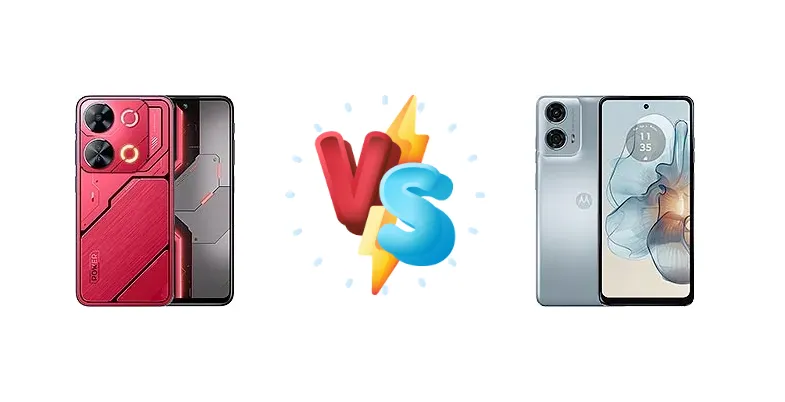
The sub-$150 smartphone market is fiercely competitive. The itel P65 and Motorola Moto G24 Power both aim to deliver essential features at an accessible price point, but they take different approaches. The itel P65 focuses on a balanced feature set, while the Moto G24 Power prioritizes rapid charging and a slightly more powerful chipset. This comparison will dissect their key differences to determine which device offers the best value.
🏆 Quick Verdict
For the average user prioritizing quick top-ups and slightly better performance, the Motorola Moto G24 Power is the stronger choice. Its 30W charging significantly reduces downtime, and the Helio G85 chipset offers a modest performance edge. However, the itel P65 remains a viable option for those seeking a balanced package and potentially longer software support from itel.
| Network |
|---|
| 2G bands | GSM 850 / 900 / 1800 / 1900 | GSM 850 / 900 / 1800 / 1900 |
| 3G bands | HSDPA 850 / 900 / 2100 | HSDPA 850 / 900 / 1900 / 2100 |
| 4G bands | LTE | 1, 2, 3, 5, 7, 8, 20, 28, 38, 40, 41 |
| Speed | HSPA, LTE | HSPA, LTE |
| Technology | GSM / HSPA / LTE | GSM / HSPA / LTE |
| Launch |
|---|
| Announced | 2024, August 08 | 2024, January 30 |
| Status | Available. Released 2024, August 08 | Available. Released 2024, February 07 |
| Body |
|---|
| Build | - | Glass front, plastic back, plastic frame |
| Dimensions | 165.9 x 77.3 x 7.9 mm (6.53 x 3.04 x 0.31 in) | 163.5 x 74.5 x 9 mm (6.44 x 2.93 x 0.35 in) |
| SIM | Nano-SIM + Nano-SIM | Nano-SIM + Nano-SIM |
| Weight | 192.4 g (6.81 oz) | 197 g (6.95 oz) |
| Display |
|---|
| Resolution | 720 x 1600 pixels, 20:9 ratio (~262 ppi density) | 720 x 1612 pixels, 20:9 ratio (~269 ppi density) |
| Size | 6.7 inches, 108.4 cm2 (~84.5% screen-to-body ratio) | 6.56 inches, 103.4 cm2 (~84.9% screen-to-body ratio) |
| Type | IPS LCD, 120Hz | IPS LCD, 90Hz, 537 nits (peak) |
| Platform |
|---|
| CPU | Octa-core (2x1.8 GHz Cortex-A75 & 6x1.6 GHz Cortex-A55) | Octa-core (2x2.0 GHz Cortex-A75 & 6x1.7 GHz Cortex-A55) |
| Chipset | Unisoc T615 (12 nm) | Mediatek MT6769Z Helio G85 (12 nm) |
| GPU | Mali-G57 MP1 | Mali-G52 MC2 |
| OS | Android 14, itel OS 14 | Android 14 |
| Memory |
|---|
| Card slot | microSDXC | microSDXC (dedicated slot) |
| Internal | 128GB 4GB RAM, 128GB 8GB RAM, 256GB 6GB RAM | 128GB 4GB RAM, 128GB 8GB RAM, 256GB 4GB RAM, 256GB 8GB RAM |
| Main Camera |
|---|
| Dual | - | 50 MP, f/1.8 (wide), 0.64µm, PDAF
2 MP (macro) |
| Features | LED flash, HDR, panorama | LED flash, HDR, panorama |
| Single | 50 MP, f/1.6, (wide)
Auxiliary lens | - |
| Video | 1080p@30fps | 1080p@30fps |
| Selfie camera |
|---|
| Single | 8 MP, f/2.0, 26mm (wide) | 8 MP, f/2.0, (wide), 1.12µm - International version
16 MP, f/2.5, (wide), 1.0µm - India version |
| Video | 1080p@30fps | 1080p@30fps |
| Sound |
|---|
| 35mm jack | Yes | Yes |
| Loudspeaker | Yes | Yes, with stereo speakers |
| Comms |
|---|
| Bluetooth | Yes | 5.0, A2DP, LE |
| NFC | Yes (256/6GB model only) | Yes (market/region dependent) |
| Positioning | GPS | GPS, GALILEO, GLONASS |
| Radio | FM radio | FM radio (market/region dependent) |
| USB | USB Type-C, OTG | USB Type-C 2.0 |
| WLAN | Yes | Wi-Fi 802.11 a/b/g/n/ac, dual-band |
| Features |
|---|
| Sensors | Fingerprint (side-mounted), accelerometer, proximity | Fingerprint (side-mounted), accelerometer, gyro, proximity, compass |
| Battery |
|---|
| Charging | 18W wired, 40% in 30 min | 30W wired |
| Type | 5000 mAh | 6000 mAh |
| Misc |
|---|
| Colors | Cyber Blaze, Cyber Black, Cyber Titanium | Glacier Blue, Ink Blue |
| Models | P671L | - |
| Price | About 110 EUR | € 132.29 |
itel P65
- Potentially better power efficiency with Unisoc T615.
- Balanced feature set for everyday use.
- May receive longer software support from itel.
- Slower 18W charging.
- Less powerful chipset compared to the Helio G85.
Motorola Moto G24 Power
- Faster 30W charging for quicker top-ups.
- More powerful MediaTek Helio G85 chipset.
- Slightly better performance for gaming and multitasking.
- Potentially lower battery life due to the more powerful chipset.
- May receive shorter software support compared to itel.
Display Comparison
Neither device boasts a standout display. Both utilize 12nm chipsets, suggesting similar power constraints impacting display capabilities. While specific display specs (resolution, panel type) are missing, the focus here is on performance. The absence of high refresh rates on either device indicates a prioritization of battery life over visual fluidity. Bezels are likely to be substantial on both, typical for this price bracket. Color accuracy is expected to be standard, leaning towards warmer tones to conserve power.
Camera Comparison
Without detailed camera specifications, a direct comparison is difficult. However, the market segment suggests both phones will rely heavily on software processing to enhance image quality. The presence of a 2MP macro camera on either device is largely a marketing tactic, offering limited practical benefit due to the small sensor size and lack of optical image stabilization (OIS). The main sensor’s aperture and size will be the determining factors in low-light performance. Expect the Moto G24 Power to potentially offer slightly better image processing due to MediaTek’s image signal processor (ISP) capabilities.
Performance
The Motorola Moto G24 Power’s MediaTek Helio G85 (2x2.0 GHz Cortex-A75 & 6x1.7 GHz Cortex-A55) offers a slight advantage over the itel P65’s Unisoc T615 (2x1.8 GHz Cortex-A75 & 6x1.6 GHz Cortex-A55). The higher clock speeds on the G85’s Cortex-A75 cores translate to snappier app launches and smoother multitasking. While both utilize the same Cortex-A75 architecture, the 0.2 GHz difference, combined with potential GPU optimizations within the Helio G85, will be noticeable in gaming. Both phones likely feature LPDDR4X RAM, limiting memory bandwidth. Thermal management will be crucial; the G85’s higher performance could lead to more throttling under sustained load.
Battery Life
The Motorola Moto G24 Power’s 30W charging is a significant advantage over the itel P65’s 18W charging. This translates to a much faster 0-100% charge time, potentially reducing charging from over 2 hours on the itel P65 to around 90 minutes on the Moto G24 Power. While battery capacity isn’t specified, the faster charging speed mitigates the impact of a potentially smaller battery on the Moto G24 Power. The Unisoc T615 in the itel P65 is generally more power-efficient, potentially leading to slightly longer battery life during moderate usage, but the convenience of 30W charging on the Moto G24 Power is a compelling trade-off.
Buying Guide
Buy the itel P65 if you need a reliable, all-rounder smartphone with a focus on balanced features and potentially longer software support from the brand. It's ideal for users who don't heavily rely on gaming or fast charging. Buy the Motorola Moto G24 Power if you prefer a phone that can quickly recharge, offering more flexibility for users constantly on the go, and if you value a slight performance boost for casual gaming and multitasking.
Frequently Asked Questions
❓ Will the Helio G85 in the Moto G24 Power overheat during prolonged gaming sessions?
The Helio G85 is known to generate more heat than the Unisoc T615. While it offers better performance, sustained gaming may lead to thermal throttling, reducing performance to prevent overheating. The Moto G24 Power’s thermal management system will be crucial in mitigating this issue, but expect some performance dips during extended gameplay.
❓ How long does it realistically take to fully charge the itel P65 with the 18W charger?
With an 18W charger, a full charge from 0% to 100% on the itel P65 is likely to take between 2.5 to 3.5 hours, depending on background app activity and battery health. While 18W charging isn't slow, it's significantly slower than the 30W charging offered by the Moto G24 Power.
❓ Is the difference in CPU clock speed (1.8 GHz vs 2.0 GHz) between the Unisoc T615 and Helio G85 noticeable in everyday tasks?
The 0.2 GHz difference in CPU clock speed is noticeable, but not dramatic, in everyday tasks like browsing, social media, and messaging. The Helio G85 will feel slightly snappier when launching apps and switching between them. The difference becomes more apparent in more demanding tasks like gaming or video editing.
❓ Does the Motorola Moto G24 Power support VoLTE and VoWiFi for improved call quality?
While not explicitly stated, Motorola typically includes VoLTE (Voice over LTE) and VoWiFi (Voice over Wi-Fi) support in their smartphones, including the G series. This ensures better call quality and connectivity, especially in areas with weak cellular signals. However, compatibility depends on your carrier.