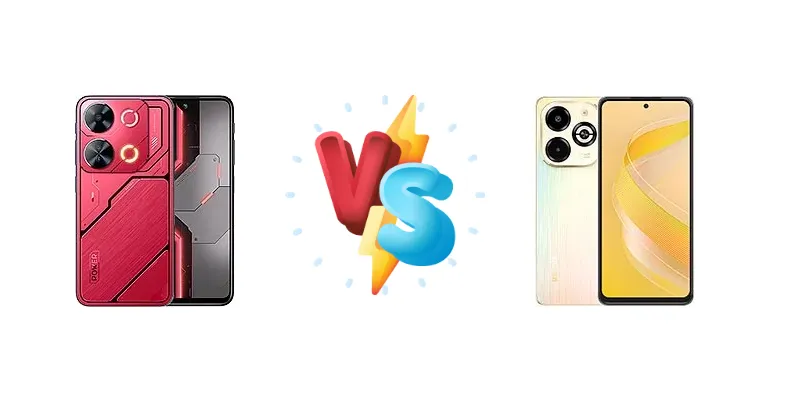
The itel P65 and Infinix Smart 8 Plus represent the fiercely competitive sub-$150 smartphone market. Both aim to deliver essential smartphone functionality at an accessible price point, but they take different approaches to achieving this. The key differentiator lies in their chipsets – the Unisoc T615 in the itel P65 versus the MediaTek Helio G36 in the Infinix Smart 8 Plus – impacting performance and efficiency.
🏆 Quick Verdict
For the average user prioritizing sustained performance and slightly better efficiency, the itel P65 is the stronger choice. Its Unisoc T615 chipset, featuring Cortex-A75 cores, offers a noticeable advantage in multi-tasking and app responsiveness compared to the Infinix Smart 8 Plus’s Helio G36. Both offer similar charging speeds and basic functionality.
| Network |
|---|
| 2G bands | GSM 850 / 900 / 1800 / 1900 | GSM 850 / 900 / 1800 / 1900 |
| 3G bands | HSDPA 850 / 900 / 2100 | HSDPA 850 / 900 / 1700(AWS) / 1900 / 2100 |
| 4G bands | LTE | 1, 2, 3, 4, 5, 7, 8, 20, 28, 38, 41, 40 |
| Speed | HSPA, LTE | HSPA, LTE |
| Technology | GSM / HSPA / LTE | GSM / HSPA / LTE |
| Launch |
|---|
| Announced | 2024, August 08 | 2024, January 30 |
| Status | Available. Released 2024, August 08 | Available. Released 2024, February |
| Body |
|---|
| Build | - | Glass front, plastic back, plastic frame |
| Dimensions | 165.9 x 77.3 x 7.9 mm (6.53 x 3.04 x 0.31 in) | 163.7 x 75.7 x 9 mm (6.44 x 2.98 x 0.35 in) |
| SIM | Nano-SIM + Nano-SIM | Nano-SIM + Nano-SIM |
| Weight | 192.4 g (6.81 oz) | 204 g (7.20 oz) |
| Display |
|---|
| Resolution | 720 x 1600 pixels, 20:9 ratio (~262 ppi density) | 720 x 1612 pixels, 20:9 ratio (~267 ppi density) |
| Size | 6.7 inches, 108.4 cm2 (~84.5% screen-to-body ratio) | 6.6 inches, 104.6 cm2 (~84.4% screen-to-body ratio) |
| Type | IPS LCD, 120Hz | IPS LCD, 90Hz, 500 nits (peak) |
| Platform |
|---|
| CPU | Octa-core (2x1.8 GHz Cortex-A75 & 6x1.6 GHz Cortex-A55) | Octa-core (4x2.2 GHz Cortex-A53 & 4x1.6 GHz Cortex-A53) |
| Chipset | Unisoc T615 (12 nm) | Mediatek Helio G36 (12 nm) |
| GPU | Mali-G57 MP1 | PowerVR GE8320 |
| OS | Android 14, itel OS 14 | Android 13 (Go edition), XOS 13 |
| Memory |
|---|
| Card slot | microSDXC | microSDXC (dedicated slot) |
| Internal | 128GB 4GB RAM, 128GB 8GB RAM, 256GB 6GB RAM | 64GB 4GB RAM, 128GB 4GB RAM |
| Main Camera |
|---|
| Features | LED flash, HDR, panorama | Ring-LED flash, HDR, panorama |
| Single | 50 MP, f/1.6, (wide)
Auxiliary lens | 50 MP, f/1.9, (wide), AF
Auxiliary lens |
| Video | 1080p@30fps | 1080p@30fps |
| Selfie camera |
|---|
| Single | 8 MP, f/2.0, 26mm (wide) | 8 MP, f/2.0, (wide) |
| Video | 1080p@30fps | Yes |
| Sound |
|---|
| 35mm jack | Yes | Yes |
| Loudspeaker | Yes | Yes |
| Comms |
|---|
| Bluetooth | Yes | 5.0, A2DP, LE |
| NFC | Yes (256/6GB model only) | No |
| Positioning | GPS | GPS |
| Radio | FM radio | FM radio |
| USB | USB Type-C, OTG | USB Type-C 2.0, OTG |
| WLAN | Yes | Wi-Fi 802.11 a/b/g/n/ac, dual-band |
| Features |
|---|
| Sensors | Fingerprint (side-mounted), accelerometer, proximity | Fingerprint (side-mounted), accelerometer, proximity, compass |
| Battery |
|---|
| Charging | 18W wired, 40% in 30 min | 18W wired
Reverse wired |
| Type | 5000 mAh | 6000 mAh |
| Misc |
|---|
| Colors | Cyber Blaze, Cyber Black, Cyber Titanium | Galaxy White, Shiny Gold, Timber Black |
| Models | P671L | X6526 |
| Price | About 110 EUR | About 100 EUR |
itel P65
- More efficient CPU architecture (Cortex-A75)
- Potentially smoother multitasking
- Faster charging (40% in 30 mins claimed)
- Lacks reverse wired charging
- Limited information on camera specs
Infinix Smart 8 Plus
- Reverse wired charging for accessories
- Slightly newer device release
- Potentially lower price point
- Less efficient CPU architecture (Cortex-A53)
- Potentially slower app loading times
- Limited information on camera specs
Display Comparison
Neither itel nor Infinix provide display specifications beyond size in their marketing materials. Given the price point, both likely utilize IPS LCD panels with 720p+ resolution. Expect similar viewing angles and color accuracy. The absence of high refresh rates or advanced features like LTPO is standard for this segment. Bezels are likely to be substantial on both devices, maximizing screen real estate within a budget.
Camera Comparison
Detailed camera specifications are scarce for both devices. Expect basic camera setups focused on daylight photography. The image processing capabilities of both phones will likely be similar, prioritizing simplicity over advanced features. Without knowing sensor sizes or lens apertures, it’s difficult to definitively declare a winner. However, given the focus on cost reduction, image quality will likely be comparable, and users shouldn’t expect flagship-level performance. The presence of a 2MP macro camera on either device is largely a marketing tactic, offering limited practical benefit.
Performance
The core difference lies in the chipsets. The itel P65’s Unisoc T615 utilizes a big.LITTLE architecture with 2x 1.8 GHz Cortex-A75 cores and 6x 1.6 GHz Cortex-A55 cores. This configuration provides a performance boost for demanding tasks compared to the Infinix Smart 8 Plus’s MediaTek Helio G36, which employs 4x 2.2 GHz Cortex-A53 cores and 4x 1.6 GHz Cortex-A53 cores. While the Helio G36’s cores clock slightly higher, the older A53 architecture is less efficient and offers lower IPC (Instructions Per Clock) than the A75 cores in the T615. This translates to snappier app launches and smoother multitasking on the itel P65. Both chipsets are built on a 12nm process, suggesting similar thermal characteristics, but the T615’s architecture will likely handle sustained loads better.
Battery Life
Both the itel P65 and Infinix Smart 8 Plus feature 18W wired charging, with the itel P65 claiming a 40% charge in 30 minutes. The Infinix Smart 8 Plus adds reverse wired charging, a useful feature for topping up accessories like wireless earbuds. Battery capacity is not specified for either device, but given the target market, expect capacities around 5000mAh. The Unisoc T615’s more efficient architecture in the itel P65 may translate to slightly longer battery life under similar usage conditions, offsetting any potential capacity differences.
Buying Guide
Buy the itel P65 if you need a phone that can handle moderate multitasking, occasional gaming, and benefits from a more modern CPU architecture for smoother daily use. Buy the Infinix Smart 8 Plus if you prioritize reverse wired charging for topping up accessories and are primarily focused on very basic smartphone tasks like calls, messaging, and light social media browsing, and want a slightly newer device.
Frequently Asked Questions
❓ Will the itel P65 handle popular games like PUBG Mobile or Call of Duty?
While both phones can *run* these games, expect to play at the lowest graphics settings and potentially experience frame drops. The Unisoc T615 in the itel P65 will provide a slightly more stable experience than the Helio G36, but neither chipset is designed for demanding gaming.
❓ How useful is the reverse wired charging on the Infinix Smart 8 Plus?
The reverse wired charging is primarily useful for topping up accessories like wireless earbuds, smartwatches, or other small devices. It won't rapidly charge a second phone, but it's a convenient feature to have in a pinch.
❓ Is the difference in CPU architecture between the Unisoc T615 and Helio G36 noticeable in everyday use?
Yes, the difference is noticeable. The Cortex-A75 cores in the Unisoc T615 offer significantly better performance per clock cycle than the Cortex-A53 cores in the Helio G36. This translates to faster app launches, smoother scrolling, and a more responsive user experience, especially when multitasking.
❓ What type of storage and RAM do these phones use?
Specifics are not provided, but given the price point, expect eMMC storage and likely LPDDR4X RAM in both devices. This is standard for this segment and will impact app loading times and overall system responsiveness compared to faster storage and RAM technologies.